SpaceX and xAI to develop voice control for combat drones
SpaceX and its AI unit xAI will take part in a U.S. Department of Defense tender. The ambitious project's goal is to create an advanced voice-control system to
AI-processed from 3DNews AI; edited by Hamidun News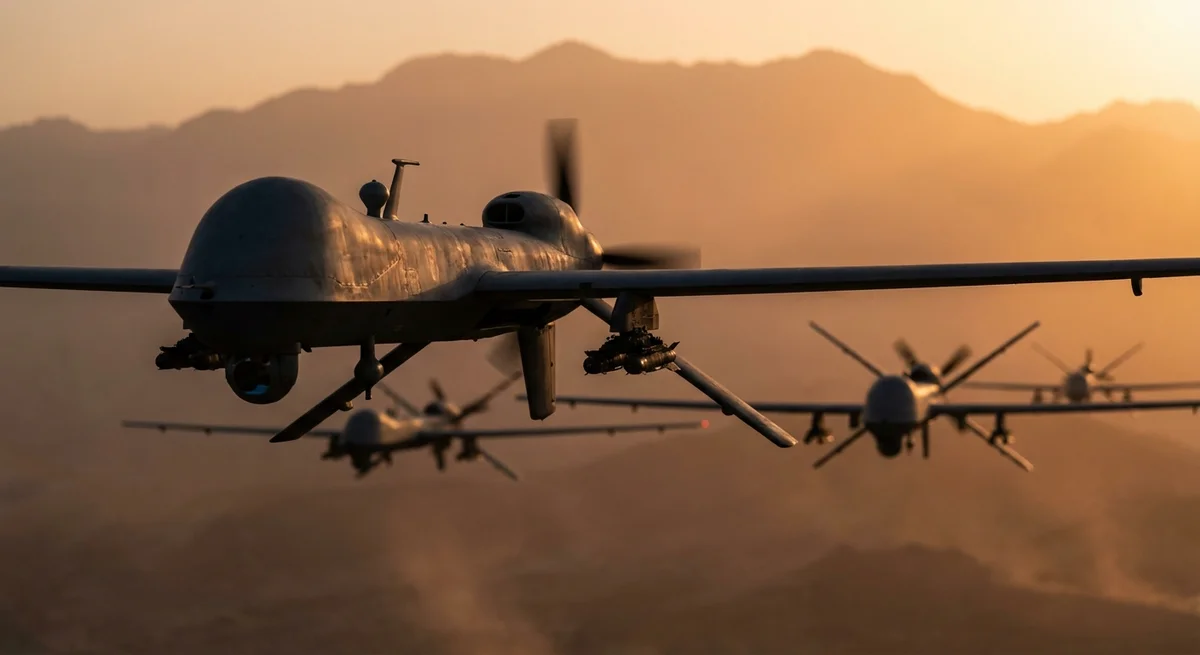
SpaceX and xAI: A Revolution in Combat Drone Management Through Voice Interface
In recent years, unmanned aerial vehicles (UAVs) have firmly established themselves on battlefields, proving their effectiveness and indispensability. Particular attention is being paid to the concept of "drone swarms" — groups of autonomous aircraft capable of acting in a coordinated manner to accomplish complex combat missions. Now, against the backdrop of growing significance of UAVs, the technological giant SpaceX, in collaboration with its artificial intelligence division, xAI, is preparing to participate in an ambitious tender from the U.
S. Department of Defense. The goal of this project is to develop an advanced voice control system that will allow operators to coordinate the actions of entire swarms of combat drones in real time, promising to radically transform the tactics of modern warfare.
Context: the rapid evolution of military technology
Military conflicts of the past decade have clearly demonstrated how quickly the face of modern war is changing. Drones, from reconnaissance to strike systems, have become an integral part of the arsenal of many world armies. However, managing a large number of unmanned aircraft simultaneously represents a colossal technical and psychological burden for operators.
The Pentagon, seeking to minimize the human factor and increase efficiency, is actively seeking ways to automate and simplify human-machine interaction. The idea of creating drone swarms capable of independently selecting and striking targets is a logical continuation of this trend. The participation of SpaceX, a company known for its innovations in the aerospace industry, and xAI, whose specialty is cutting-edge developments in artificial intelligence, in this competition is not coincidental.
It underscores a drive to integrate the most modern AI technologies, in particular large language models, into military interfaces.
Deep dive: voice control as an intuitive interface
The essence of the proposed technology is to create a system where an operator can control a drone swarm by issuing voice commands. This represents a shift from complex graphical interfaces and multiple buttons to an intuitively understandable dialogue. Imagine a commander who can say: "Direct Alpha group to suppress the enemy fire point on the left," and dozens, even hundreds of drones instantly respond, coordinating their actions.
xAI, with its expertise in natural language processing and machine learning, is capable of developing AI that will not only recognize commands but also understand context, adapt to the situation on the battlefield, and even propose optimal courses of action. This will allow the operator to focus on strategic planning rather than routine management of each individual aircraft. Such a system can include elements of self-learning, where the AI analyzes successful and unsuccessful operations, continuously improving its coordination and tactical algorithms.
Consequences: a new era in warfare
The integration of voice control and AI in managing drone swarms has far-reaching consequences. First, it will significantly increase the speed of decision-making and response to changing circumstances. Second, it will reduce the burden on operators, allowing them to effectively manage a far greater number of aircraft than is currently possible. Third, it could lead to the creation of new tactical techniques based on the flexibility and speed of swarm systems. However, like any powerful technology, it carries potential risks. Questions of ethics, control over autonomous systems, and prevention of unauthorized access or misuse will be particularly acute. The development of such systems will require careful testing and implementation of robust security mechanisms.
Conclusion: the future is already here
The participation of SpaceX and xAI in the Pentagon's competition to develop voice control for combat drones is vivid evidence of how rapidly artificial intelligence technologies are penetrating the defense sphere. If the project succeeds, it could become a true breakthrough that will fundamentally change the principles of warfare, making it more automated, faster, and possibly less risky for human personnel. This is not just another step in the development of military technologies, but a harbinger of a new era, where intuitive interaction between humans and powerful AI systems will become the norm on the battlefield.
Want to stop reading about AI and start using it?
AI News is a curated feed of AI/tech news. Hamidun Academy teaches you to use AI systematically in your work.