Socrates’ lessons for neural networks: how AI should teach us to think
A senior engineer at Google urges users to change their approach to interacting with generative AI, drawing on the principles of Aristotle and Socrates. Instead
AI-processed from ZDNet AI; edited by Hamidun News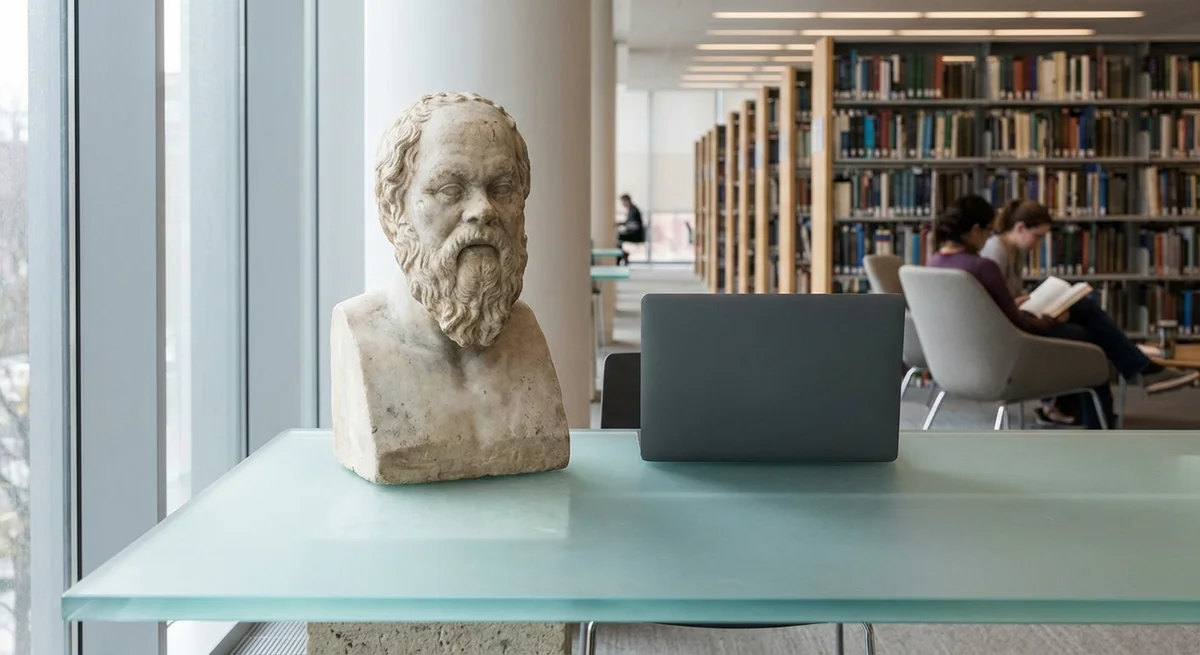
Socratic
Lessons for Neural Networks: How AI Should Teach Us to Think
In the era of rapid development of artificial intelligence, especially generative neural networks, there is an urgent need to rethink our interaction with these powerful tools. A senior engineer at Google urges us to abandon passive consumption of the information that AI provides us, and instead use them as catalysts for our own thinking process. Drawing on the wisdom of ancient philosophers such as Aristotle and Socrates, he proposes viewing neural networks not as omniscient oracles dispensing ready-made answers, but as partners in dialogue, capable of helping us sharpen our logic and learn to independently arrive at correct conclusions.
Context: AI as a Tool for Knowledge
Modern generative neural networks, such as ChatGPT, Gemini and others, possess a remarkable ability to generate text, images, code and much more. This leads to the temptation to use them as a "black box" that solves our tasks for us. We can ask AI to write an essay, draw up a project plan, or even answer a complex question, receiving a ready-made result. However, as the Google engineer notes, such an approach, while seeming efficient at first glance, carries a hidden threat. It promotes the formation of a passive user position, where the main task becomes formulating a request, rather than deeply understanding the problem and searching for a solution.
Deep Dive: The Socratic Method in the Digital Age
This is where the principles laid down in the foundations of ancient philosophy come to our aid. Socrates, known for his method of maieutics, or the art of midwifery, taught that true knowledge is born in the process of dialogue, through a series of leading questions that help a person independently discover hidden truths. This method assumes that the teacher does not impart knowledge, but helps the student "give birth" to it in his own mind.
As applied to AI, this means that we should ask it questions that stimulate our own thinking, rather than simply receiving ready-made answers. Instead of asking "What were the causes of World War I?", we can ask AI: "What arguments could the supporters and opponents of war in 1914 have presented, and how would they have justified them?"
or "What alternative paths could have prevented the conflict, based on the historical realities of that time?"
Aristotle, in his turn, paid great attention to logic and the systematization of knowledge. His works laid the foundations for rational thinking, analysis and proof. When interacting with AI, we can use it to check our own reasoning, to search for counter-arguments, or to obtain information that will help us build a more coherent and logical argumentation. AI can become our "opponent" in intellectual debate, helping us identify weaknesses in our arguments and strengthen them.
Consequences: Preserving Cognitive Autonomy
In an era when content is generated on an unprecedented scale, there is a real risk of degradation of our own cognitive skills. If we rely entirely on AI to solve intellectual tasks, we risk losing the ability to think critically, analyze information, and independently formulate judgments. Such a scenario could lead to a society where people become passive consumers of information, easily susceptible to manipulation and lacking the ability to deeply understand complex issues. A philosophical approach to the use of AI, on the contrary, is designed to preserve for humans the role of active thinker, researcher and creator. It allows us to use AI as a powerful tool to expand our intellectual capabilities, rather than replace them.
Conclusion: The Future of Thinking with AI
The integration of AI into our lives is inevitable. The question is only how we will do it. If we approach our interaction with neural networks guided by the principles of Socratic dialogue and Aristotelian logic, we will be able not only to avoid cognitive degradation, but also to significantly enrich our thinking process. AI should become our partner in learning, our stimulus to reflection, a tool that helps us understand "how" to arrive at truth, rather than simply dictating "what" we should know. Only in this way can we preserve our intellectual independence and use the full potential of artificial intelligence for the benefit of humanity.
Want to stop reading about AI and start using it?
AI News is a curated feed of AI/tech news. Hamidun Academy teaches you to use AI systematically in your work.