«Two Cai Mings»: how a Chinese startup built robots for the country's biggest show in 100 days
Beijing startup Songyan Dynamics unveiled five anthropomorphic robots at the 2026 New Year's Gala. The biggest sensation was a biomimetic clone of actress Cai M
AI-processed from 36Kr (36氪); edited by Hamidun News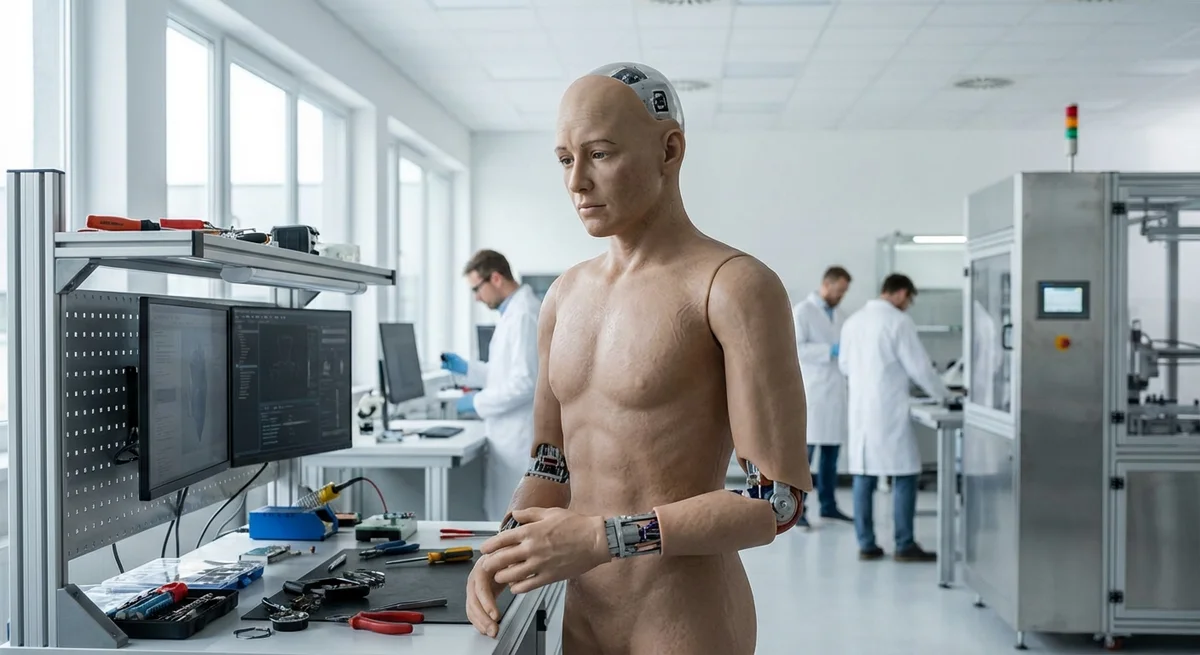
The Beijing startup Songyan Dynamics presented five anthropomorphic robots at the 2026 New Year Gala, causing a real sensation. The main headline was a biomimetic clone of the famous actress Cai Min, capable of reproducing human facial expressions and articulation in minute detail. Additionally, the N2 model demonstrated a series of stable backflips, and a mini robot named "Xiaobumi" performed an energetic breakdance routine.
Company founder Jiang Zheyuan emphasized that this ambitious project required 100 days of intense non-stop work, with constant iterations and refinements. Success on central television became not just a triumph, but a starting point for large-scale expansion: the startup is preparing for mass production of affordable robots aimed at the educational and home segments, with an estimated price of around 10,000 yuan.
The story of creating robots for the 2026 New Year Gala is not simply a technological breakthrough, but a vivid example of how ambitious goals can be achieved in compressed timeframes. Collaboration between Songyan Dynamics and the show organizers began rapidly: after the first meeting between Jiang Zheyuan's team and television channel representatives, specific partnership terms were agreed upon within days. The organizers showed particular interest in the company's capabilities in creating biomimetic robots and demonstrating stable acrobatic stunts.
"It turned out incredibly similar," recalls Jiang Zheyuan of Cai Min's reaction upon first meeting her robotic double. Creating an anthropomorphic robot capable of conveying a rich palette of human emotions represents an extremely complex engineering challenge. It requires the integration of numerous miniature yet powerful servomotors in limited facial space, as well as the development of sophisticated control algorithms ensuring smooth and natural movement. In parallel, to ensure stability in performing complex tricks such as backflips, the Songyan Dynamics team made significant corrections and optimizations to their algorithms.
"One hundred days of intense work before performing at the Spring Festival became a powerful stimulus for developing our robotics innovations," Jiang Zheyuan shares candidly. During preparations for the show, the team constantly received new, sometimes quite unexpected, recommendations from directors—for example, to add the robot's ability to raise its head or perform barely noticeable facial expressions. Responding to these requests had to happen within one or two days, quickly adapting both the mechanics and control software. To achieve maximum precision of movement, after the very first rehearsal Jiang Zheyuan decided to acquire stage decorations and quickly recreate their exact copy in a rented workshop so the robots could train in conditions as close to real as possible.
In parallel with show preparations, anthropomorphic robot manufacturers actively worked on strategies for attracting and retaining an audience that could surge dramatically after such a massive event as the Spring Festival. Jiang Zheyuan notes that success in 2025 was due to two factors: first, the enormous reach of the Spring Festival audience directly translated into sales, and second, the performance itself opened completely new commercial scenarios for robotics. "The Spring Festival is like a major battle," Jiang Zheyuan draws an analogy, "after the battlefield is cleared, it's important to have 'ground forces' to harvest and consolidate positions." This is why, in addition to rehearsals, the company actively prepared for the post-show period.
In particular, to ensure mass production and timely delivery of the "Xiaobumi" robot, which played the role of a dancing robot grandson in the sketch, partnerships were established with OEM manufacturers, and warehouse reserves were created to cover potentially increased demand. Certainly, the Spring Festival brought not only sales growth, but also significant increase in brand recognition, and contributed to wider dissemination of information about robotics. Songyan Dynamics' plans for 2026 include mastering new areas of application, including integrating robots into the home environment for companionship and developing educational programs.
It is expected that the performance of several Chinese robotics companies at the 2026 Spring Festival will become not simply a spectacle, but the beginning of a new era—an era of robotics commercialization and the definition of the future for companies in this dynamically developing industry.
"For us, each rehearsal was an opportunity to receive new requirements from the directors," says Jiang Zheyuan. "For example, they could ask the robot to raise its head or add barely noticeable facial expressions. This required from us the highest speed of iterations and adaptation of both software and hardware, often within one or two days.
We kept daily reports, detailing progress on each product, each movement—iterations literally happened by the hour. I tried to convey to the team how unique this opportunity was—to perform at the Spring Festival, to be in the main hall. We strived to make the robots' movements become reflexive for operators, to be performed on muscle memory, without the need for conscious control.
A funny fact: on the first day of rehearsals, around four in the afternoon, we already received three sets of decorations for our sketch, and by midnight we recreated their exact copy in a workshop next to the office so the robots could train in realistic conditions."
"Backflips and other acrobatic elements were the result of collaborative work," explains Jiang Zheyuan. "The directors determined what actions were needed to improve the stage effect, and we selected suitable capabilities from our arsenal. Initially, a backflip was required, although our robots were more stable in forward flips. Nevertheless, in three days we developed an ultra-stable backflip. Performing three consecutive backflips on live broadcast is a task that few companies can handle, requiring the highest precision and stability of algorithms."
"Creating a biomimetic face is a multifaceted task," says the Songyan Dynamics founder. "First, conveying rich facial expressions requires a large number of degrees of freedom in the robot's facial part, which implies the use of miniature servomotors and precise control algorithms. Second, achieving resemblance to a living human requires high copying accuracy. Third, synchronizing lip movement with speech is the most complex part, requiring serious breakthroughs in algorithms. Overall, a biomimetic face is a complex engineering project."
"The Spring Festival can be compared to war," Jiang Zheyuan continues. "We conducted a 'bombardment' with our robots, but now it is necessary to 'clear the battlefield' and consolidate our position. Therefore, in addition to preparing for the show, we undertook a series of steps.
First, preparing production capacity. The launch of mass production of 'Xiaobumi' is planned for March, partnerships with OEM manufacturers have already been established and reserves have been formed. Second, an information campaign aimed at raising awareness of our affordable consumer robots priced at just over 10,000 yuan to strengthen our positions in the B2C and B2B markets.
Third, attracting new talent. I am confident that increased brand recognition will significantly facilitate our building of a strong technical team."
"Right now my main priority is the volume of deliveries," admits Jiang Zheyuan.
"Delivery problems will be minimal, since we have already been through this," he assures. "Previously, we manufactured robots on our own lines, manually assembling each unit."
Want to stop reading about AI and start using it?
AI News is a curated feed of AI/tech news. Hamidun Academy teaches you to use AI systematically in your work.