Lenovo and Nvidia join forces to build AI factories
Lenovo and Nvidia unveiled the "Lenovo AI Cloud Super Factory" to transform data centers into AI factories. OpenAI and the Gates Foundation will allocate $50 mi
AI-processed from 36Kr (36氪); edited by Hamidun News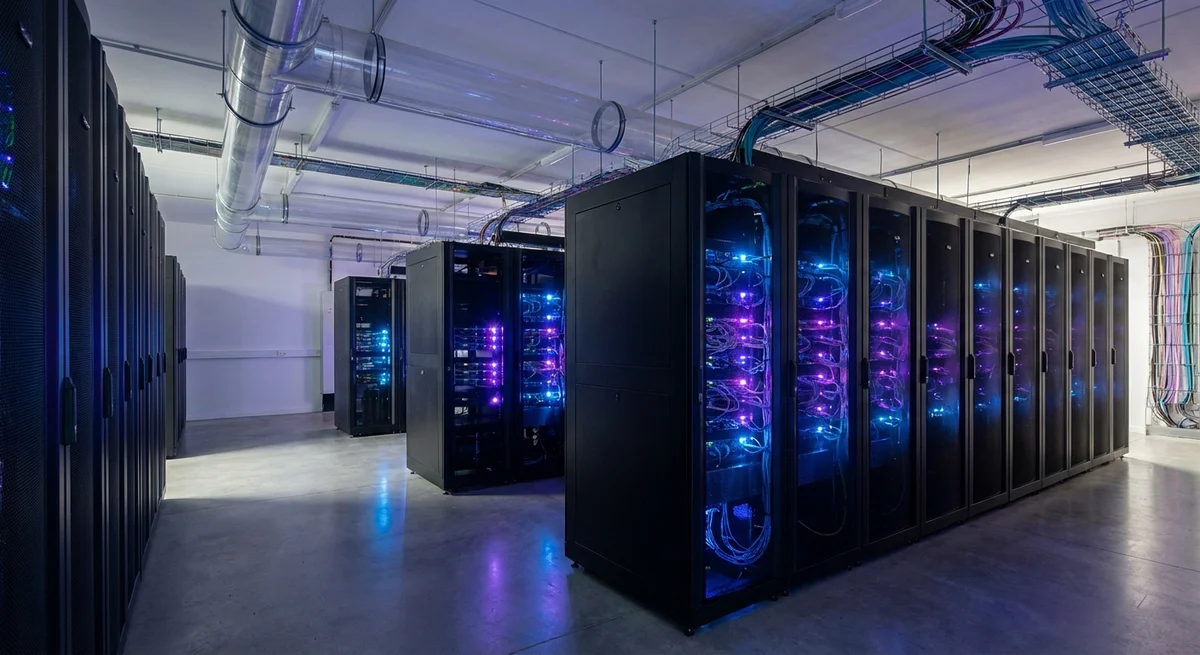
Lenovo and Nvidia Unite to Create AI Factories
Introduction
The technological world continues to develop rapidly, and artificial intelligence (AI) is becoming a central element of this transformation. Recent news indicates a new phase of cooperation between industry leaders. Lenovo and Nvidia announced an ambitious project called "Lenovo AI Cloud Super Factory," designed to rethink data center architecture and transform them into highly efficient "AI factories." In parallel, OpenAI and the Bill & Melinda Gates Foundation are making significant investments in medical AI in Africa, while the Chinese film industry is demonstrating record growth rates, highlighting the global impact of technology and creative industries.
Context: Global Transformation and Local Breakthroughs
In recent years, there has been exponential growth in demand for computing power, driven by the rapid development of artificial intelligence technologies. Companies worldwide are seeking to optimize their data centers to handle increasing loads and effectively leverage AI potential. In this context, the collaboration between Lenovo and Nvidia becomes particularly significant. By combining their expertise in hardware and AI software solutions, they propose a new paradigm – the "AI Factory," which goes beyond traditional "computing centers."
Parallel to this, technological innovations are aimed at addressing pressing global challenges. The OpenAI and Gates Foundation initiative to invest 50 million dollars in medical AI in Africa underscores the commitment to using AI to improve quality of life and healthcare access in developing regions. This project, starting with Rwanda, aims to transform 1,000 medical institutions by 2028, demonstrating AI's potential in solving humanitarian tasks.
On another front, the Chinese film industry achieved impressive results, demonstrating a record value of the entire production and distribution chain of 810 billion yuan. This metric testifies not only to the growth of the creative sector, but also to its close integration with technologies that enable the creation of more complex and captivating cinematic works.
Deep Dive: "AI Factory" and the Future of Computing
The "Lenovo AI Cloud Super Factory" project represents a comprehensive solution aimed at modernizing corporate data centers. Rather than viewing them as places for data storage and performing standard computations, Lenovo and Nvidia propose transforming them into specialized "factories" optimized for training and deploying AI models. This includes integrating Nvidia's cutting-edge hardware with Lenovo's server solutions, as well as software platforms that simplify the management and scaling of AI applications.
Microsoft CEO Satya Nadella emphasized that in the age of AI, the key role is not so much the existence of a single "foundation" AI model, but the ability to "orchestrate models" and the presence of a powerful "computing factory." This reflects the shift from monolithic solutions to more flexible and distributed architectures, where cloud providers such as Azure play the role of "token factories," providing the necessary computing power and infrastructure for exponentially growing demand.
In the field of robotics, Chinese company Zhizhen Robot received a patent for "motion redirection" technology, which allows robots to interact more effectively in complex environments. This technology, capable of optimizing movements, avoiding collisions, and ensuring safety, is an important step toward creating more adaptive and versatile robotic systems, which is particularly relevant for industrial and service applications.
Consequences: AI as a Driver of Innovation and Social Progress
Investments in medical AI in Africa open new horizons for improving public health. Increased accessibility to medical services and improved diagnostic accuracy thanks to AI can significantly reduce morbidity and mortality, especially in regions with limited resources. This also stimulates the development of local technology talent and job creation.
The growth of the Chinese film industry, supported by technological achievements, demonstrates how creative industries can use AI to create next-generation content. This can lead to the emergence of new forms of entertainment and cultural exchange.
The implementation of "AI Factory" and the concept of "model orchestration" promises to accelerate the pace of AI solution development and deployment across all industries. This will enable companies to bring new products and services to market faster, increase operational efficiency, and make more informed data-driven decisions.
Conclusion
The collaboration between Lenovo and Nvidia, investments in medical AI in Africa, and the impressive achievements of the Chinese film industry all testify to a global shift toward broader application of artificial intelligence. The transformation of data centers into "AI Factories" and the development of technologies enabling more effective robot interaction are key trends that will shape the future of technology and business. Artificial intelligence is ceasing to be merely a tool, becoming a fundamental foundation for innovation, economic growth, and solutions to the most complex social challenges.
Want to stop reading about AI and start using it?
AI News is a curated feed of AI/tech news. Hamidun Academy teaches you to use AI systematically in your work.