Chinese startup SenseOrigin raises 100 million yuan for satellite radars
Startup SenseOrigin (感知起源) has completed angel funding rounds, raising about 100 million yuan to develop commercial Earth observation technologies. The…
AI-processed from 36Kr (36氪); edited by Hamidun News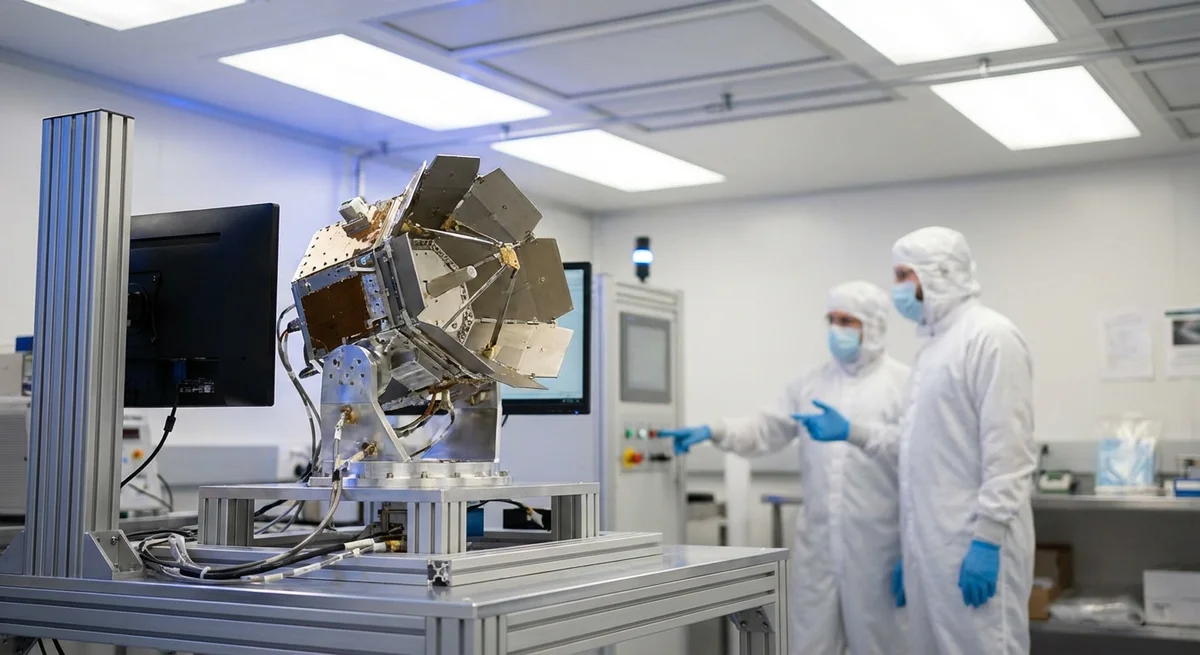
# Chinese startup SenseOrigin raised 100 million yuan for a satellite radar revolution
Engineers know one uncomfortable truth: quality photographs from orbit require sunshine and clear skies. Clouds and night turn satellite images into a black square. This summer, Chinese company SenseOrigin announced raising approximately 100 million yuan (about 14 million dollars) to solve a problem the world has been trying to solve for decades. Its weapon is not a camera, but a radar that sees through clouds, rain, and darkness.
SenseOrigin was founded in 2023, but its team came from legendary institutes. Founder and technical director Ma Binqiang is a Ph.D. from the Academy of Space Technology of the Chinese Academy of Sciences, developer of major radar systems. His co-founder Ju Caiqiang was the project lead of China's first commercial SAR satellite "Haisy-1"—just this sounds like a curriculum vitae where every line is a patent or orbital launch. The company specializes in producing stellar payloads, that is, payloads based on SAR (Synthetic Aperture Radar)—synthesized aperture radar.
Why is this important right now? Earth changes rapidly: natural disasters, climate change, industrial development require constant monitoring. Optical satellites only see under favorable conditions—it's like having a photographer who works only on sunny days. SAR systems work differently: they actively emit radio waves and analyze the reflection, regardless of time of day or weather. This makes them indispensable for tracking natural disasters, agriculture, infrastructure monitoring, and security tasks. But here a bottleneck appears: historically, SAR equipment was produced by a limited group of state research centers, which meant high costs, long development times, and low manufacturing efficiency.
The main breakthrough of SenseOrigin is not just creating a competitive SAR radar, but a fundamentally new technology called MIMO-SAR. Regular SAR has a fundamental trade-off: the higher the image resolution, the narrower the field of view. The company solved this dilemma the classic way in engineering—through multi-channel technology. MIMO (Multiple-Input Multiple-Output) allows the radar to simultaneously transmit and receive signals at different frequencies and angles, overcoming the physical constraints that have existed for decades. The result is striking: image resolution improves while the cost per square kilometer of photography drops by one or two orders of magnitude.
The company has already moved from theory to practice. The first example of a commercial MIMO-SAR radar is in the final stages of production, and orbital testing is scheduled for the end of 2024. There is no overstatement of significance here: in the history of Chinese commercial space, this will be the first fully independently developed SAR radar to undergo orbital testing. Until that happens, all theory remains theory. But investors clearly believe in this team: the round was participated by venture funds and investment companies from Shandong, Xiamen, and Suzhou.
The context of SenseOrigin's development coincides with the overall acceleration of commercial space in China. If just a few years ago satellites were launched rarely, now SAR satellite fleets are growing every quarter. However, the old supply system simply cannot keep pace with the rate: science needs reliable systems, commerce needs mass and efficiency, this contradiction requires new players. SenseOrigin arrived at an ideal moment—not too late to set standards, but late enough to learn from the mistakes of others.
The path from the first orbit to profitable production is long and thorny. SenseOrigin will compete not only with state institutes, but also with foreign companies that have accumulated experience. But if its MIMO-SAR works as promised, this could rewrite the economics of Earth satellite sensing. And for the first time, such a transformation will be led not by a state conglomerate, but by a young startup from Shandong Province.
Want to stop reading about AI and start using it?
AI News is a curated feed of AI/tech news. Hamidun Academy teaches you to use AI systematically in your work.