Hexin Power: embodied AI for farmers valued at 500 million yuan
Chinese startup Hexin Power raised tens of millions of yuan in an angel round, reaching a valuation of 500 million yuan. The company develops embodied AI for ag
AI-processed from 36Kr (36氪); edited by Hamidun News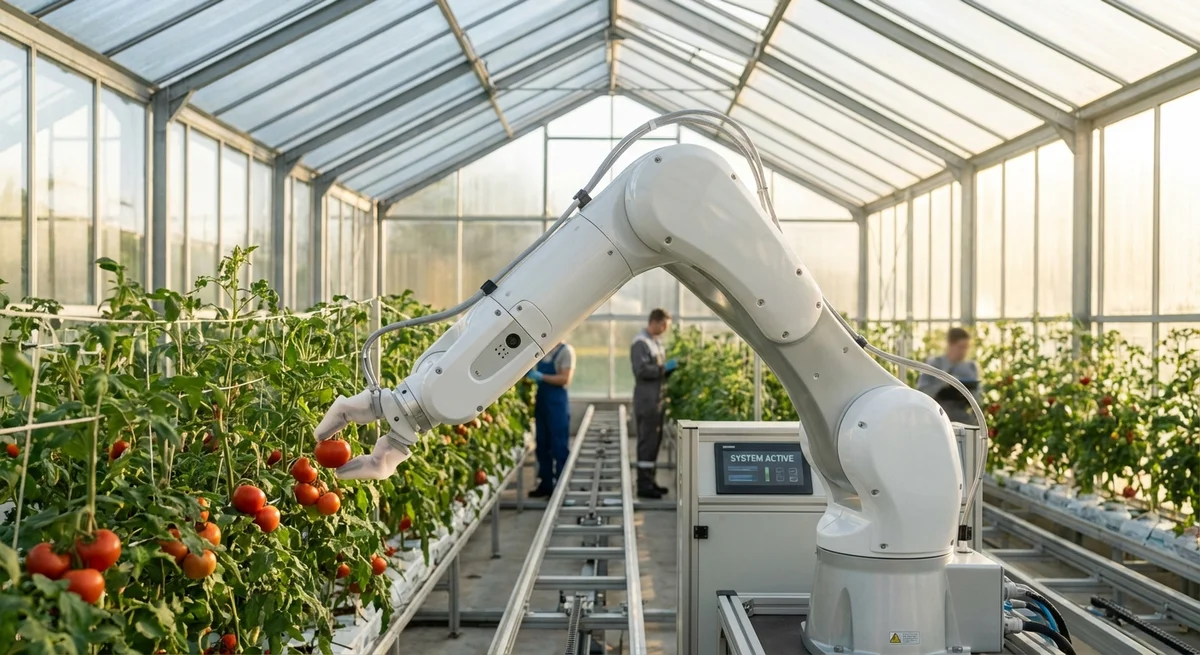
# Chinese startup Hexin Power claims role of global leader in agricultural robotics
Chinese startup Hexin Power completed an angel funding round worth tens of millions of yuan, achieving a valuation of 500 million yuan. This event symbolizes the rapid transition of China's agricultural industry from simple mechanization to intelligent automation, where robots and drones do not merely repeat programmed movements, but adapt to the unpredictable conditions of real fields. The company is developing what specialists call "embodied AI" — physical systems that understand agricultural processes and are capable of making independent decisions in an unstructured environment.
The fundamental problem that Hexin Power solves lies in the gap between the needs of global agriculture and the availability of solutions. First, the world faces a severe shortage of agricultural labor. Second, existing Western automation solutions cost astronomical sums — mushroom-picking robots from American company 4AG Robotics cost more than a million dollars. Hexin Power offers Russian-level competition in price: the company's workhorse, a robot for harvesting mushrooms in greenhouses, costs around 200,000 yuan — roughly five times cheaper. Meanwhile, the machine requires no modification of existing greenhouses and achieves productivity 2.5 times higher than human labor.
Hexin Power's technological superiority stems from its chosen strategy: instead of using off-the-shelf components, the company developed its own technology stack from scratch. The team created high-speed electric motors capable of reaching up to 200,000 RPM — a critical advantage for drones requiring maximum efficiency. In the algorithmic domain, the company, together with Tsinghua, the Chinese Academy of Agricultural Sciences, and Harbin Polytechnic University, developed its own computer vision models. The flagship development — the YOLO-Fi algorithm — allows with 98 percent accuracy to recognize weeds and distinguish plants of needed crops, adapting to the specifics of tobacco, rice, and other crops.
The company's product portfolio covers the full spectrum of agricultural operations: drones for applying protective substances to plants, mobile robots for monitoring crops, specialized machines for harvesting and weed removal. For processing tall crops like tobacco, the team developed the P70 drone, optimized for penetrating dense vegetation. For large-scale rice plantings, there is the P100S model. Each system is based on deep understanding of agronomic requirements — for example, the chemical drift prediction platform uses aerodynamic tunnels and laboratory tests to understand how wind and flight dynamics affect chemical distribution.
Commercial success is already real. The company has delivered more than ten robots and closed orders for hundreds of units of equipment worth several million yuan. Strategically, Hexin Power is expanding globally simultaneously: it already has a presence in Central Asia, Nigeria, and other African countries, where in a 15-kilometer agrotechnical test zone in Nigeria they are testing equipment in real conditions. Plans are ambitious — the company is negotiating with Russian partners about developing frost-resistant equipment and building a distribution network in Turkey.
Behind all this stands a team with serious background. Founder Zhao Feng spent 14 years in strategic agricultural investments, including projects creating African-Chinese trade zones. The chief technologist held the position of professor at Harbin Polytechnic. The financier has experience working at a Swiss investment bank and was engaged in agricultural analysis.
The global agricultural robotics market, according to forecasts, will be worth 800 billion yuan by 2030. Hexin Power aims to capture a significant share, turning Chinese engineering thinking into a standard tool for farmers worldwide. The company positions itself as a supplier of universal intelligent systems capable of adapting to different climates, crops, and agricultural traditions. If the company manages to scale, it will not simply change the economics of farming — it will redefine who and how will feed the growing global population.
Want to stop reading about AI and start using it?
AI News is a curated feed of AI/tech news. Hamidun Academy teaches you to use AI systematically in your work.