The End of DJI's Monopoly: How Oppo and Vivo Are Preparing Osmo Pocket Rivals
The DJI Osmo Pocket 3 became a major hit, bringing the company more than 20 billion yuan in revenue in a year. That success caught the attention of major…
AI-processed from 36Kr (36氪); edited by Hamidun News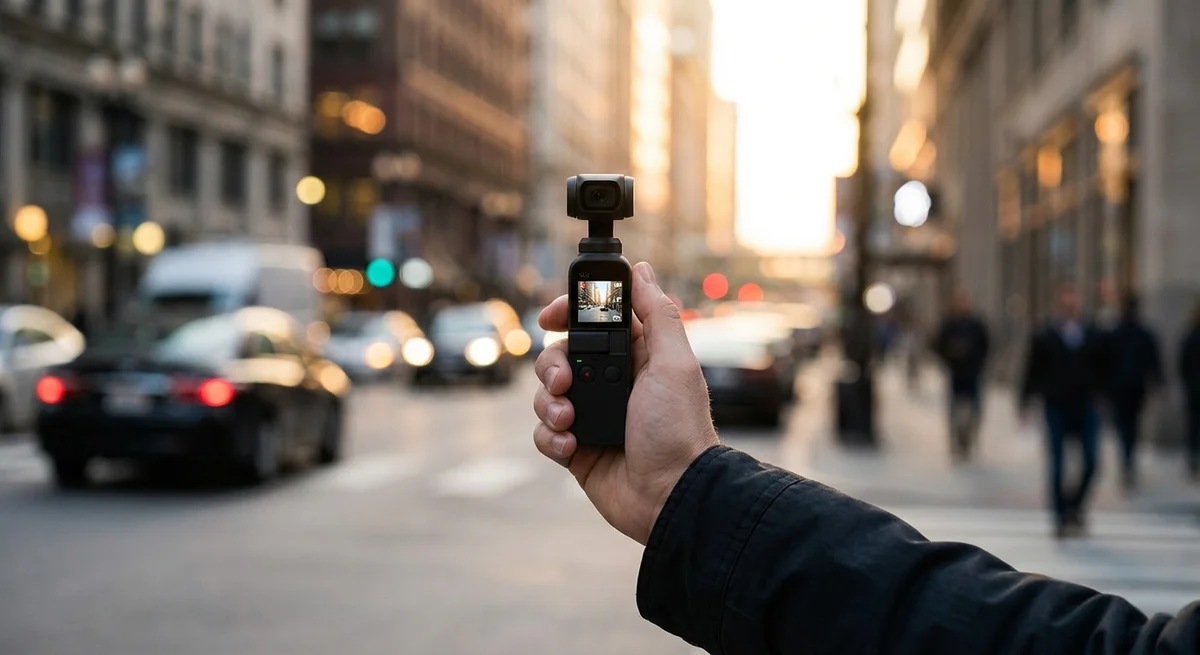
# The End of DJI's Monopoly: How Oppo and Vivo Are Preparing Competitors to Osmo Pocket
DJI Osmo Pocket 3 has become a phenomenon rarely seen in consumer electronics. In a single year, the company earned over 20 billion yuan from one product — a palm-sized camera with three-axis stabilization. The device was in such short supply that it was called "electronic Mao Tai," and on the secondary market it sold at a 30 percent discount.
Yet it was this very success that caught the attention of far more formidable competitors. Vivo has officially confirmed the development of its own compact camera for vloggers, and OPPO is already conducting serious development under the leadership of its chief product officer. If DJI took seven years to create the category, the world's largest smartphone manufacturers will need far less time to rewrite it.
The market for compact cameras with mechanical stabilization seemed niche until Osmo Pocket 3 proved otherwise. The technology itself is complex — most competitive attempts before 2020 failed. Snoppa, Moza, and Feiyu released competing models, but all hit the same wall.
Snoppa Vmate, for instance, offered an innovative solution with a rotating lens and built-in Wi-Fi, but never resolved issues with video transmission and build quality. By the time the company fixed critical flaws, DJI had already released a second version with a better sensor. When a third version appeared on the horizon, Snoppa faced a chip shortage and was forced to exit the market entirely.
Feiyu remains the only player continuing to release alternative models, but its budget solutions cannot compete with the image quality of DJI's flagship offering.
The reason for DJI's dominance lies in simplicity — it was not just a camera with good stabilization, but a camera with good image quality. The major breakthrough came when the company installed a one-inch sensor. This allowed the Pocket 3 to shoot in poor lighting, better render colors, and provide more material for post-production. Stabilization is a necessary condition, but the camera became desirable because of image quality. Moreover, DJI surrounded the device with an ecosystem: it can sync with drones from the same manufacturer, users get ready-made solutions for a complete shooting process. All of this was unavailable to startups with limited resources.
But now it is 2024, and the industry has drawn an important conclusion: a product that generates 20 billion yuan a year is not a niche product. OPPO and Vivo possess something that Snoppa or Moza never had: they have experience developing complex mobile cameras, computational photography algorithms worthy of admiration, and more importantly, they have hundreds of thousands of retail points. When OPPO or Vivo release a competing product, it will not appear in online stores and platforms like Aliexpress, but in traditional stores, in the hands of salespeople who speak local dialects and understand their customers.
The technology itself is no longer a barrier. Engineers at these companies can develop proper stabilization, as their predecessors did. The challenge is that the same stabilization must be built into a chassis designed with mobile market requirements in mind, and the image must be processed by algorithms accumulated over years. OPPO and Vivo can do this. The question is no longer whether they can copy Osmo Pocket 3, but what advantages they will bring to the table.
Experts predict fierce competition by 2026. DJI will retain its position thanks to its pioneering status and deeper ecosystem integration, but its monopoly will end precisely when companies with vastly greater resources enter the market. The history of consumer electronics in China has proven: if a startup finds a golden vein, in a couple of years the giants arrive with excavators. This time will be no exception.
Want to stop reading about AI and start using it?
AI News is a curated feed of AI/tech news. Hamidun Academy teaches you to use AI systematically in your work.