First the brain, then the dumplings: Alibaba DAMO Academy improves robot intelligence
Alibaba's DAMO Academy has published a report on progress in robotics. Experts emphasize that to perform complex household tasks such as cooking, robots need mo
AI-processed from Jiqizhixin (机器之心); edited by Hamidun News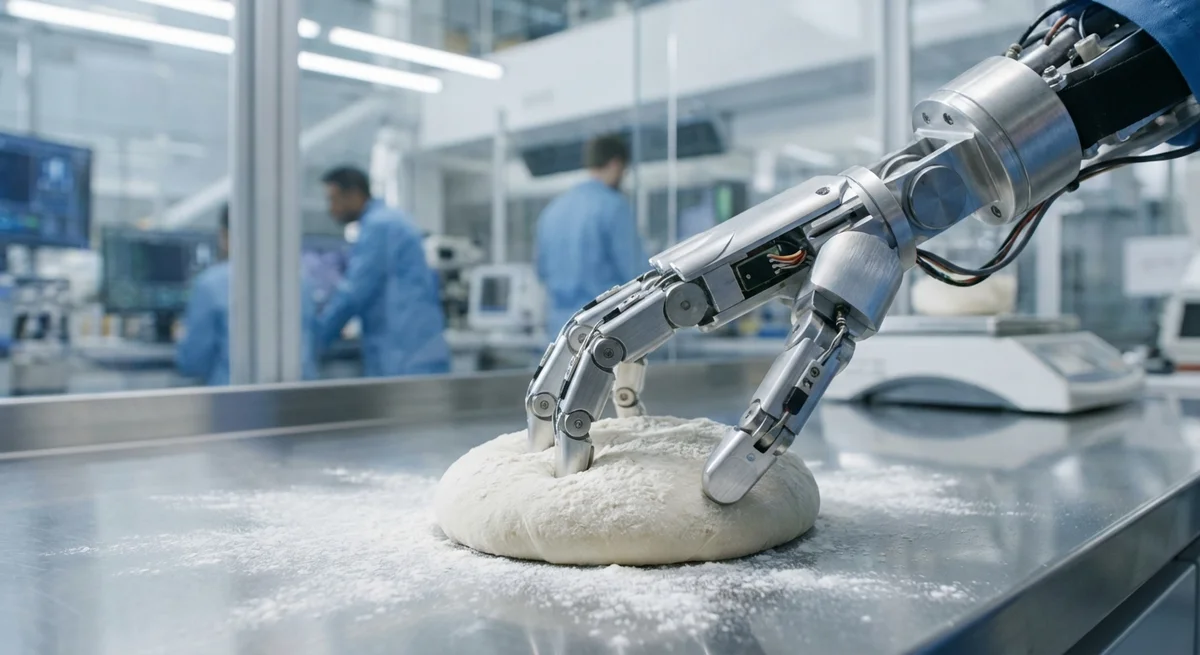
# First the Brain, Then the Dumplings: Alibaba DAMO Academy Enhances Robot Intelligence
Picture a scene: a robot stands in a kitchen before a bowl of dough and a pile of dumpling ingredients. Its manipulators are flawless — they can grasp a coin, tie a knot, sculpt a complex shape. But it stands and waits. Waits for instructions. Because the main challenge in modern robotics is not in the machine's hands, but in its head. Alibaba DAMO Academy — the research division of the Chinese giant — recently conveyed precisely this truth in its report. And this simple truth is changing the entire industry's approach to developing home robots.
For years, robotics engineers focused on mechanics. How many axes does the manipulator have? What is positioning accuracy? How fast does the limb move? These questions are valid, but incomplete. Alibaba DAMO Academy now insists on a priority that sounds revolutionary precisely because it is obvious: a robot needs to understand what it is doing. Multimodal language models are becoming a new frontier in robotics — not merely image recognition systems, but full-fledged "brains" capable of integrating vision, touch, and high-level planning into a unified cognitive system.
The essence of the challenge lies in the fact that making dumplings is superficially simple, but in reality an incredibly complex task. The robot must assess the consistency of the dough, understand when it is ready, divide it into portions, roll out each piece, fill it with filling, and form it correctly. But most importantly — the robot must adapt. Dough behaves differently under different conditions. Ingredients vary. A human intuitively handles this variability, relying on life experience and the ability to quickly reinterpret a situation. A robot, meanwhile, requires decision-making algorithms that allow it to respond to unforeseen circumstances without complete failure.
DAMO Academy researchers are focused precisely on this layer of abstraction. It is about developing algorithms that transform high-level commands into sequences of actions. Technically, this means working with multimodal neural networks that simultaneously process visual information, data on force and pressure from sensors, information on limb position in space, and prior experience performing similar operations. Only such an integrated approach allows a machine not merely to reproduce learned movements, but to make actual choices under conditions of uncertainty.
The practical significance of this breakthrough is enormous. Home robots remain rare precisely because they struggle with unstructured tasks. Industrial manipulators work perfectly on an assembly line, where everything is predictable. But at home? At home everything is more complex. You need a machine that understands context, can improvise, is capable of learning on the fly. DAMO Academy points in the right direction: invest resources not so much in perfecting hardware, but in developing software — specifically, in intelligent control systems.
This means that the path to a robot housekeeper will be longer than technological optimists predicted five years ago. But this honest assessment is extremely important for the industry. Instead of chasing the impossible, Alibaba DAMO Academy offers a realistic roadmap. First, we perfect the brain. And then, when this task is solved well enough, the dumplings will truly turn out right.
Want to stop reading about AI and start using it?
AI News is a curated feed of AI/tech news. Hamidun Academy teaches you to use AI systematically in your work.