Goodbye, latency: Nanyang Technological University speeds up robot response in dynamic environments
Scientists at Nanyang Technological University (NTU) have presented a solution to the fundamental problem of "slow response" in robots powered by Vision-Languag
AI-processed from Jiqizhixin (机器之心); edited by Hamidun News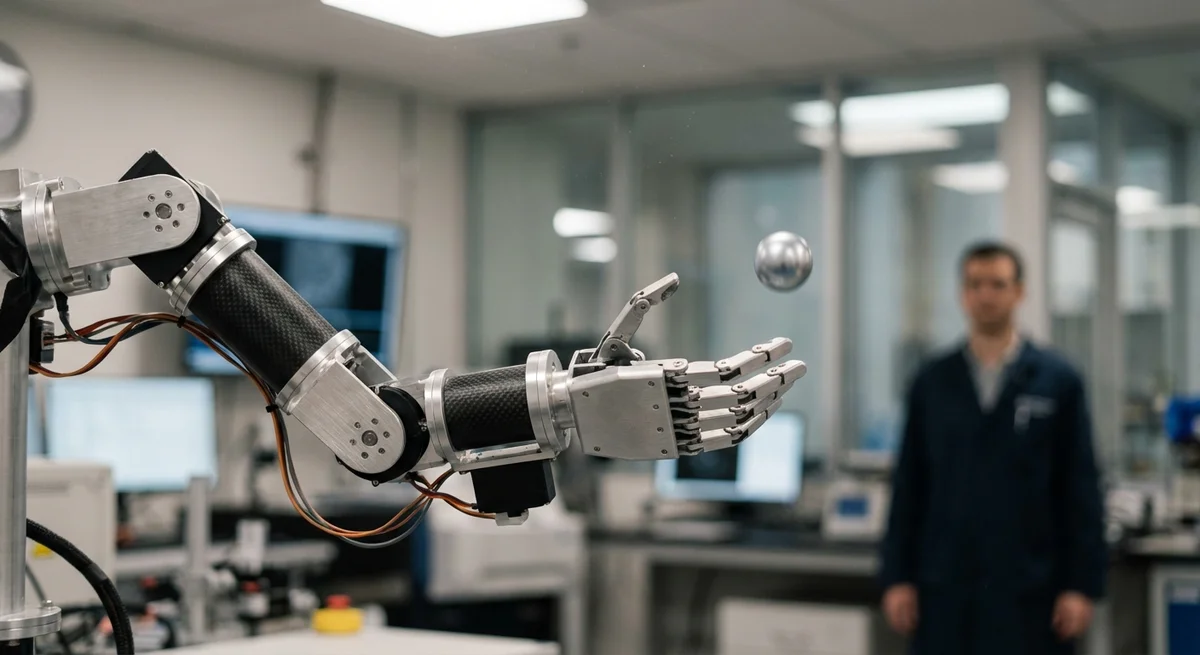
# Goodbye, Latency: How Nanyang Technological University Taught Robots to React Instantly
One of the most frustrating flaws in modern robots is the pauses. A robot sees an obstacle but seems to freeze for a moment before reacting. This delay, measured in seconds or even fractions of a second, makes machines clumsy in rapidly changing conditions. Scientists from Nanyang Technological University have just announced a solution that could change the situation. Their new optimization method allows robots based on Vision-Language-Action (VLA) models to process commands with virtually no delay while maintaining the precision of movements. The achievement narrows the gap between how quickly a robot understands a situation and how quickly it acts.
The problem that engineers from NTU solved looks simple at first glance, but hides deep technical complexity. Vision-Language-Action models combine three powerful components: computer vision to analyze the environment, language models to understand instructions, and action control systems to execute commands. In practice, this means that a robot must simultaneously process an image from a camera, analyze it through a neural network, understand a text command, coordinate multiple servo motors and joints.
The computational costs of such a pipeline are enormous, and with traditional approaches the system can operate with a delay of several seconds. For a robot working in a dynamic environment — say, in manufacturing next to moving objects or in a home with people — such slowness is simply dangerous.
The solution proposed by scientists is based on a subtle understanding of exactly where computational losses occur. Rather than simply accelerating each component separately, researchers from NTU developed a joint optimization method that makes different parts of the system work in harmony. They used a knowledge distillation technique that allows compression of large models without significant loss of accuracy, and special algorithms for distributing computing power among the robot's processors. The result is impressive: reaction time was reduced so much that a robot can track rapid human or object movement and respond appropriately, as if it possesses true muscle memory.
The significance of this achievement extends far beyond theoretical interest. Robots that can react instantly acquire the ability to work in real conditions rather than in a controlled laboratory. In manufacturing, they can safely interact with people, adapting to unforeseen situations. At home, they can help elderly people without creating risks due to slow reactions. In logistics, such robots can work at the pace dictated by human workers. Additionally, NTU's solution demonstrates that the path to true autonomy does not lie in creating ever more powerful models, but through smart engineering that makes existing technologies work more efficiently.
However, this is only the first step. Engineers from Nanyang Technological University have shown that the problem can be solved, but scaling their approach to more complex scenarios still lies ahead. As robots become increasingly capable and begin to perform more complex tasks, the need for instant reaction will only grow. The research from NTU opens the door to an era where a robot will not be 'half a second behind' reality, but will live at its pace, which is what is needed for machines to become truly useful partners for people.
Want to stop reading about AI and start using it?
AI News is a curated feed of AI/tech news. Hamidun Academy teaches you to use AI systematically in your work.