Lingxi Photonics raised millions to develop optical engines for AI clusters
# Optical Engines Instead of Copper Cables: How a Chinese Startup Solves a Critical Problem for AI Data Centers When you turn on a Netflix movie, video…
AI-processed from 36Kr (36氪); edited by Hamidun News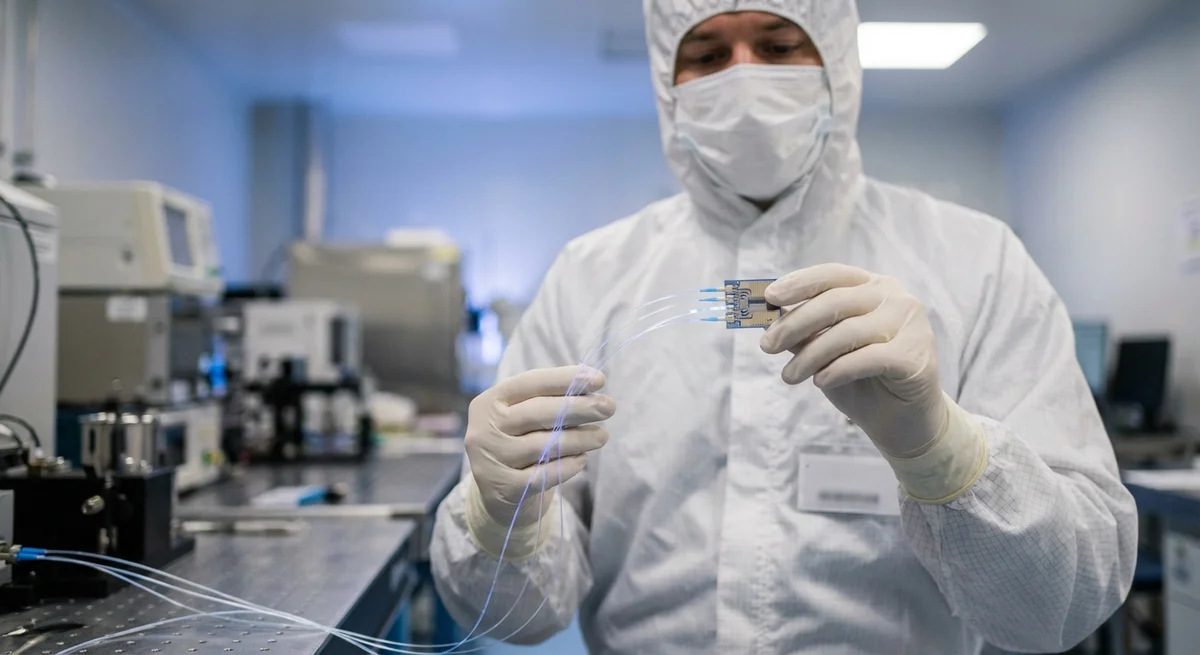
# Optical Engines Instead of Copper Cables: How a Chinese Startup Solves a Critical Problem for AI Data Centers
When you turn on a Netflix movie, video content is transmitted through the network at the speed of light. But when it comes to cloud data centers training massive language models, things get complicated. Data centers built for AI work face a paradox: processors become more powerful, yet the copper cables connecting them are already falling behind. This bottleneck is now being solved by Beijing Lingxi Photonics — a young Chinese startup that has raised tens of millions of yuan to develop next-generation optical engines.
Lingxi Photonics, founded in September 2025 by researchers from the Chinese Academy of Sciences, announced the closure of an angel funding round worth tens of millions of yuan. The round involved six investors, including state and private funds such as Shunxi Fund, Puhua Capital, and Tsinghua Innovation Fund. The company's founder, Wang Binghao — a researcher with a PhD from American university Texas A&M who spent considerable time in HP laboratories and later headed the optical systems group at the Chinese Academy of Sciences.
The problem that Lingxi Photonics solves appears highly specialized at first glance, but its consequences are enormous. As AI clusters grow, there is an acute need for high-speed communication between chips. Current solutions — optical modules connected to servers externally — consume too much energy and have bandwidth limitations. The new CPO (Co-Packaged Optics) and OIO (Optical I/O) technology embeds optical components directly into switching chips and accelerators, eliminating intermediate connections. It's like switching mail delivery to aviation — speed and reliability increase many times over.
At the heart of Lingxi Photonics' technology are so-called micro-ring modulators — tiny silicon devices one-thousandth the size of existing analogues. They convert electrical signals to optical with unprecedented efficiency. The company has already demonstrated prototypes achieving 256 Gbit/s on a single channel and 500 Gbit/s with advanced PAM4 modulation. When using wavelength division multiplexing (DWDM) technology, the system supports data transmission at speeds up to 6.4 terabits per second. For context: this is equivalent to sending an entire library in fractions of a second.
The critical advantage of Lingxi Photonics lies in the fact that its solution does not require the most advanced semiconductor process technology in the industry. Optical chips are developed based on standard silicon photonics, and electronic components are based on analog circuits available at existing 28-nanometer and older fabs. This means that under current geopolitical conditions, when US export restrictions pressure the Chinese industry, the company can rely on local capacities without depending on foreign suppliers. Wang Binghao emphasizes that the team has already launched manufacturing processes at numerous Chinese factories.
The size of the market the company is targeting is enormous. Analysts predict that by the end of the decade, the market for optical engines alone could reach $330 billion — more than ten times the current market for optical modules. Lingxi Photonics plans to present first prototypes in 2026–2027, pursuing two strategies in parallel: multi-channel parallel solutions for switches and wavelength-splitting systems for accelerators like GPU and NPU. The company is already conducting technical discussions with leading Chinese chip makers, AI accelerator manufacturers, and major internet companies.
Although American giants like Nvidia and Broadcom have already invested billions in CPO development, this field remains open for competitors with advantages in design and manufacturing. Lingxi Photonics enters at a time when optical solutions are moving from laboratories into real data centers. If the company succeeds in delivering promised prototypes on time, it could rewrite the equation in global competition for intelligent infrastructure.
Want to stop reading about AI and start using it?
AI News is a curated feed of AI/tech news. Hamidun Academy teaches you to use AI systematically in your work.