Microsoft unveiled OrbitalBrain: distributed AI learning right in space
Основной проблемой современных спутников дистанционного зондирования Земли остается ограниченная пропускная способность каналов связи. Огромные массивы данных м
AI-processed from MarkTechPost; edited by Hamidun News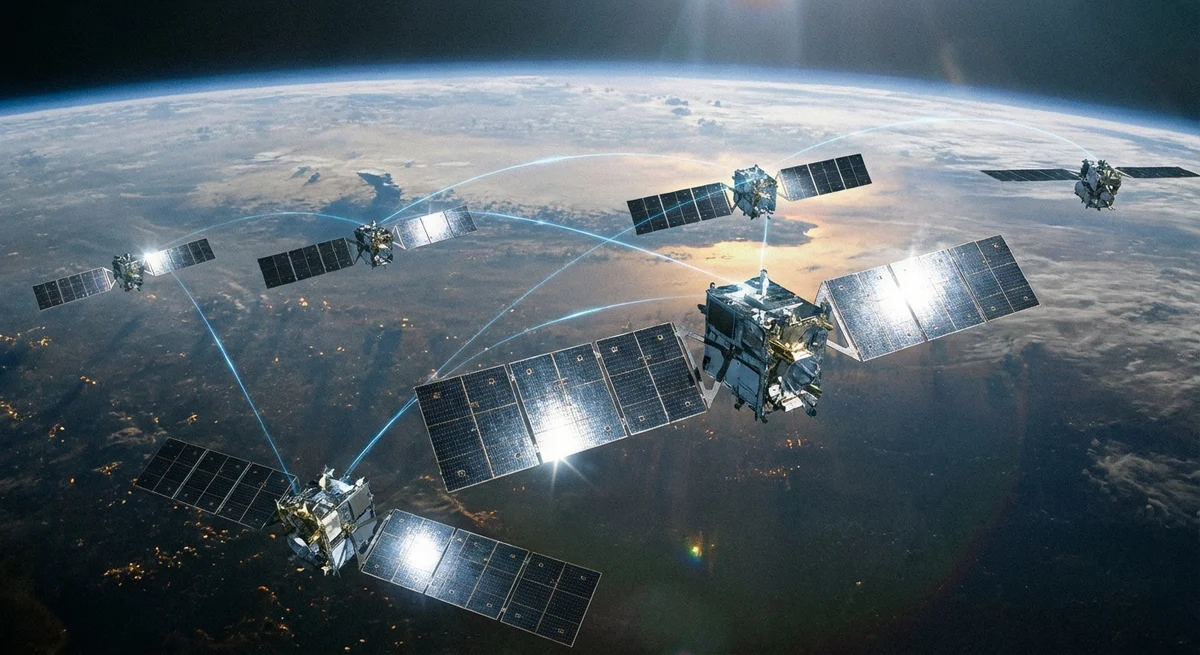
# Microsoft Presented OrbitalBrain: Artificial Intelligence Training in Space Changes the Rules
Earth satellites collect petabytes of high-resolution images every day, but most of this data never reaches ground servers at the right moment. The narrow bandwidth of satellite communication channels turns an enormous information flow into a bottleneck. Images wait days to be downloaded, and ground machine learning models starve for fresh data. Microsoft Research decided to turn this problem on its head and solve it where it belongs—in space. The company presented OrbitalBrain—a framework for training artificial intelligence directly in orbit using inter-satellite links and collaborative processing within constellations of spacecraft.
The essence of the problem is mundane, but no less acute for it. Modern remote sensing satellite constellations operate on a principle unchanged since the first space telescopes: observe, accumulate, then transmit. A single satellite can generate thousands of images per day, each weighing gigabytes.
Radio channel capacity allows only critically important information or a tiny sample of the entire volume to be transmitted to Earth. The rest either gets compressed and loses detail, or waits hours and days until the satellite enters the reception zone of a ground station. While this data travels downward, events on the planet have long since occurred.
Forest fire monitoring systems, agricultural yield monitoring, and emergency response systems receive information with a lag of hours or days.
OrbitalBrain completely reverses this logic. Instead of copying data to Earth, the system trains neural networks directly in space. Satellites in a constellation exchange information with each other through optical inter-satellite links, which are significantly more powerful than radio channels, and jointly train models on-site.
This means that useful analysis results—detected fires, anomalous areas, classified objects—are sent to Earth instead of raw images. The volume of transmitted data is reduced by hundreds of times. The framework uses joint accounting of the available computational resources of each satellite to optimally distribute the machine learning training load.
If one spacecraft is overloaded, work shifts to a less occupied one. The system accounts for the dynamics of mutual satellite positioning, predicts which connections will soon be lost, and plans data transmission in advance.
The consequences of this approach extend far beyond simply accelerating operations. Space constellations become truly autonomous systems capable of making decisions on site without waiting for commands from Earth. Emergency monitoring becomes nearly real-time—satellites will be able to send finished analytical conclusions within minutes of photographing an event location. Developing countries gain access to industrial monitoring of agricultural land and natural resources without dependence on ground infrastructure. Scientific missions for climate and human activity monitoring will be able to process global data volumes that previously were simply impossible to analyze in full.
Challenges, of course, remain. Space equipment operates in extreme conditions of radiation and cold, satellite computing capabilities are modest by Earth standards, and algorithms require reworking for the new paradigm of distributed learning. But Microsoft is already demonstrating that these obstacles are surmountable. OrbitalBrain opens an entirely new chapter in the space industry—when satellites transform from passive camera carriers into active nodes of a global neural network, observing our planet in real time.
Want to stop reading about AI and start using it?
AI News is a curated feed of AI/tech news. Hamidun Academy teaches you to use AI systematically in your work.