Мозг для роботов: стартап Noematrix привлек сотни миллионов юаней на развитие воплощенного ИИ
Китайский стартап Noematrix, основанный ведущими учеными из Шанхайского университета Цзяотун и Стэнфорда, привлек сотни миллионов юаней в раунде серии A. Инвест
AI-processed from 36Kr (36氪); edited by Hamidun News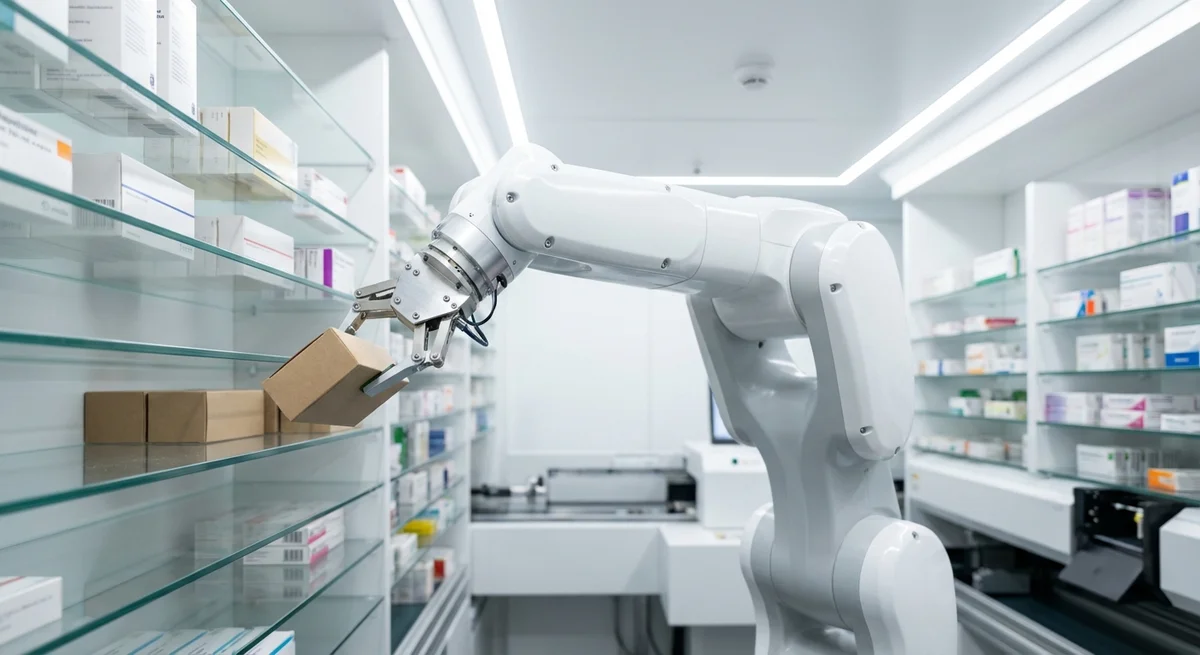
# Brain for Robots: How Chinese Startup Noematrix Is Changing the Future of Automation
When a machine picks up a box of medicine and places it in a bag, it looks simple. In reality, we're witnessing the solution to one of the most complex problems in robotics. Chinese startup Noematrix, founded by scientists from Shanghai Jiao Tong University and Stanford, has just raised hundreds of millions of yuan in a Series A round. Investors — venture fund C Capital and prominent names Sea Limited and Alibaba — are betting that this young venture can create a universal brain for robots that will literally transform automation.
Noematrix's story began in November 2023, when the company was founded as one of the first in China to focus on embodied artificial intelligence — AI that operates not just in a computer, but in the physical body of a machine interacting with the real world. The team assembled serious scientific talent: co-founder Lu Ce is the head of the AI laboratory at Shanghai Jiao Tong University, author of over two hundred scientific papers, and a laureate of prestigious robotics conferences. His partner Wang Shiquan is a Stanford doctoral candidate with experience creating a fully functional robotics company. Together they assembled a team of experts in systems solutions and large language models.
The company's flagship product — Noematrix Brain — is a system that gives robots a capability they have long lacked: understanding fuzzy, natural commands and the ability to act under conditions of uncertainty. Imagine a pharmacy. A robot receives an order and must do what seems simple: find the needed medicine, take it, package it.
But in reality, it's a multi-step task where each step requires decisions. The robot must plan an optimal route to the shelves if there are multiple. It must precisely identify where among hundreds of boxes the needed drug is located.
Its gripper must be sensitive enough not to crush the tablets, yet strong enough to hold them. And all of this must work every day, on different types of packaging, in different spaces.
Noematrix has already deployed its system in real pharmacies and laundries, and these are not merely laboratory prototypes. The system adapts to different robot platforms — from dual-armed mobile manipulators to humanoid machines. The key distinction of the company's approach lies in how it collects data for training models. Instead of expensive data collection solely on finished robots, Noematrix uses a method of "accompanying data collection" with its own exoskeletons and portable devices. A human in an exoskeleton performs a task, the system records all their movements, interactions with objects, visual signals. This allows collecting vast amounts of data from homes, offices, and industrial facilities. Currently, Noematrix has tens of thousands of hours of high-quality real-world experience data.
This difference is critical for the entire industry. Training deep learning models requires an exponential number of examples — and in robotics, quality data has historically been expensive and rare. The company created something like a "genetic database" of embodied AI, building a repository of real physical interactions. This strategy allows it to move faster than competitors and train models on diverse scenarios.
Long-term competition in this field will be won by whoever can create a closed loop: data from real scenarios improves models, improved models allow robots to work in new environments, new environments generate new data. Noematrix is clearly banking on this. The company is already discussing implementation of its system in hospitality, logistics, and other sectors. Simultaneously, it is expanding to international markets through partnerships with leading humanoid robot manufacturers and data collection centers.
Investment from this round will go toward developing foundational models with improved generalization ability and integrating cloud technologies for continuous improvement of robots in field conditions. By year-end, the company plans to present a complete solution for intelligent pharmacies. This could be the beginning of an era when robots finally stop being simple tools with rigid programming and become intelligent agents capable of adapting to the real world.
Want to stop reading about AI and start using it?
AI News is a curated feed of AI/tech news. Hamidun Academy teaches you to use AI systematically in your work.