Pony AI и Toyota запускают серийное производство беспилотных роботакси
Китайский оператор беспилотных такси Pony AI объявил о начале коммерческого производства автономных транспортных средств в партнерстве с японским автогигантом T
AI-processed from Bloomberg Tech; edited by Hamidun News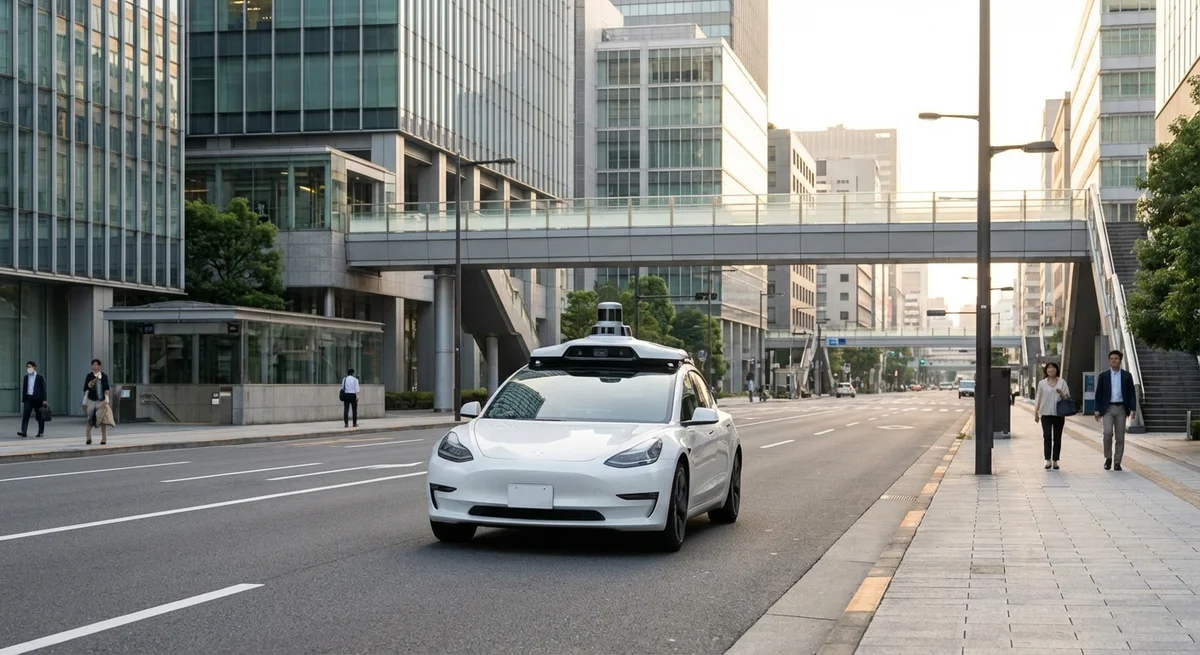
# Pony AI and Toyota Launch Serial Production of Autonomous Robotaxis
Chinese company Pony AI has officially begun commercial production of autonomous vehicles in collaboration with Toyota — one of its key investors. This event transforms a long history of development into concrete results: from the laboratory and small pilot programs to an actual production line that will manufacture driverless vehicles by the thousands. For the autonomous vehicle industry, this marks a transition from the proof-of-concept phase to the scaling phase, when the technology begins to become more accessible and affordable.
The partnership between Pony AI and Toyota developed gradually. Toyota invested significant capital in the startup and has long believed in its technology — now the Japanese automaker is not merely a sponsor but an active co-participant in the process. Toyota provides production facilities, its engineering expertise in automotive manufacturing, and knowledge about how to organize mass production of reliable vehicles. For its part, Pony AI brings artificial intelligence algorithms, environmental perception systems, and years of work on autonomous vehicle safety on busy city roads in China. This is not simply a financial partnership — it is a fusion of two entirely different areas of expertise.
Why is this important right now? Autonomous taxis are among the most anticipated and simultaneously most complex technologies in the world of transportation. In the US, companies like Waymo and Cruise have promised mass production for many years but have not reached serious volumes. Meanwhile, Pony AI, working in the Chinese market with its dense cities and intense traffic, has accumulated enormous experience in safely operating vehicles in complex conditions. The company has been conducting commercial rides in cities like Guangzhou and Shenzhen for years. The transition to production on Toyota's facilities means that successful technology finally finds a path to scaling.
The logic of the collaboration is clear to both sides. Toyota needs ready-made, tested algorithms and experience to enter the autonomous vehicle market — for a company oriented toward traditional automobiles, this is a painful transition, and the risk is greater than for a startup. Pony AI, in turn, gains access to global production standards, quality, and capacity needed to manufacture vehicles rather than assembling them by hand in garages. Without this, any startup would be doomed to years of painful volume scaling.
What will happen to these autonomous vehicles next? We are talking about robotaxi fleets that will operate in Chinese cities — vehicles without steering wheels or pedals, fully controlled by an AI system. This will change urban logistics: simpler, cheaper, more convenient than traditional taxis. But it will also raise questions: what will happen to drivers, how will such vehicles be insured, are cities ready for this? Answers to these questions are not yet ready, but the fact of launching production itself means that the countdown has begun.
For the autonomous vehicle industry, this is a signal: Chinese companies are moving faster and more practically than appeared to be the case in the West. Pony AI and Toyota demonstrate that autonomous vehicles are not an eternal fantasy but a set of skills that can be combined, launched on a production line, and begin to sell. No one knows how many vehicles will be produced this year, how many next year — but the direction is clear: the era of robotaxis is no longer in laboratories. It is moving onto the roads.
Want to stop reading about AI and start using it?
AI News is a curated feed of AI/tech news. Hamidun Academy teaches you to use AI systematically in your work.