China created the world's most accurate optical clock: 1-second error margin in 72 billion years
Chinese scientists have achieved a breakthrough in metrology by creating the world's most precise optical clocks. A team of researchers from the Institute…
AI-processed from 36Kr (36氪); edited by Hamidun News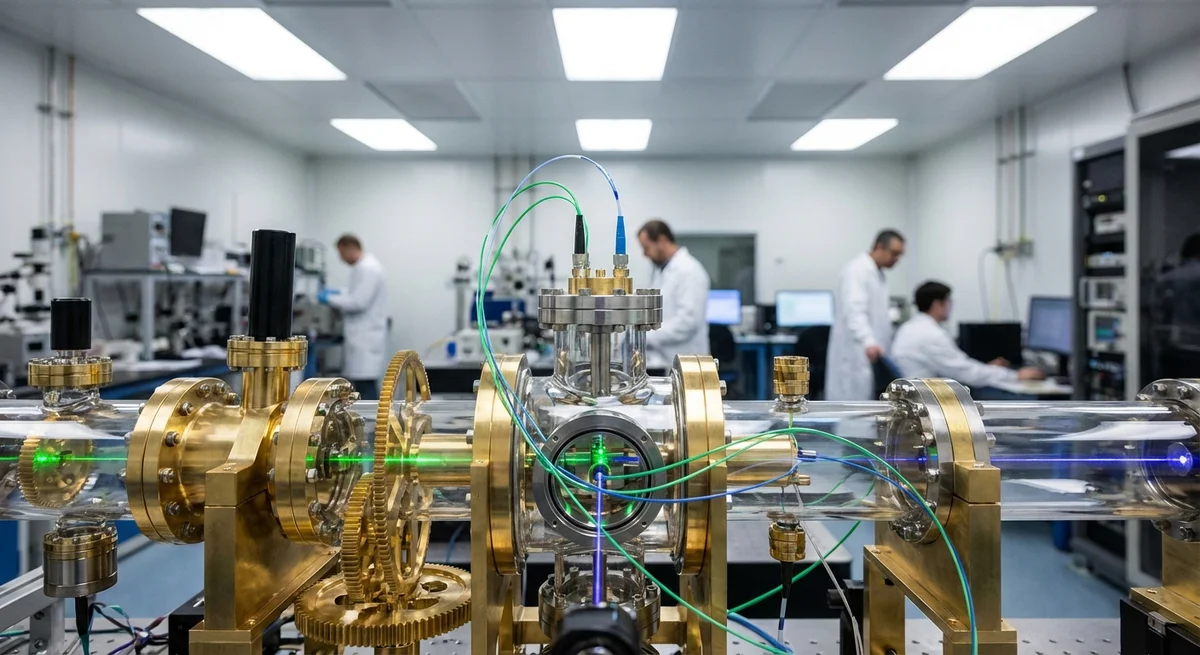
Chinese scientists have achieved a breakthrough in metrology by creating the world's most precise optical clocks. A team of researchers from the Institute for Precision Measurement Innovation and Technology of the Chinese Academy of Sciences presented the second generation of optical clocks based on calcium ions with liquid nitrogen cooling, demonstrating unprecedented accuracy. The total system error is just 4.
4E-19 (4.4 to the power of 10 minus 19), meaning the clock will lose or gain no more than one second every 72 billion years. The research results were published in the prestigious international journal Physical Review Letters.
Optical clocks are a type of atomic clock operating in the optical frequency range, significantly higher than traditional microwave atomic clocks used in modern GPS systems and other navigation technologies. The higher frequency allows for greater precision, since smaller changes in frequency have a larger impact on timekeeping. Developing optical clocks is a complex task requiring precise control over many factors, including temperature, electromagnetic fields, and vibration.
The new Chinese clocks use calcium ions cooled with liquid nitrogen to achieve high stability and accuracy. Ion trapping is a method in which ions are held in place using electromagnetic fields. Liquid nitrogen cooling allows the reduction of thermal noise, which can affect measurement accuracy.
The achieved error of 4.4E-19 is the highest figure ever recorded for optical clocks, making them the most precise in the world. It is worth noting that atomic clock precision is critically important for many modern technologies.
Global navigation systems such as GPS and GLONASS use atomic clocks on satellites to determine location with high accuracy. More precise clocks allow for improved navigation accuracy. Additionally, atomic clocks are used in scientific research, such as testing fundamental physical theories and studying gravitational waves.
The development of ultra-precise optical clocks has far-reaching implications. First, it opens new possibilities for fundamental scientific research, allowing scientists to conduct more accurate measurements and test fundamental laws of physics with unprecedented precision. Second, it could lead to the development of new technologies in navigation, communications, and sensing.
For example, more precise clocks could enable the creation of more reliable and accurate GPS systems, as well as the development of new types of sensors for detecting weak gravitational fields. China is investing substantial resources in the development of advanced technologies, including artificial intelligence, quantum computing, and advanced metrology. The development of the world's most precise optical clocks is testament to these efforts and strengthens China's position as one of the leaders in science and technology.
In the future, further breakthroughs in this field are to be expected, which will lead to new technological achievements and scientific discoveries. The new optical clocks created by Chinese scientists represent an impressive technological breakthrough that opens new horizons for science and technology. The unprecedented precision of these clocks will enable more accurate measurements, the development of new technologies, and the testing of fundamental laws of physics with greater confidence.
Want to stop reading about AI and start using it?
AI News is a curated feed of AI/tech news. Hamidun Academy teaches you to use AI systematically in your work.