Waymo и DeepMind строят «Матрицу»: зачем беспилотникам воображать аварии
Waymo и Google DeepMind представили Genie 3 — генеративную модель мира, которая превращает обычные видео с дорог в интерактивные симуляторы. Вместо того чтобы ж
AI-processed from Jiqizhixin (机器之心); edited by Hamidun News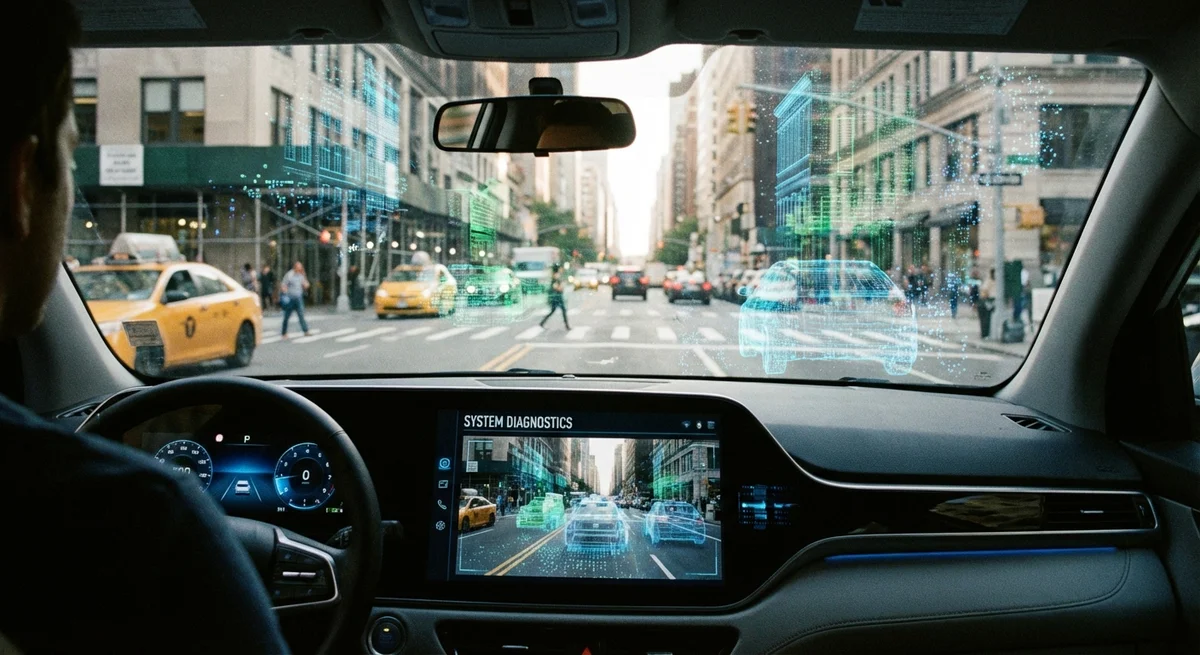
Imagine you're teaching a child to cross the road. Instead of waiting years for a speeding driver to whiz past or a piano to fall out of a truck, you simply put a virtual reality helmet on him that generates these nightmares on demand. That's roughly what Waymo and Google DeepMind are doing right now.
They decided that reality alone isn't enough to train a truly safe autonomous vehicle, and created Genie 3 — a generative world model capable of "imagining" road situations. The problem with all modern autonomous driving systems comes down to the so-called "long tail." Autonomous vehicles handle typical traffic just fine on a sunny day, but stumble before anomalies: a kangaroo running onto the road or oranges scattered across the asphalt.
It's physically impossible and dangerous to collect enough such examples in the real world. Previously, engineers would manually draw such scenes in simulators similar to video games, but they always remained too sterile and far removed from life. Genie 3 changes the rules of the game.
It's not just a video player, but a fully-fledged neural network environment. The model takes a short fragment of real footage from Waymo cameras and transforms it into an interactive sandbox. Engineers can tell the model: "Now let this car suddenly cut us off," and Genie 3 will redraw the video in real time, respecting the laws of physics and visual authenticity.
The autonomous vehicle inside this simulation can react to changes, and the model will generate the environment's response in return. This is the very "world model" that's talked about so much in the context of GPT-5 and the future of AI. Technically, Genie 3 is based on an architecture that understands causal relationships.
It doesn't just change pixels; it understands that if a car hits the brakes, the distance to it should decrease. This allows Waymo to train its algorithms under conditions of "controlled hallucinations." While competitors rack up millions of real miles hoping to encounter something unusual, Waymo simply generates the needed experience on DeepMind servers.
The transition to world models is a fundamental shift in robotics. We're moving away from simply copying human driver behavior toward training the system to understand the fundamentals of reality. If an AI understands how the world works, it doesn't need to see a thousand accidents to realize the danger of an object flying into the windshield.
The irony is that for a long time hallucinations were considered the main enemy of neural networks. Now, the very ability to "hallucinate" on a given topic is becoming the key to creating the safest driver in history. The main point: Waymo is transitioning from data collection to their synthesis on an industrial scale.
If this bet on Genie 3 pays off, physical road tests will turn into just a formal exam for a system that has already lived millions of lives in the digital "Matrix." Will anyone be able to catch up to Google without access to such computational power and expertise in generative models?
Want to stop reading about AI and start using it?
AI News is a curated feed of AI/tech news. Hamidun Academy teaches you to use AI systematically in your work.