SpaceX и xAI: Илон Маск строит империю, где ракеты научатся думать
Илон Маск официально объединил SpaceX и xAI. Это не просто бюрократический маневр, а попытка создать замкнутую экосистему, где нейросети xAI будут управлять сло
AI-processed from TechCrunch; edited by Hamidun News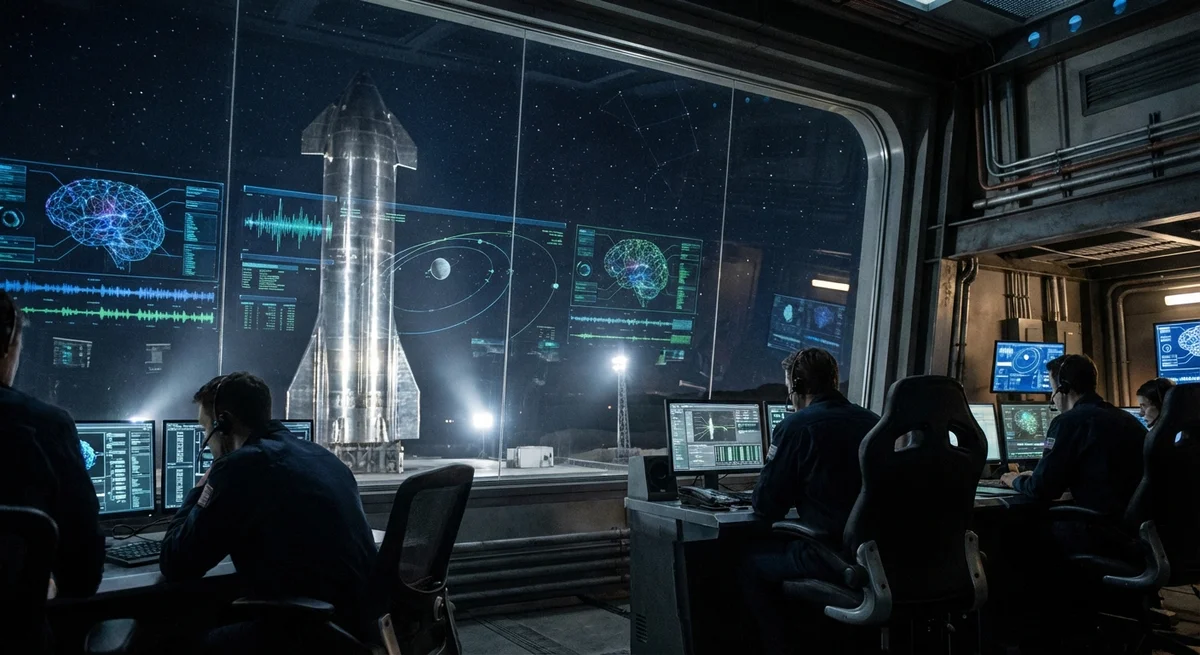
Elon Musk has decided to shuffle the deck again on a table where the stakes have long exceeded the budgets of average European states. The merger of SpaceX and xAI is not just news from the corporate reshuffling section, but the official birth of what can be called a new type of personal conglomerate. While other Silicon Valley giants are trying to embed AI into their search engines or office suites, Musk decided to give artificial intelligence the most powerful body in the Universe — Starship rockets. This is a logical step for a man who has always despised the division between software and hardware.
To understand the scale of what is happening, you need to recall how events unfolded over the past couple of years. After OpenAI went toward closed commercial structures, and Google got bogged down trying to make its neural networks as politically correct as possible, Musk launched xAI. Initially, Grok seemed like just a toy for X users, capable of answering questions boldly and ironizing over current affairs. However, those who carefully followed Elon's rhetoric understood: he did not need just a chatbot for public entertainment. He needed a system capable of processing the physical world as quickly and efficiently as software code.
SpaceX today is not only spectacular launches of Starlink satellites, but also a colossal array of data on telemetry, orbital mechanics, and materials science. Add xAI's computing power here, and you get an ideal testing ground for training real-world AI. If previously flight management required the work of thousands of engineers and rigidly prescribed algorithms, now we are entering an era where a neural network can make decisions about booster landing in real time, based on the experience of millions of previous simulations. This is the very speed of innovation that Musk talks about in every other interview.
The economic aspect of this deal looks even more provocative for traditional business. Musk's fortune of 800 billion dollars is already comparable to General Electric's market capitalization in its best days. But there is a fundamental difference: GE was an unwieldy machine with thousands of bureaucrats and a complex hierarchy. Musk, on the other hand, preaches the concept of a flat structure, where victory in the technology race is determined exclusively by the pace of change. By merging companies, he removes the last boundaries between departments, allowing rocket engine engineers and large language model developers to work on common tasks without unnecessary approvals and legal red tape.
For the entire industry, this means the beginning of a new race in which the rules have just changed. If competitors of SpaceX previously fought over price per kilogram of payload, now they will have to fight with the intelligence of the system itself. Blue Origin or Ariane Space risk becoming printer manufacturers in the era of personal computers. They no longer need just to build reliable rockets — they need to teach them to think and adapt. And considering that xAI has direct access to the most powerful computing clusters, Musk's advantage becomes practically unattainable.
We should not forget the long-term goal looming on the horizon — the colonization of Mars. An autonomous settlement on another planet is physically impossible without advanced AI capable of managing life support systems and construction robots without signal delay from Earth. The merger of these two assets is the first brick in the foundation of future Martian infrastructure. Musk is not just building a business empire for profit, he is creating a unified technological environment for humanity's expansion beyond Earth's orbit.
The question is only how sustainable such a structure is, dependent on the will and energy of one person. History knows examples of great monopolies that ultimately were broken up by antitrust regulators. But as long as the US government is critically dependent on SpaceX for national security issues and delivering astronauts to the ISS, Musk's hands remain untied. He is setting a precedent where one person possesses technological and financial weight exceeding the capabilities of many sovereign states.
Key point: The merger of SpaceX and xAI turns AI from a digital assistant into an operating system for managing the physical world. Can anyone compete with an empire where software and hardware are soldered so tightly together?
Want to stop reading about AI and start using it?
AI News is a curated feed of AI/tech news. Hamidun Academy teaches you to use AI systematically in your work.