Footprints in the sand: AI settled paleontologists' long-standing disputes
Paleontology has always been somewhat like fortune-telling with coffee grounds, except instead of a cup you have a multi-ton block of sandstone, and instead…
AI-processed from 3DNews AI; edited by Hamidun News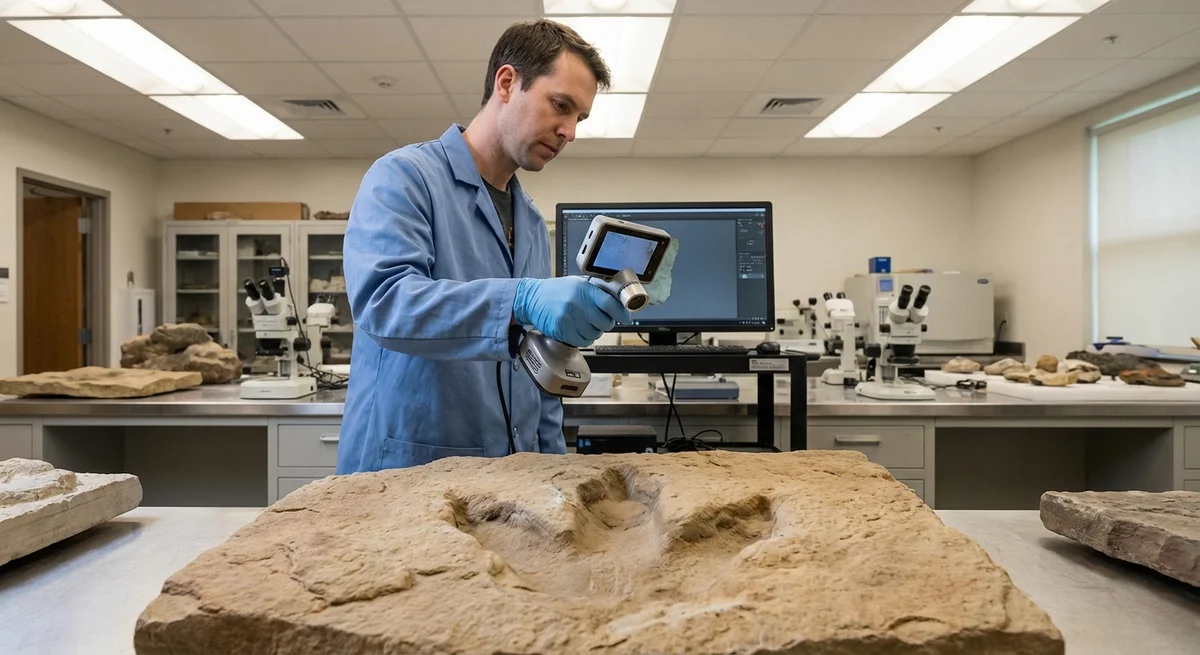
Paleontology has always been somewhat like fortune-telling with coffee grounds, except instead of a cup you have a multi-ton block of sandstone, and instead of grounds you have a barely visible depression left by someone's paw a hundred million years ago. Remember how as children we tried to guess the shapes of clouds? Scientists do roughly the same thing when they look at fossilized footprints, called ichnites. The problem is that the same dinosaur leaves completely different tracks depending on whether it was running through sticky clay or walking on dry sand. Add to this erosion, pressure from overlying layers, and the subjective interpretation of the researcher, and you get a perfect recipe for scientific disputes lasting decades.
A group of German researchers decided it was time to end this romanticism and introduce mathematical precision. They deployed deep learning to once and for all systematize what was previously considered a matter of intuition. Scientists identified eight typical features—a kind of "digital passport" of a footprint, which includes specific angles of phalanx inclination, the ratio of finger length, and the depth of certain pressure zones. The human brain tends to see familiar patterns where none exist, but a neural network is impartial. It sees geometry where we see just a hole in stone.
Why does this matter now? We are at a point where the number of discovered fossils exceeds the physical capacity of scientists to process them. Thousands of rock slabs with footprints gather dust in museum storerooms, classified "by eye" back in the last century. Using AI allows for a large-scale revision of these collections. The first tests showed that the algorithm can distinguish dinosaur species even when the impression is partially preserved. This opens the path to creating a global database where each newly discovered footprint will be instantly compared with all known findings on the planet.
Analysis of footprints gives us something that bones cannot—dynamics. A skeleton tells us what the animal looked like when it died. A footprint tells us how it lived: at what speed it moved, whether it hunted alone or in packs, and how it interacted with its environment. Digitizing this experience with AI transforms paleontology from a descriptive discipline into a precise data science. Now we can model the gait of ancient reptiles with such accuracy that was previously available only to Hollywood special effects artists, but now it's backed by rigorous mathematics.
Of course, skeptics might say we're trusting machines to interpret our past. But here's the irony: the algorithms we create for designing autonomous vehicles and facial recognition systems are best at explaining our deepest past to us. We use technologies of the future to finally understand who dominated this planet long before the first hint of human intelligence appeared. Perhaps in a couple of years it will turn out that half of the exhibits in your favorite museums are mislabeled, and we'll have to rewrite the textbooks.
The key point: AI transforms paleontology into data science, removing the human factor from the identification process. Are we ready for neural networks to rewrite the history of dinosaurs?
Want to stop reading about AI and start using it?
AI News is a curated feed of AI/tech news. Hamidun Academy teaches you to use AI systematically in your work.