Найден. Жив: почему нейросети справляются там, где пасуют тысячи волонтеров
В России ежегодно пропадает около 180 тысяч человек — это население среднего областного центра. Традиционные методы поиска с фонариками и прочесыванием леса ног
AI-processed from Habr AI; edited by Hamidun News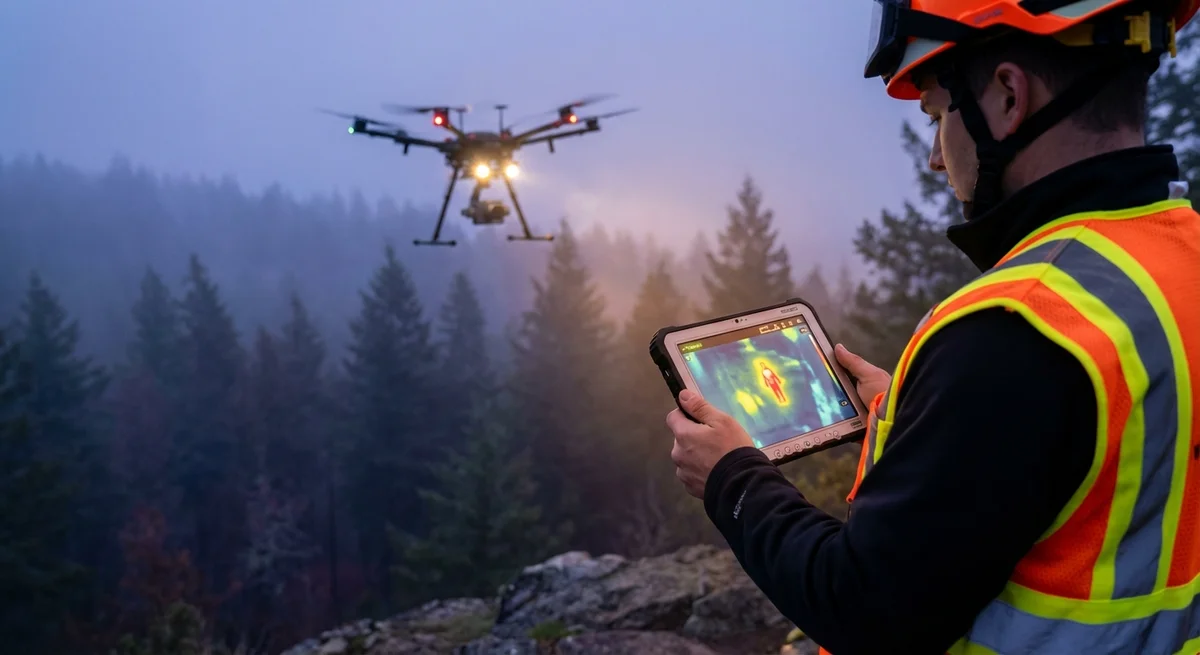
Let me be honest: the statistics on missing persons in Russia look like a report from a war zone. 180 thousand reports to the Ministry of Internal Affairs annually — this isn't just a number, it's the population of an entire city like Yuzhno-Sakhalinsk that disappears into forests and urban jungles. When time is measured in hours, especially in winter, classical search methods begin to falter. You can assemble a thousand volunteers, but human resources are limited by physics: eyes grow tired, legs fail, and attention scatters after just a couple of hours of monotonous work. This is where algorithms enter the stage — beings that have never heard of a coffee break or attention deficit.
For a long time, the main problem for search teams like LizaAlert was data processing. Imagine: a drone on a single flight takes several thousand high-resolution photographs. To carefully review this array, a group of volunteers needed five to eight hours.
Under forest search conditions, this is an unaffordable luxury. If a person went missing in frost, after eight hours there may be no one left to search for. The situation changed when computer vision joined the effort.
Neural networks learned to do what they do best — search for patterns. The algorithm doesn't search for a "person," it searches for anomalies: a bright spot that doesn't look like foliage, a shape that doesn't occur in nature, or a heat signature standing out against cooling earth.
The turning point came when developers trained models on specific datasets consisting of thousands of real images of forest areas in different seasons. Now the neural network "consumes" 2-3 thousand photographs in mere minutes. It filters out 95% of empty content, leaving searchers only with frames where there's actually something to grab onto. This reduced the time of initial analysis by orders of magnitude. Instead of painfully scrutinizing every pixel, search coordinators receive a ready-made selection of suspicious areas and immediately send ground teams or helicopters there.
Why is this important right now? We're at a point where "smart city" technologies and military developments have finally begun serving humanitarian goals without excessive fanfare. The use of AI in search and rescue operations (SAR) is the best example of how computational power directly converts into saved lives. It's important to understand that the machine doesn't replace the rescuer. It frees them from routine, allowing them to focus on decision-making. An algorithm can find a bright red jacket in overgrown brush, but it's the human who will decide how to evacuate the victim from an inaccessible swamp.
Also interesting is how the infrastructure of such searches is changing. If powerful servers were previously required, today models are optimized to work at the "edge" — directly on board an unmanned aerial vehicle or on a laptop in a field headquarters. This is critical because deep in the forest there's often no communication at all, let alone access to cloud computing. Local neural network execution makes search groups completely autonomous. We're seeing the birth of a new safety standard, where a drone with AI becomes as essential an attribute of a rescuer as a radio or compass.
However, the medal has another side. Developing such systems requires enormous investments and access to quality data, which often puts volunteer organizations in dependence on large corporations. Nevertheless, current results show that cooperation between the IT sector and volunteers is, perhaps, the most effective form of social partnership today. When technology helps hear a faint "I'm here" through the noise of a vast forest, debates about AI ethics take a backseat.
The main point: The speed of data analysis in search operations has increased many times over, and now the question is merely one of scaling. Will autonomous swarms of search drones become the standard for every region in the next two years?
Want to stop reading about AI and start using it?
AI News is a curated feed of AI/tech news. Hamidun Academy teaches you to use AI systematically in your work.