Joyance: 100 million for robots that walk almost like humans
While the Western world held its breath waiting for the next video from Tesla or Boston Dynamics, a quiet but extremely expensive revolution is unfolding in…
AI-processed from 36Kr (36氪); edited by Hamidun News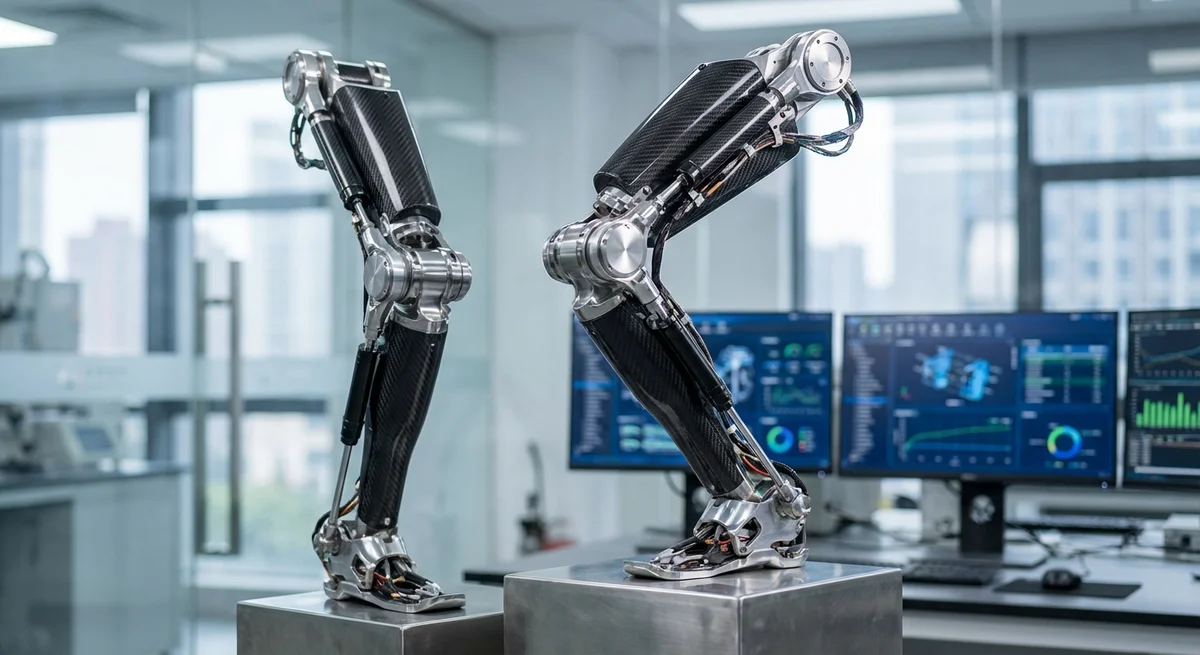
While the Western world held its breath waiting for the next video from Tesla or Boston Dynamics, a quiet but extremely expensive revolution is unfolding in China. Joyance, known in narrow circles as Zhuoyide, has just closed a Pre-A+ funding round for approximately 100 million yuan. This is not just another venture capital news story, but a clear signal: the race for "embodied intelligence" is moving from the stage of polished presentations into a phase of aggressive industrial scaling.
Investors of the caliber of Shanghai Pudong Leading Area Investment and Zhangjiang Science and Technology Venture Capital are not accustomed to throwing capital at empty promises. They are buying a ticket to a future where a robot stops being an awkward manipulator behind a factory fence and becomes a full participant in urban space.
Joyance is betting on high-level biomimetics. This means their machines must not merely execute tasks, but move and interact with the physical world as naturally as you and I do. Why is this happening right now? For the past couple of years, we've marveled at how large language models write poetry and code. But intelligence without a body is just a brain in a jar. For AI to become truly useful in the real economy, it needs "arms" and "legs" capable of navigating the chaos of human environments.
Joyance understands that the main problem with modern humanoids lies not only in the lack of computational power, but also in the imperfection of mechanics and energy efficiency. The attracted millions will go toward refining the "hardware," iterating the product, and creating a reliable supply chain. In the round, not only financial funds participated, but also strategic players like Qingdao Zhenghe Industrial and Xiamen Sunlion Tech. This is a direct indication that Joyance is preparing for mass production. When large industrial groups enter a project, it signals a transition from laboratory prototypes to assembly line manufacturing. The Chinese ecosystem allows this to happen faster and, importantly, considerably cheaper than anywhere else in the world.
If we once grew accustomed to viewing China as the "factory of the world," now it is the "laboratory and factory" in one. Particular attention should be paid to the term "high-level biomimetics." Most modern robots look like an accumulation of servos and plastic, inspiring at best curiosity and at worst the "uncanny valley" effect. Joyance, however, aims for their machines to replicate human body kinematics with eerie precision. This is critically important for work in spaces designed by and for humans: from narrow doorways to stairs with non-standard steps. If a robot moves unnaturally, it is not only less efficient but also provokes subconscious rejection from staff or clients.
It's interesting to observe how the rhetoric in the industry is changing. The word "innovative" already causes a slight yawn, so Joyance and their partners talk about "building an ecosystem" and "penetrating the market." They are building not just a robot, but infrastructure. This includes everything: from specialized servos to reinforcement learning algorithms that allow the robot not to slip on wet floors. The raised funds will help the company not simply release ten more prototypes, but create a delivery and maintenance system without which any technology remains an expensive toy.
What does this mean for the market? We will likely see the first commercially successful humanoids not in the living rooms of California villas, but in the warehouses and logistics centers of Shanghai. Joyance clearly aims to be a leader in this segment, and 100 million yuan is fuel for the first serious leap. China has stopped playing catch-up and begun dictating its own rules in robotics. While we discuss AI ethics, Joyance is building factories. The key question: will Western companies be able to compete with Chinese robots on price when they enter the global market with already-refined mass production?
Want to stop reading about AI and start using it?
AI News is a curated feed of AI/tech news. Hamidun Academy teaches you to use AI systematically in your work.