Prism: LaTeX подружили с GPT-5.2, чтобы ученые наконец-то перестали страдать
Пока индустрия обсуждает возможности базовых моделей, Prism выпустила бесплатный воркспейс с нативным LaTeX и встроенной GPT-5.2. Это не просто текстовый редакт
AI-processed from OpenAI Blog; edited by Hamidun News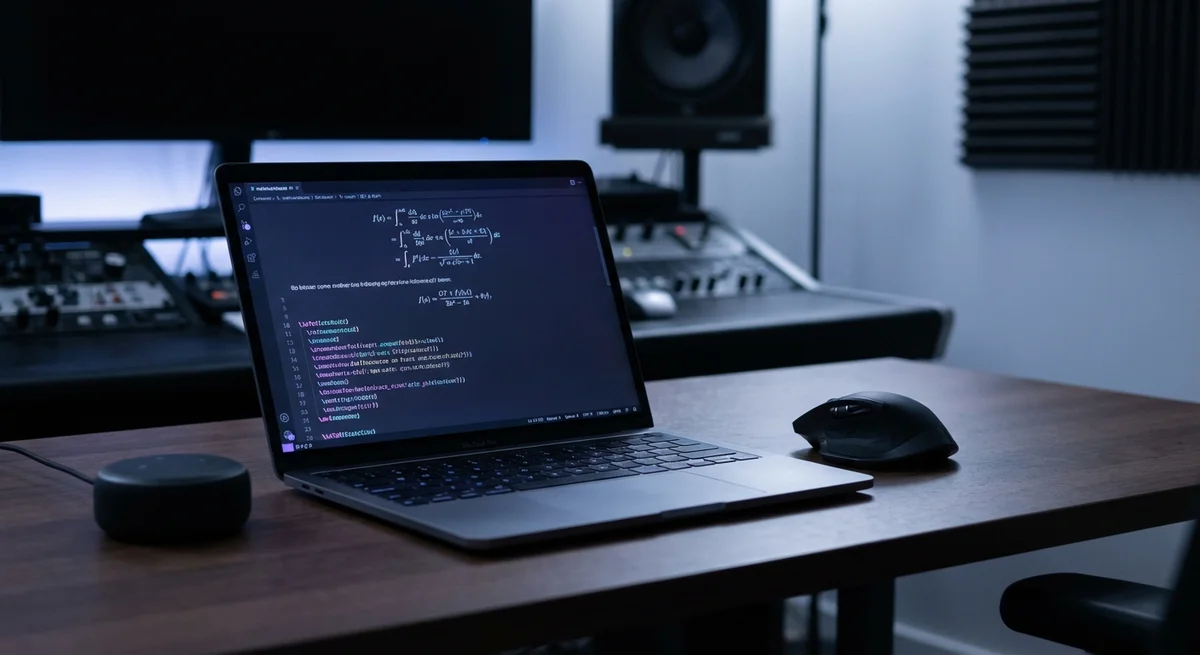
For many years, the academic community lived in a peculiar Stockholm syndrome, held hostage by LaTeX. We grew accustomed to the fact that writing a serious scientific paper was an obligatory battle with capricious syntax, where a single missed curly brace could cause the entire document compilation to collapse. But times are changing, and today the attempt to lay out formulas manually without the help of advanced intelligence looks just as strange as calculating logarithms on a wooden abacus. Enter Prism — a tool that promises to turn this archaic process into something human.
While the general public held its breath waiting for the official release of the next generation of models from OpenAI, the creators of Prism decided not to fuss around and announced support for GPT-5.2. This looks like an audacious challenge to the entire academic software industry. Prism is not just another VS Code plugin or a browser overlay. It is a full-fledged workspace created specifically for those who live in a world of formulas, graphs, and strict logic. The developers immediately understood that researchers don't need just a chat-bot in the corner of the screen; they need an environment that understands the context of scientific work at the level of a co-author.
The main change here lies in the word reasoning. GPT-5.2 inside Prism doesn't just correct typos or suggest synonyms. It knows how to reason in terms of mathematics and physics. Imagine that you are sketching out a draft proof, and the system in real-time points out a logical flaw in the third lemma or suggests a more elegant way to derive an equation. This fundamentally changes the very nature of work: the scientist shifts focus from mechanical text input to the generation of meaning. The system takes on all the dirty work of formatting references, tables, and bibliographies, allowing the mind to do what it is designed for.
Why is this important right now? We are observing a reproducibility crisis and an incredible burden on the scientific community. The number of publications is growing exponentially, while the time for quality review of each work is shrinking. Integration of powerful reasoning models directly into the article-writing process could become the very filter that weeds out gross errors at the preprint stage. Moreover, Prism bets on collaboration. In a world where a physicist from CERN and a mathematician from Stanford need to work on the same file, old tools often become a bottleneck.
The fact that Prism remains free raises separate interest. In an industry where the cost of computational resources for models of this level is measured in millions of dollars, such generosity hints at an aggressive market capture strategy. Likely, the company plans to build the highest quality database of scientific interaction to further train models on the real processes of knowledge discovery. For the user, this means access to future technologies without needing to squeeze budgets from grant providers for subscriptions.
If Prism manages to truly deliver seamless work with GPT-5.2, we will see the sunset of the era of classical editors. Scientists are conservative people, but even they won't be able to ignore a tool that saves weeks of life on routine formatting. The only question is how deeply we are ready to trust the verification of our ideas to an algorithm, and whether the AI assistant will become too influential on the course of scientific thought, pushing researchers toward more predictable and safer conclusions.
The key point: Prism could become the very Overleaf killer that was awaited for decades, but the real revolution here is not in formatting, but in the ability to verify scientific logic on the fly. Claude and Gemini will have to urgently find a way into the academic niche before GPT-5.2 becomes the de facto standard there.
Want to stop reading about AI and start using it?
AI News is a curated feed of AI/tech news. Hamidun Academy teaches you to use AI systematically in your work.