Two-legged problems: why AI writes code but stumbles at the threshold
Imagine the scenario: artificial intelligence writes complex Python code in just a couple of seconds, composes a symphony in Bach's style, and makes medical…
AI-processed from Habr AI; edited by Hamidun News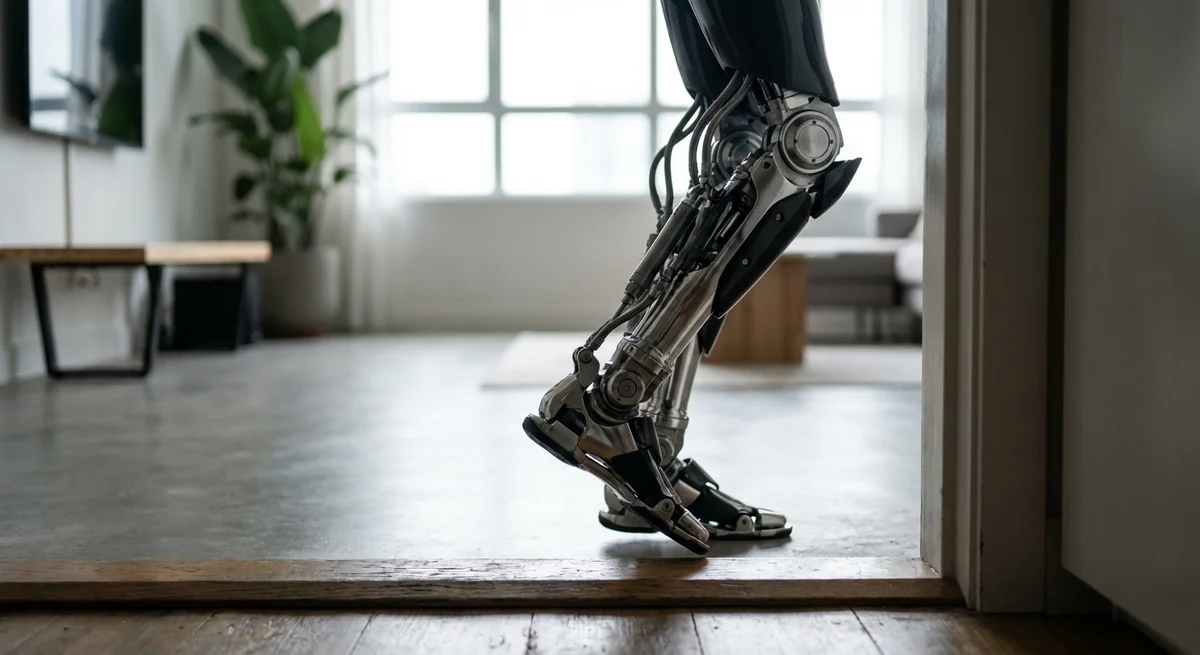
Imagine the scenario: artificial intelligence writes complex Python code in just a couple of seconds, composes a symphony in Bach's style, and makes medical diagnoses more accurately than a medical consultation. But the moment this same intelligence "settles" into a metallic body and attempts to simply walk to the kitchen, problems begin. It trips over the carpet, freezes before the threshold, and ultimately falls with the grace of a sack of potatoes. This seems absurd in 2026, but the physical world remains the most challenging playground for algorithms. We're used to thinking that reasoning is a higher function and walking is something primitive. Reality turned out to be exactly the opposite.
In robotics, there has long existed what is called Moravec's paradox. Its essence is simple: high-level reasoning requires very little computational power, while low-level sensorimotor skills require enormous resources. We easily teach a computer to play chess at a grandmaster level because chess is a logical structure with clear rules. But teaching a robot to feel a table surface or balance on one leg is a genuine nightmare for engineers. Evolution spent millions of years perfecting our vestibular apparatus and muscle response, and we're trying to reproduce this with servos and lithium batteries over just a couple of decades.
The main problem lies in latency and feedback. When you walk on uneven terrain, your brain receives thousands of signals from your muscles and joints in real time, correcting your body's position before you even realize you've stepped on a stone. A modern robot's cycle works differently. Cameras see the obstacle, the processor processes the image, the algorithm makes a decision, and only then does a signal go to the motors. If this chain takes even 50 milliseconds longer than it should, gravity takes over. We call this "ping" in games, but for a robot weighing 80 kilograms, high ping means expensive repairs.
Moreover, there is a huge gap between simulation and reality that specialists call the sim-to-real gap. In a virtual environment where neural networks are trained to control the body, physics is perfect. There's no dust in the bearings, no voltage sag in the battery, and no microscopic floor irregularities.
When a model trained in the "digital" world is transferred to real hardware, it encounters the chaos of the physical world. Every actuator has its own backlash, every sensor has noise, and the system starts to "lag." Right now, companies like Figure and Boston Dynamics are trying to solve this through end-to-end learning, where a neural network directly links the visual stream with motor voltage, bypassing intermediate layers of classical programming.
We shouldn't forget about purely mechanical limitations either. The human foot is an engineering masterpiece of 26 bones and countless ligaments that works like an ideal shock absorber. Most modern robots have instead of a foot a rigid "hoof-like" platform, or at best a joint with limited degrees of freedom. We're trying to force a piece of metal to imitate biological tissue that is by nature elastic and capable of storing energy. Until we create new types of actuators that will work like artificial muscles, robots' gait will remain "wooden" and uncertain.
The future, of course, lies with neuromorphic chips and new materials, but for now we should temper our expectations for domestic helper robots. Most likely, the first residents of our homes won't be two-legged athletes, but wheeled platforms with manipulators—it's simply cheaper and more reliable. Gravity is a harsh mistress, and she doesn't forgive errors in code when they concern moving an iron body through space. We're at a point where intelligence is already ready for philosophical conversations, but still afraid of an ordinary threshold in the bathroom.
The key point: The problem of walking is not a problem of "intelligence," but a problem of reaction speed and imperfect mechanics. Until hardware catches up to software in flexibility and responsiveness, humanoids will remain expensive toys for laboratories.
Want to stop reading about AI and start using it?
AI News is a curated feed of AI/tech news. Hamidun Academy teaches you to use AI systematically in your work.