GPT-5 и пробирки: OpenAI удешевляет производство белков на 40%
OpenAI вышла за пределы чат-ботов. В партнерстве с Ginkgo Bioworks компания интегрировала свои новейшие модели, включая наработки уровня GPT-5, в автоматизирова
AI-processed from 36Kr (36氪); edited by Hamidun News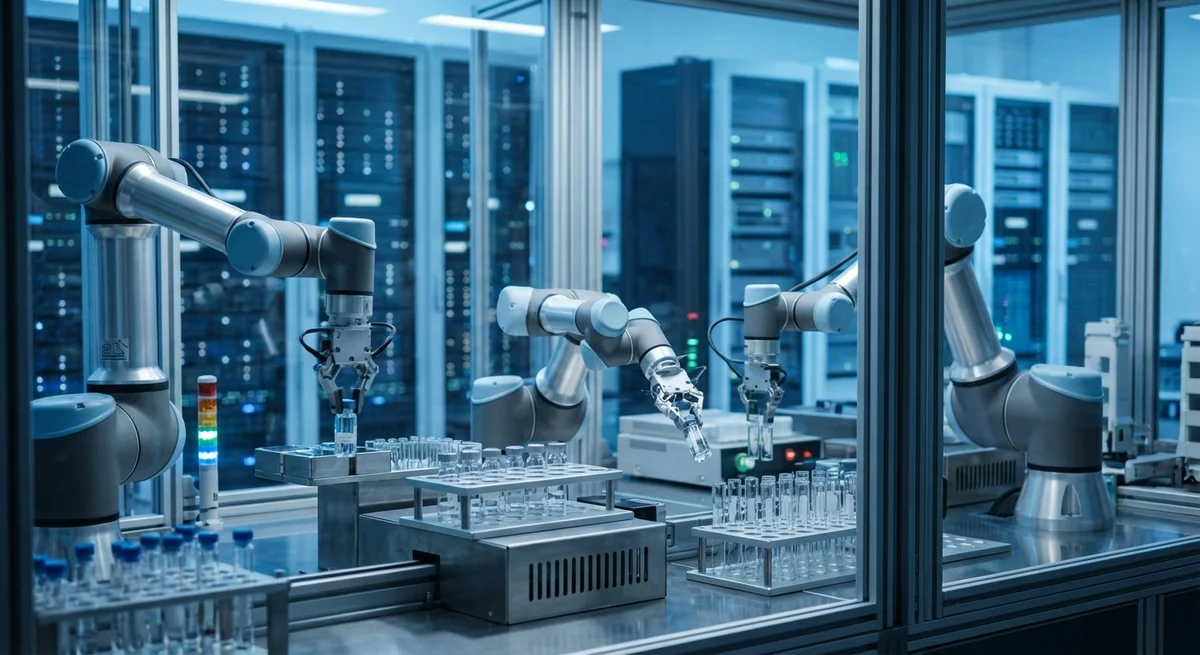
You know, while we entertain ourselves by making neural networks write letters to our bosses or draw cats in spacesuits, Silicon Valley has started reassembling the very foundation of life itself. OpenAI has officially confirmed that its collaboration with Ginkgo Bioworks has borne fruit that should send a mild tremor through pharmaceutical giants. We're talking about creating a closed-loop system that combined intelligence at the level of GPT-5 with fully automated biolaboratories.
The result of this synergy is a 40% reduction in protein production costs. To give you context: proteins aren't just the protein shakes from the gym. They're the foundation of modern cancer drugs, insulin, new materials, and even artificial meat.
Previously, the process of creating them resembled an endless lottery. Scientists would propose a hypothesis, go to the lab, spend weeks running tests, fail, and start over. It's long, expensive, and wildly inefficient.
Ginkgo Bioworks spent years building "biology factories," trying to automate this chaos, but they lacked a "brain" capable of processing biological data at the same speed that robots move pipettes. OpenAI gave them that brain. The new system works on the principle of a continuous cycle.
The AI designs a protein sequence, sends a command to the robotic line, which synthesizes a sample and immediately runs tests. Test results instantly return to the neural network for analysis. If something goes wrong, the model understands the error and immediately proposes a new iteration.
The only human needed in this chain is to check the electricity bills. This "closed loop" is what allowed them to remove the human factor and endless downtime from the equation, yielding those same 40% savings. Why is this important right now?
We're approaching a moment when large language models stop being merely "language" models. Sam Altman and his team are clearly betting on Physical AI — intelligence that understands the laws of physics, chemistry, and biology. If GPT-4 taught us to communicate with computers, then GPT-5 (or the prototypes currently being used at Ginkgo) is learning to manipulate atoms and cells.
This is a direct path to personalized medicine, where drugs are synthesized for your specific DNA in mere days and at reasonable costs. Of course, skeptics will say that 40% is a figure for investors, and real clinical trials will still take years. But let's be honest: in an industry where the cost of developing a single drug is measured in billions of dollars, a near-doubling of savings at the basic stage is a tectonic shift.
OpenAI is effectively turning biology from high science into an engineering optimization task. If we used to "discover" drugs, now we "calculate" them. What's also interesting is how OpenAI chooses its partners.
Ginkgo Bioworks isn't just a startup, it's a massive infrastructure machine. By combining software and hardware at this level, the companies create a barrier to entry that will be very difficult for competitors to overcome. While Google DeepMind with its AlphaFold predicts protein structures, OpenAI is already learning to produce them en masse and cheaply.
This is a transition from theory to raw practice. The main point: OpenAI has definitively stopped being a "chatbot company." Now it's an operating system for the physical world, and biology is just the first testing ground.
Claude 4 from Anthropic now simply must be able to do something similar, otherwise it'll remain stuck in the digital sandbox.
Want to stop reading about AI and start using it?
AI News is a curated feed of AI/tech news. Hamidun Academy teaches you to use AI systematically in your work.