GPT-5 в биолаборатории: синтез белка стал дешевле на 40%
OpenAI и Ginkgo Bioworks создали замкнутый цикл: GPT-5 проектирует эксперименты, а облачная автоматизация их исполняет. Результат — падение стоимости бесклеточн
AI-processed from OpenAI Blog; edited by Hamidun News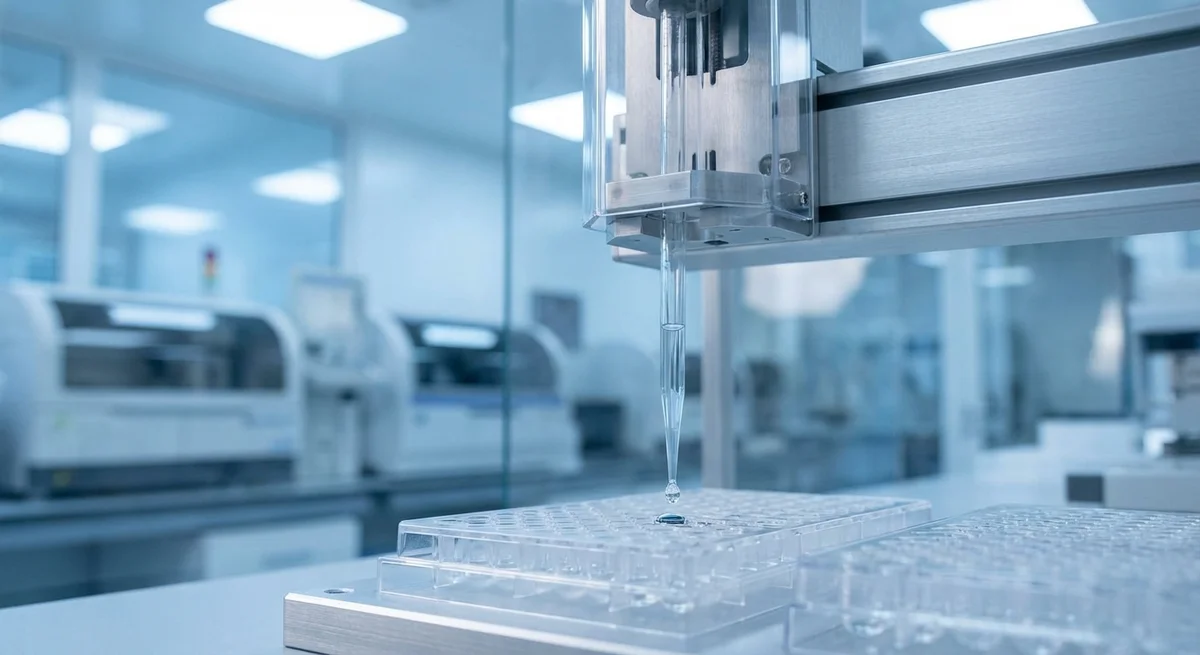
While some use language models to argue with bots on social media or write essays, others trust them to design life at the molecular level. The collaboration between OpenAI and Ginkgo Bioworks demonstrates that GPT-5 is not just a chatbot with good memory, but a full-fledged scientific researcher capable of optimizing complex biochemical processes. This involves cell-free protein synthesis, a technology that has stalled for years due to its exorbitant cost and setup complexity. Now the price has dropped by 40% at once, and this is just the first iteration of their joint work.
Cell-free synthesis has always been considered something like the "holy grail" of biotech. It allows producing proteins without the use of living cells, which is faster and cleaner, but requires jeweler's precision in selecting components. Previously, scientists spent months on trial and error, trying to find the ideal balance of enzymes and substrates. Ginkgo Bioworks provided its cloud resources and automated manipulators, while GPT-5 took on the role of a brain that analyzes the results of each stage and immediately corrects the next step. This frees the industry from "human error" and endless waiting for laboratory reports.
This approach is called a closed experimental loop. The machine does not simply execute commands; it learns from its mistakes in real-time. If previous versions of GPT could only suggest hypotheses based on read papers, the new iteration of OpenAI's model demonstrates alarming efficiency in planning actual physical processes. A 40% reduction in costs in such a conservative field as biosynthesis is not just "optimization"—it is a full-fledged tectonic shift in the industry. We see how AI stops being a superstructure and becomes the foundation for production.
For pharmaceutical giants and startups, this means the path from the idea of a new drug to its prototype is cut dramatically. We are entering an era when biology becomes a discipline of programming. Instead of growing bacteria and hoping for a result, engineers set parameters, and the AI system finds the shortest path to the goal. This makes the development of personalized medicines and new vaccines economically feasible even for small laboratories, not just for corporations with billion-dollar budgets. The scaling problem that once killed hundreds of promising projects is now solved through cloud AI resources.
Of course, skeptics will say that 40% is just a number on paper from one specific case. However, one should consider the trajectory of model development. If GPT-5 achieved such results in initial tests, then specialized agents based on it could crash production costs even further within a year. Ginkgo Bioworks has clearly bet on the right horse, integrating OpenAI's intelligence into its "factory of the future." This partnership transforms cloud laboratories into something resembling Amazon server farms, except instead of data, they process biological code.
The bottom line: Biotechnology stops being a lottery and becomes an engineering challenge. Can GPT-5 make antibiotic development as cheap as writing software code?
Want to stop reading about AI and start using it?
AI News is a curated feed of AI/tech news. Hamidun Academy teaches you to use AI systematically in your work.