Бетонный принтер в законе: как Госдума пытается легализовать стройку будущего
В России готовят экспериментальный правовой режим для 3D-печати зданий. Проблема проста: принтеры уже умеют возводить стены за считанные часы, но по документам
AI-processed from CNews AI; edited by Hamidun News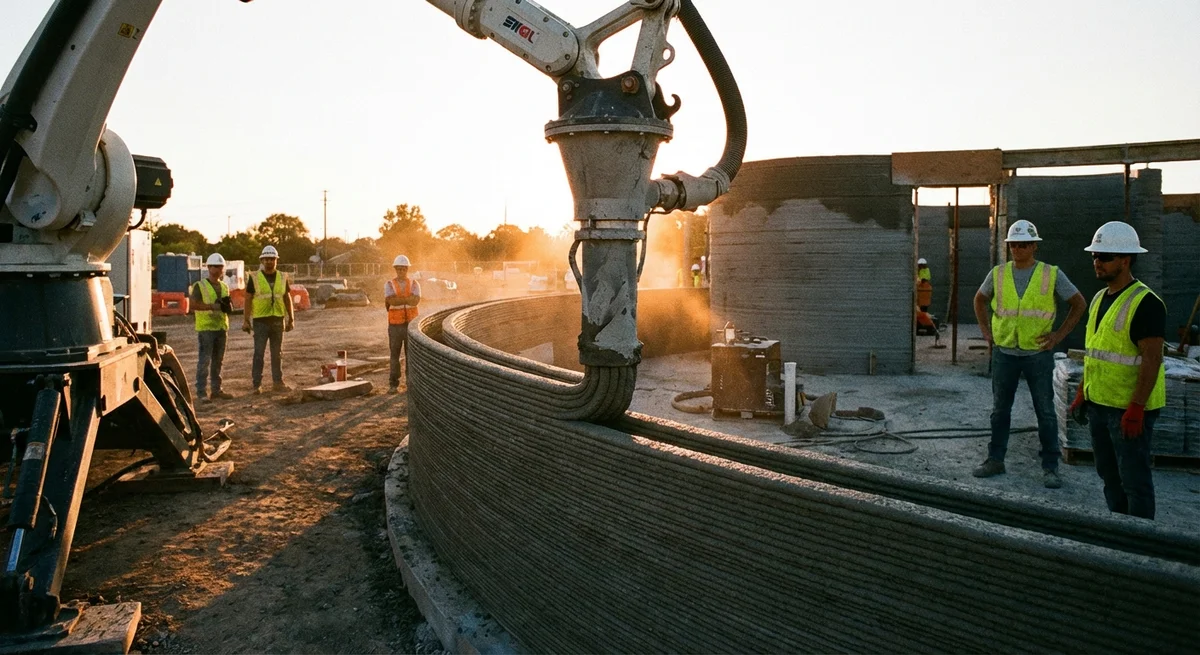
Imagine a construction site where the loudest sound is not the shouts of a foreman, but the steady humming of a robotic gantry. A giant nozzle, layer by layer, lays down walls that look more like a multi-layered designer cake than a familiar concrete panel. This is not science fiction footage, nor a presentation from a Silicon Valley startup, but a reality that the Russian construction industry has been trying to legalize for several years.
The State Duma's Committee on Economic Policy has finally moved from discussions to action, preparing a proposal to create an experimental legal regime (ELR) for 3D printing in construction. This is an important step because, until now, additive technologies in Russia have been in a gray area: you can print, but getting it approved for use as full-fledged housing is difficult.
The main problem now is not a lack of printers or a shortage of concrete. Russian companies like AMT and Spetsavia have long since proven that their machines can erect building shells in just a few days. The real wall that developers are hitting is made of paper. The current SNiPs and GOSTs were written at a time when a reinforced concrete slab was considered the pinnacle of progress. A printed wall, which is essentially a complex multi-layered structure made from extruded material, simply does not fit into existing categories. If a building cannot be classified according to old manuals, it cannot be insured, sold with a mortgage, or have its safety guaranteed according to state standards.
The initiative with the experimental regime did not appear out of nowhere. Since 2024, heated debates have been taking place at expert council venues on digital economy about how to legalize this sector. The ELR is essentially a legal sandbox. It allows companies to temporarily ignore some archaic requirements in exchange for total control and data collection. The state wants to see how these houses will behave in reality, without forcing businesses to wait decades for national standards to be updated. It is an attempt to let innovation move faster than bureaucracy, which for our construction industry itself looks like a small revolution.
Why do we need this right now? The answer lies in economics and demographics. Traditional construction has hit a ceiling: labor costs are rising and a shortage of qualified masons is becoming chronic. A printer does not take a lunch break, does not require insurance, and operates with mathematical precision. Automation makes it possible to reduce labor costs by 30–40% and accelerate the wall construction process by half. In a situation where the country needs to build millions of square meters of affordable housing, such figures transform 3D printing from an expensive toy for geeks into a strategic necessity.
Of course, there is also a skeptical side to the question. Printing the shell is only 25% of the total work. We still haven't learned to efficiently print communications, floor slabs, and quality insulation in the same cycle. Moreover, the Russian climate with its freeze-thaw cycles is a severe test for additive concrete. The experimental regime should provide answers to these practical questions. We need to understand whether such a house will delaminate after five winters and how the reinforcement will behave within the printed layers. Without real case studies, which will now become possible thanks to the State Duma, we would have remained at the level of printing small architectural forms and gazebos.
The transition to the ELR means the state has acknowledged: trying to shoehorn 3D printers into old frameworks is futile. Creating a separate dedicated lane for technology will allow the market to form new rules of engagement. If the experiment succeeds, in five to seven years we will see a shift from manual construction to industrial automated printing of entire settlements. This will completely change the suburban landscape and may make individual housing a truly mass-market product.
Key point: The state has finally given the green light to concrete printers, acknowledging that old standards are holding back progress. Will the technology survive testing by Russian winters and bureaucracy within the framework of the experiment?
Want to stop reading about AI and start using it?
AI News is a curated feed of AI/tech news. Hamidun Academy teaches you to use AI systematically in your work.