Космический ЦОД Маска: миллион спутников против законов физики и здравого смысла
Илон Маск замахнулся на проект за гранью фантастики: миллион спутников для развертывания ИИ-мощностей прямо на орбите. Идея в том, чтобы использовать бесконечну
AI-processed from HuXiu (虎嗅); edited by Hamidun News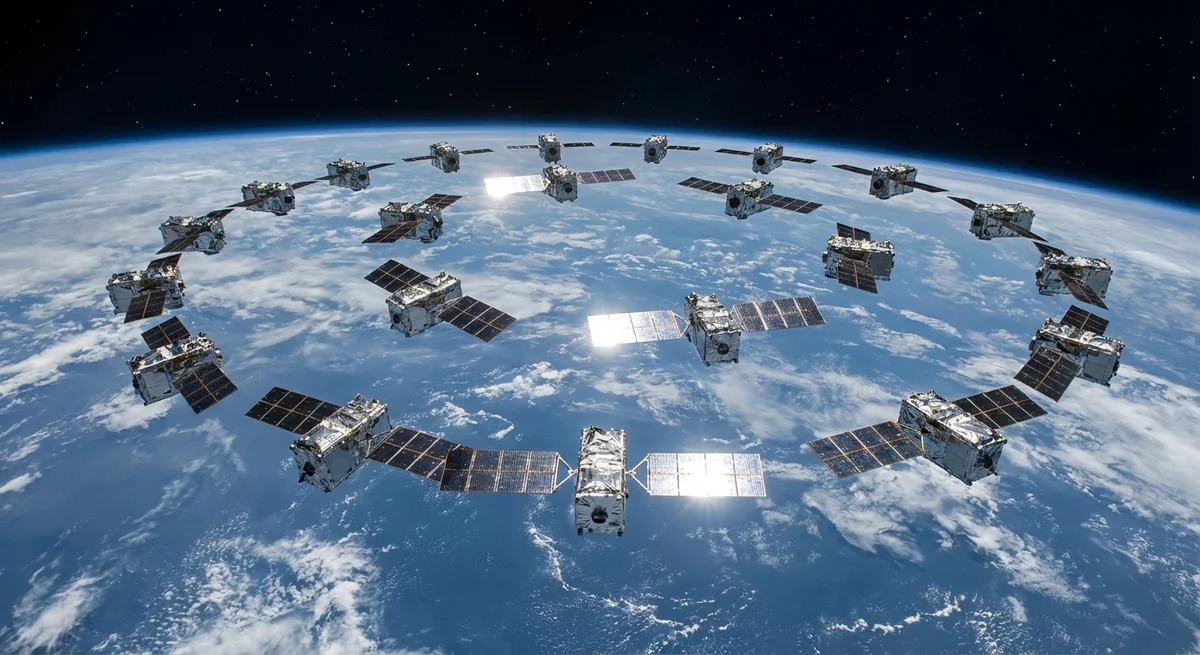
Imagine the sky soon becoming not just a place for stars, but a giant humming motherboard. Elon Musk is once again making the industry nervously scratch its head, announcing plans to launch a million satellites. This is not just an expansion of Starlink for internet in every remote location, but a full-fledged "million satellites" project, aimed at creating a distributed data center for AI right in orbit.
When we're talking about such scale, the line between brilliant engineering solution and grandiose bluff blurs faster than Falcon 9 stages enter the atmosphere. Why drag servers into space if you can build them in Texas? The answer lies in two things that have become scarce in the era of the LLM boom: electricity and cooling.
Modern clusters of thousands of H100s consume energy equivalent to small cities and require enormous volumes of water for cooling. Musk proposes an elegant, if mad, solution. In space, solar panels work more efficiently, unaware of clouds and night, and the cosmic cold — that very "cold wind of the Universe" — solves the chip overheating problem.
This is an attempt to build infrastructure where there is no utility company bureaucracy and no environmental activists upset about depleting local rivers to cool neural networks. Context here is more important than the number itself. After Starlink proved its viability, transforming from an adventure into a dominant force, Musk understood that orbit is not just a transit, but new real estate.
A million objects — that's dozens of times more than has been launched in all of human history. This raises legitimate questions about Kessler syndrome and light pollution, but Musk seems more concerned with the shortage of computing power for his xAI. If you can't find enough outlets on Earth, you create your own outlets in the sky.
However, skepticism here is warranted as never before. Critics point to data transmission latency and radiation that ruthlessly destroys electronics outside the atmosphere. Servers in space don't live long, and their maintenance is impossible.
So Musk is betting on a "disposable" architecture: satellite-servers must be so cheap and numerous that thousands breaking down per week doesn't affect overall performance. This radically changes the approach to hardware — from reliability we shift to redundancy. What does this mean for the market?
If the project is realized even 10%, we'll see the birth of the world's first sovereign computing cloud, which obeys no nation's laws. It's the perfect refuge for AI that can learn and operate beyond regulators' reach. Musk is not just building a data center, he's building a new digital jurisdiction where fuel is sunlight and borders are vacuum.
The main question: Will this million satellites become reality or remain a tool for pumping SpaceX and Tesla stock? For now, physics says "complicated," but Musk's history says "don't bet against him." Will Claude and Gemini soon be requesting data from orbit?
Want to stop reading about AI and start using it?
AI News is a curated feed of AI/tech news. Hamidun Academy teaches you to use AI systematically in your work.