MADrive: Яндекс строит цифровую Матрицу для своих беспилотников
Обучать беспилотники в реальности дорого и опасно, а обычные симуляторы слишком похожи на видеоигры. Яндекс решил проблему с помощью MADrive — метода генерации
AI-processed from Habr AI; edited by Hamidun News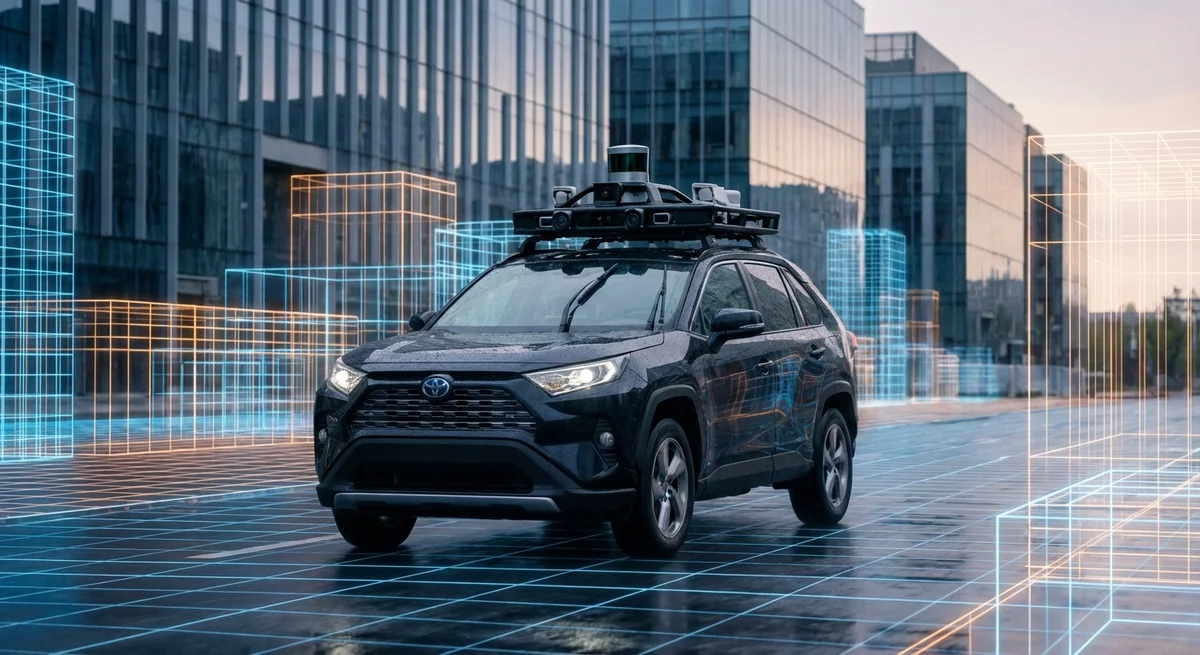
Imagine you need to teach artificial intelligence to drive a multi-ton vehicle in the center of a megacity. You can't simply release a "raw" algorithm onto the street and hope for the best — the cost of an error is too high. This is why the entire autonomous transport industry lives in simulations. But here a major problem emerges: the so-called sim-to-real gap. If the image in the virtual world differs even slightly from reality, the autonomous vehicle's sensors begin to "fail" when they encounter real asphalt.
Yandex's sensor simulation team decided to go beyond conventional game engines and created MADrive (Memory-Augmented Driving Scene Modeling). It's not just an image generator, but a complex system that can model road scenes while accounting for physics and context. Previously, simulators often suffered from objects looking flat or behaving unnaturally when viewed from different angles. MADrive uses memory mechanisms to maintain object consistency: if an autonomous vehicle "looks" at a parked car from a different angle, it remains the same car, not transforming into a shapeless blob.
Why is this needed right now? The autonomous vehicle industry has hit "edge cases" — rare situations on the road that occur once every hundred thousand kilometers. You could wait forever for them in reality. MADrive allows generating such scenarios infinitely many times in digital space. This enables training neural networks on aggressive drivers, suddenly running pedestrians, or anomalous weather conditions, without risking real hardware or human lives.
Parallel to the generation method, Yandex released MAD-Cars as open source — a massive dataset that the developers themselves call the largest of its kind. These are thousands of detailed 3D models of automobiles that can be used for computer vision tasks. In the world of AI, data is the new oil, and such a move looks like Yandex's attempt to become a key player in the academic and research community. When all the world's leading laboratories start using your dataset as a standard, you automatically become the one dictating the rules of the game.
For the average user, this means one simple thing: robotaxis will become safer and appear on streets faster. The more perfect the simulation, the less time engineers need to spend on real roads, "polishing" algorithms. We are entering an era when an autonomous vehicle's virtual experience becomes more important than its real mileage. If previously we took pride in millions of miles driven, now we will compete in the quality of synthetic data.
Key point: MADrive makes simulation so high-quality that the boundary between virtual testing and real-world deployment blurs. Will the industry be able to completely abandon road testing in the next five years?
Want to stop reading about AI and start using it?
AI News is a curated feed of AI/tech news. Hamidun Academy teaches you to use AI systematically in your work.