AI boom vs. toilets: why there's now no one to fix your tap
AI Boom vs. Toilets: Why No One Can Fix Your Pipes Anymore While we lazily argued in the comments about whether GPT-5 would replace the average junior…
AI-processed from CNews AI; edited by Hamidun News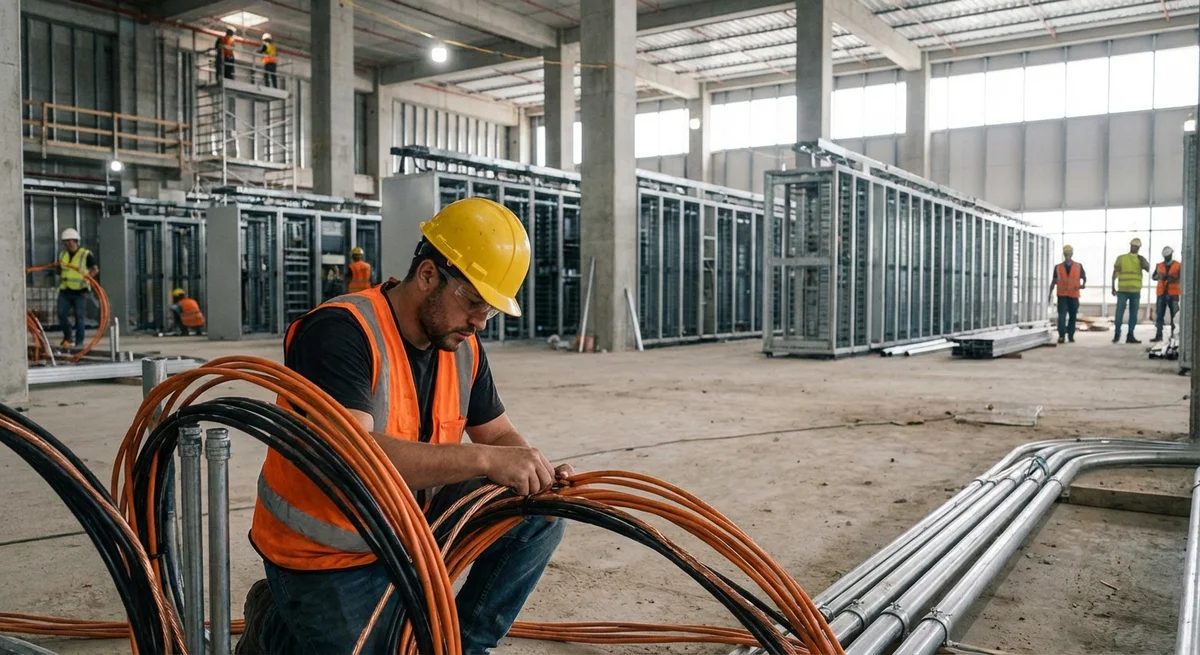
AI Boom vs. Toilets: Why No One Can Fix Your Pipes Anymore
While we lazily argued in the comments about whether GPT-5 would replace the average junior developer in fintech or when Midjourney would put illustrators out of work, reality threw us a far more ironic plot twist. Turns out that the main victim of the AI revolution at this stage is not your designer friend, but your neighbor the plumber, who suddenly stopped answering calls. And no, he didn't teach himself Python in his spare time. He simply left for where they pay orders of magnitude more than any ambitious Silicon Valley startup—to the construction of endless and insatiable data centers.
The boom in generative artificial intelligence spawned a monstrous, almost physiological appetite for computational power. But behind every "smart" chatbot that writes you poems or corrects errors in your code stands not just an abstract cloud, but quite tangible tons of concrete, kilometers of copper cables, and sophisticated cooling systems. Giants like Microsoft, Google, and Amazon are building server farms at such a pace that you'd think humanity's survival depends on it. As a result, the U.S. and European labor markets have become so skewed that calling a repairman feels like a mission-impossible-level quest.
Why is this happening right now, and why did these particular professions come under fire? It all comes down to scale and the technological specifics of new chips. A modern data center designed for training neural networks is not just a warehouse with computers. It's a real energy and hydraulic monster. To cool racks of cutting-edge NVIDIA graphics processors, which emit colossal amounts of heat, you need thousands of liters of water and the most complex closed-loop circulation systems. And that's where plumbers and HVAC specialists enter the scene. They no longer fix kitchen sink clogs; they design and install life-support systems for the planet's "digital brain."
Electricians found themselves in an even more scarce and privileged position. The power consumption of new Big Tech facilities is measured not in megawatts but in gigawatts. Someone has to connect it all, test it, and, most importantly, maintain it 24/7. Large technology corporations literally vacuum the labor market, offering salaries, bonuses, and benefits packages that the private sector, small businesses, or municipal services simply cannot compete with. Where a good electrician was once just a sought-after professional, today he has become a strategic resource on a state scale, fought over by billionaires.
The situation is made worse by a decades-long demographic and educational trend. For years, young people have been actively convinced that the future belongs exclusively to digital professions. As a result, we have an oversupply of marketers and social media specialists, but a critical shortage of people who can tell a live wire from a neutral one or properly weld a pressurized pipe.
The irony is that the industry promising us total automation and freedom from routine manual labor stumbled over a shortage of those very "blue collars." We can endlessly improve data compression algorithms or transformer architecture, but we cannot "download" an extra mile of copper wire or get a neural network to install a distribution panel in an open field.
The physical world has presented its bill to the digital, and it's a substantial one. For the average consumer, this means two things. First, the cost of property ownership and maintenance will only rise—services from any skilled tradesperson will become a luxury item.
Second, construction timelines for any projects unrelated to AI infrastructure will stretch indefinitely. The entire focus of global capital and human resources has shifted toward serving Big Tech's needs. We're entering a strange era where the ability to handle a wrench or multimeter is valued by the market no less than the ability to write complex prompts.
Soon we may see former programmers signing up for retraining courses to learn how to install cooling systems for the servers that replaced them.
The bottom line: the AI revolution has suddenly hit a shortage of manual labor specialists. If you thought the future was just code and pixels, just look at the waiting list for your plumber. It seems the industry's next critical step won't be creating GPT-6, but a desperate attempt to build a robot capable of replacing an electrician on a construction site. But until that happens, fixing your leaking pipe will probably be a do-it-yourself job or cost you a fortune.
Key takeaway: Physical infrastructure has become a bottleneck for AI. Without plumbers and electricians, our "digital future" will simply overheat and burn out.
Want to stop reading about AI and start using it?
AI News is a curated feed of AI/tech news. Hamidun Academy teaches you to use AI systematically in your work.