Лаборатория без людей: Китай запустил ИИ-систему для автономного создания материалов
Исследователи из Китайской академии наук (CAS) разработали мультиагентную систему для ускорения материаловедения. Это не просто софт, а полноценный «цифровой мо
AI-processed from Jiqizhixin (机器之心); edited by Hamidun News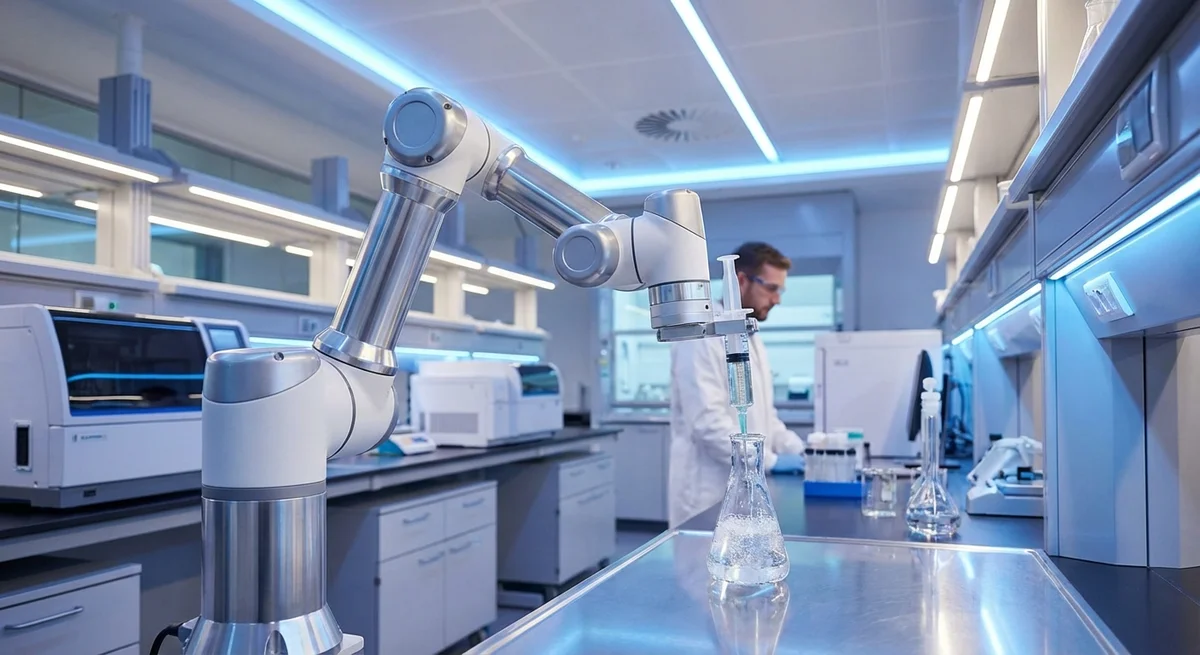
While we debate whether GPT-5 can replace programmers, deep within the Chinese Academy of Sciences (CAS) researchers have quietly completed something far more tangible. They unveiled a multi-agent system for developing new materials—something that once required decades and thousands of human-hours in white coats. This isn't just another algorithm for predicting molecular properties, but a full-fledged digital team capable of controlling real robots in physical laboratories. Science is finally switching to autopilot, and it seems humanity is about to become the slowest link in this chain.
Traditional materials science has always resembled a very expensive lottery. Scientists spent years testing combinations of elements, hoping to find that elusive superconductor or catalyst. This was called the "Edisonian approach"—endless trial and error, where each failure cost weeks of lab work. The Chinese project radically changes the rules of the game by implementing the concept of an autonomous closed-loop system. The system itself forms hypotheses, plans experiments, and conducts them using robotic manipulators. No more tedious test-tube work—just pure data analysis.
At its core lies a multi-agent system architecture. Imagine a virtual research institute where each department is a specialized language model. One agent acts as a "librarian," analyzing thousands of scientific papers and extracting data on previous successes and failures. Another takes on the role of "theorist," modeling atomic interactions at the quantum level. A third becomes an "engineer," translating abstract chemical formulas into concrete instructions for lab equipment. They communicate with each other, debate, and correct each other's actions in real time, mimicking the work of a full scientific team.
The most interesting part begins at the execution stage. When the "engineer" sends a command to the robot, it mixes reactants or sinters powders. If the result doesn't match expectations—which happens almost always in science—the system doesn't get stuck. It analyzes sensor data, understands where theory diverged from practice, and immediately launches the next iteration. This is the "closed loop" that tech giants have dreamed about for so long. All that's left for a human is to set initial parameters and watch on a monitor as a material with desired properties is created while they drink their coffee.
Why does this matter right now? We've hit a technological ceiling in everything: from battery capacity to solar panel efficiency. We need new materials yesterday, and classical science moves too slowly. The Chinese development proves that combining LLMs and robotics can shrink the R&D cycle by tens, if not hundreds of times. While Western startups focus on generating images or text, colleagues from the Middle Kingdom are laying the foundation for a new industrial revolution where AI controls matter directly, bypassing the human factor.
Of course, the question arises: what about thousands of grad students whose job used to be monotonously mixing liquids? Most likely, their role will transform into "meaning operators." Instead of turning knobs on instruments, they'll need to properly formulate tasks for multi-agent systems and interpret results, which sometimes may contradict classical intuition. We're entering an era where scientific discovery becomes a product of efficient neural network management rather than the random inspiration of a lone genius.
The key point: China has successfully put scientific research on the rails of multi-agent AI, creating a working closed loop. Will the rest of the world offer something equally scalable in the physical world, or will we continue using AI only for generating memes?
Want to stop reading about AI and start using it?
AI News is a curated feed of AI/tech news. Hamidun Academy teaches you to use AI systematically in your work.