Джеймс Коллинз: почему ваш ИИ бесполезен без «мокрой биологии»
Пока все обсуждают генерацию картинок, Джеймс Коллинз из MIT использует ИИ для спасения жизней. Его подход прост: алгоритмы ищут молекулы, а экспериментальные п
AI-processed from MIT News; edited by Hamidun News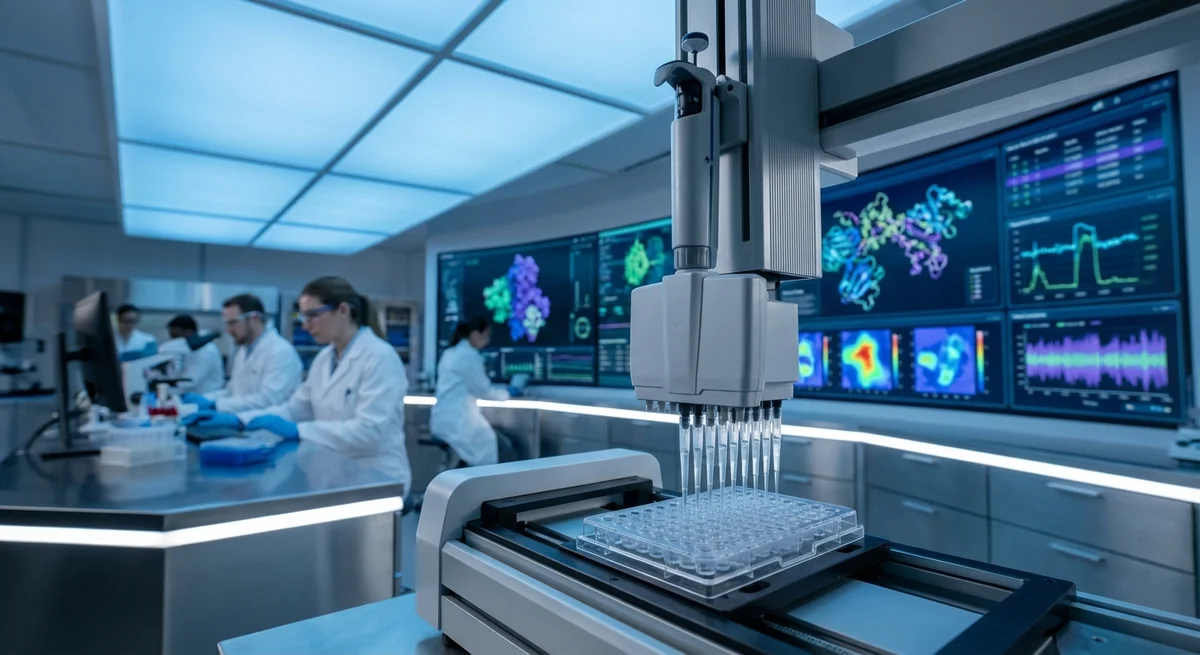
While we debate whether ChatGPT will replace programmers, a far more urgent question is being decided in the quiet laboratories of MIT and Harvard: how not to perish from a banal infection twenty years from now. Professor James Collins, a man who sees biology as a set of engineering problems, is convinced that without artificial intelligence we are doomed. But his approach differs from typical Silicon Valley optimism. He does not believe you can simply unleash a neural network on chemical libraries and get a miracle pill. What's needed is tight integration between code and living matter, which he calls "wet biology."
Traditional drug discovery is a lottery where a ticket costs a billion dollars and the draw lasts ten years. For decades, scientists sifted through thousands of compounds hoping to find the one that would work. Collins and his colleagues decided to change the rules of the game. They use AI not as a magic ball, but as a powerful accelerator of human intuition. However, the main problem they encountered is fuel quality. Neural networks learn from data, and biological data is often dirty, incomplete, or simply erroneous. If you feed an algorithm garbage, you get a perfectly designed poison instead of medicine on the output.
Collins emphasizes that the secret to success lies not in the complexity of the neural network architecture, but in the design of the experiments themselves. His team creates special platforms that generate massive arrays of data at industrial scale specifically for training models. This allows AI to find patterns where the human brain sees only chaos. For example, this is how galicin was discovered—a potent antibiotic that is radically different from anything medicine had used before. It kills bacteria that couldn't be tackled for decades, and does so so elegantly that microbes simply don't have time to develop defense mechanisms.
What does this mean for the industry as a whole? We are finally transitioning from an era of random discovery to an era of directed design. This is a fundamental shift.
Before, we were looking for a needle in an endless haystack; now we're building a giant magnet that pulls out all the needles we need by itself. But Collins rightly warns against excessive trust in raw numbers. Biological systems are incredibly complex, nonlinear, and often behave illogically.
A model may predict a perfect interaction on a computer screen, but in a living organism, a molecule might simply not reach its target or cause a cascade of side effects. That's why collaboration between IT specialists and field biologists has become a critical survival factor.
In the near future, the process of drug development will begin to resemble the work of a modern software company. First, a deep simulation is launched, then a rapid prototype on a robotic platform, instant iteration based on errors received, and a final product. This will reduce development time from years to mere months. But the main question remains open: are our regulators and bureaucratic apparatuses ready for such speed? After all, state mechanisms for drug approval often turn out to be much slower than the fastest and most rapidly mutating bacteria. We need to change not only microscopes to neural networks, but also the fundamental principles of how health institutions operate.
The bottom line: AI in medicine is not a replacement for a scientist, but a tool that allows us to finally play on equal terms with microbial evolution. Can we maintain this pace before the antibiotics of the past turn completely into useless chalk?
Want to stop reading about AI and start using it?
AI News is a curated feed of AI/tech news. Hamidun Academy teaches you to use AI systematically in your work.