AlphaGenome: DeepMind заставила «мусорную» ДНК говорить на человеческом
Google DeepMind выпустила AlphaGenome — систему для анализа не кодирующих белки участков ДНК. Долгое время их считали «мусорными», но именно они управляют работ
AI-processed from IEEE Spectrum AI; edited by Hamidun News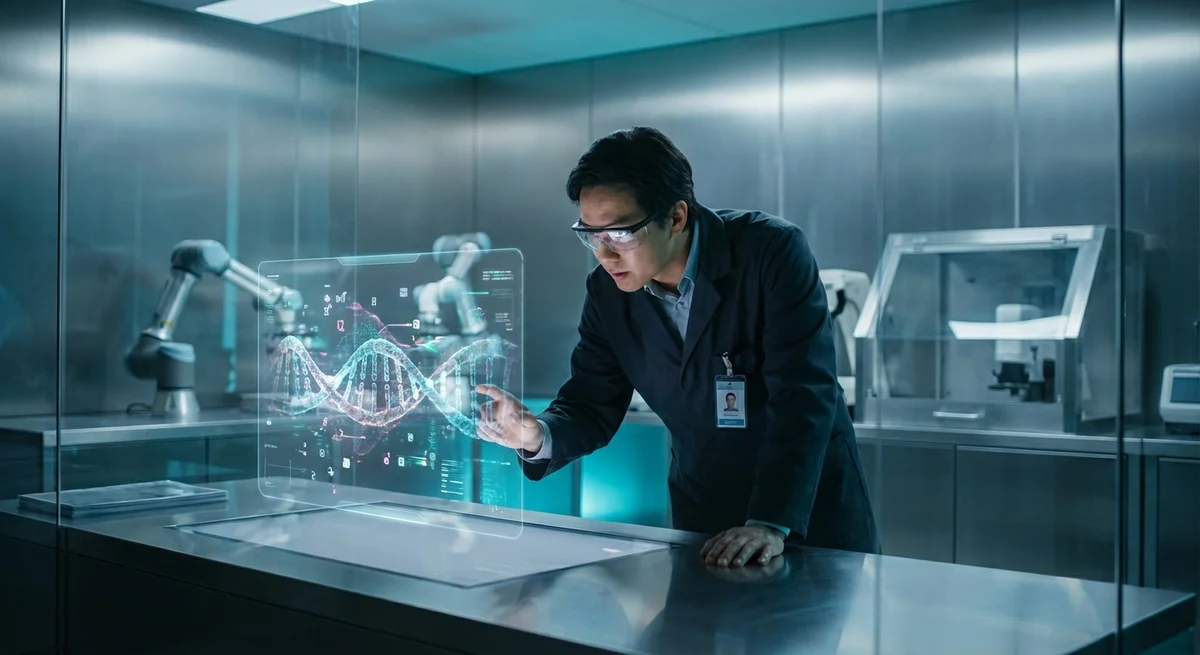
When AlphaFold predicted protein structure in 2020, the world was amazed, and its creators later won the Nobel Prize. But proteins are just the tip of the iceberg. Now Google DeepMind's team has decided to look into the "dark matter" of our organism. AlphaGenome is a new Swiss Army knife for working with that portion of DNA that for decades has been lazily called junk.
We're talking about 98% of the genome that doesn't directly code for proteins, but instead works as an extremely complex control panel. It decides when a gene should switch on, where it should stay silent, and where it should work overtime. Previously, scientists had to juggle dozens of different programs to understand how a single tiny mutation in this void affects cancer development or a rare disease. AlphaGenome replaces this software zoo with a single system that sees the whole picture.
The model was trained on raw DNA data, and now it can predict 11 types of biological signals. These include splicing (cutting genetic messages), DNA packaging density, and interactions between distant regions of the genome. The most impressive thing is the resolution. AlphaGenome can analyze sequences a million letters long without losing context, while still seeing changes at the single nucleotide level. It's like looking at a map of an entire city while seeing a crack on a specific brick.
Of course, there are nuances. Critics from Memorial Sloan Kettering note that the model still struggles with rare cell types, since it was trained on data from common tissues. Moreover, it tends toward false negatives — it's more likely to miss an important mutation than to raise a false alarm. But if AlphaGenome says there's a problem here, scientists can be almost certain about it. This saves months, and sometimes years of "wet" laboratory work.
Why does Google need this? Here we see clear business logic. DeepMind is building a vertically integrated platform for molecular biology. They have tools for predicting protein structure (AlphaFold), their mutations (AlphaMissense), designing new molecules (AlphaProteo), and now managing genes. This is no longer just scientific inquiry, but the foundation for a new industry of drugs created entirely "in digital."
Independent researchers from Japan have already confirmed AlphaGenome's success, using the model to verify the connection between sleep deprivation and neural activity. The AI confirmed their hypothesis, saving a lot of time on data validation. This transforms the tool from a theoretical toy into a real science accelerator.
The key point: DeepMind is finally transforming from a laboratory for playing Go into the chief architect of modern biology. Claude and GPT write texts, while Hassabis's models write the code of life itself. It remains to be seen when the number of these digital models will translate into the quality of real drugs in pharmacies.
Want to stop reading about AI and start using it?
AI News is a curated feed of AI/tech news. Hamidun Academy teaches you to use AI systematically in your work.