Google's Project Genie: Now Anyone Can Build Their Own Mario 64 (But Very Poorly)
Imagine waking up in a world where creating a new installment of a legendary franchise doesn't require hundreds of programmers, five years of development…
AI-processed from The Verge; edited by Hamidun News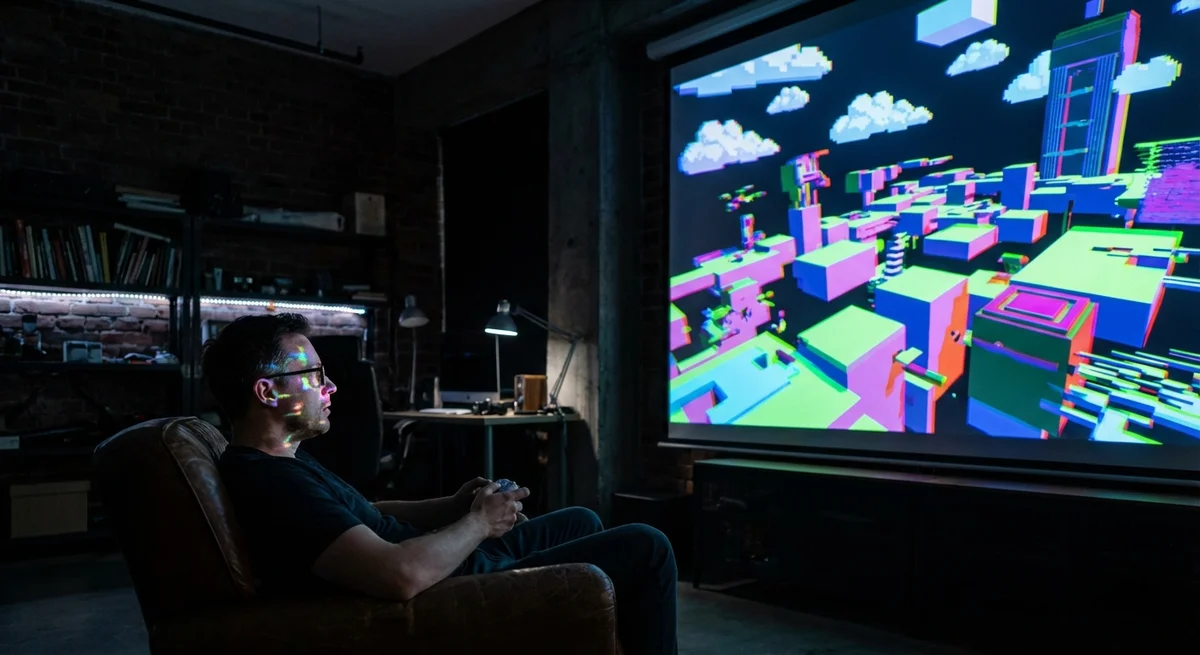
Imagine waking up in a world where creating a new installment of a legendary franchise doesn't require hundreds of programmers, five years of development, and a budget rivaling a small nation. All you need is to simply ask your computer. This week, Google DeepMind threw fuel on the fire of these tech fantasies by giving select testers a chance to try Project Genie—its new experimental tool that transforms text into something resembling interactive worlds. One lucky tester immediately decided to stress-test the system and made it generate clones of Nintendo hits. The result came out strange, occasionally terrifying, but incredibly important for understanding where the entire entertainment industry is heading.
Let's be honest: what Genie produces right now looks like a bad dream of a nineties gamer. When the neural network is asked to create something resembling Super Mario 64 or Metroid Prime, it dutifully renders three-dimensional landscapes that fall apart at the slightest attempt at interaction. In one example, two Links ran across the screen at once, and the physics of jumps evoked memories of the worst indie-horror games on Steam.
But the irony is that Google DeepMind wasn't even trying to make a perfect game. They're attempting to teach AI to understand the very essence of "game space." Unlike ordinary video generators, which simply predict the next frame, Genie attempts to simulate control and the world's reaction to user actions.
This isn't just a video stream—it's an interactive hallucination that you can control.
To grasp the scale of what's happening, you need to remember how modern games actually work. Usually, behind every bush in a virtual forest stands the labor of a modeler, and behind every character jump are thousands of lines of physics engine code. Project Genie takes a different path.
It was trained on massive amounts of video recordings of gameplay, essentially "peeking" at how the rules of virtual worlds operate. As a result, the neural network begins intuitively understanding that if a character presses the jump button, the camera should rise and the ground should fall away. It doesn't know Newton's laws; it simply knows that "that's how it usually works."
This is a fundamental shift in development approach: from rigid programming to learning from examples.
Of course, for now all this looks like a fun toy for meme generation. Image artifacts leak from every crack, objects materialize out of nowhere, and controls feel sluggish as in thick jelly. However, it's worth remembering what the first image generators looked like just a couple of years ago.
Those very "six-fingered monsters" transformed into Midjourney's photorealistic masterpieces practically overnight. If development speeds hold, in a year or two Genie will be able to produce not crooked sketches but quite playable levels. And that's when the lawyers at Nintendo and other major publishers will get a real headache.
How do you protect intellectual property for a visual style when a neural network creates "not-Mario" on the fly based on nothing but a text description?
For the game development industry, this means the beginning of the end for the era of traditional engines like Unreal or Unity in their current form. Why manually tweak lighting and collisions when you can train a model on the best examples and let it generate endless variations of levels on the fly? This opens the path to absolutely personalized content. Imagine a game that adapts to your fears, preferences, and skill level, creating new rooms and enemies right at the moment you open the next door. This is no longer just a game—it's an endless series where you are both the screenwriter and the main character and the sole viewer.
The bottom line: Google has shown that AI is ready to move beyond text and static pictures. We stand on the threshold of an era of "dynamic worlds," where the line between watching video and playing a game will finally blur. Will the industry be able to digest such a technology, or are we facing an ocean of low-quality procedural garbage?
Want to stop reading about AI and start using it?
AI News is a curated feed of AI/tech news. Hamidun Academy teaches you to use AI systematically in your work.