DingTalk в Пекине: китайский бизнес перестал играть с нейросетями и начал на них зарабатывать
На пекинском саммите DingTalk стало ясно: эра пустых обещаний в AI закончилась. Платформа Alibaba собрала десятки компаний для массового внедрения AI-агентов в
AI-processed from Jiqizhixin (机器之心); edited by Hamidun News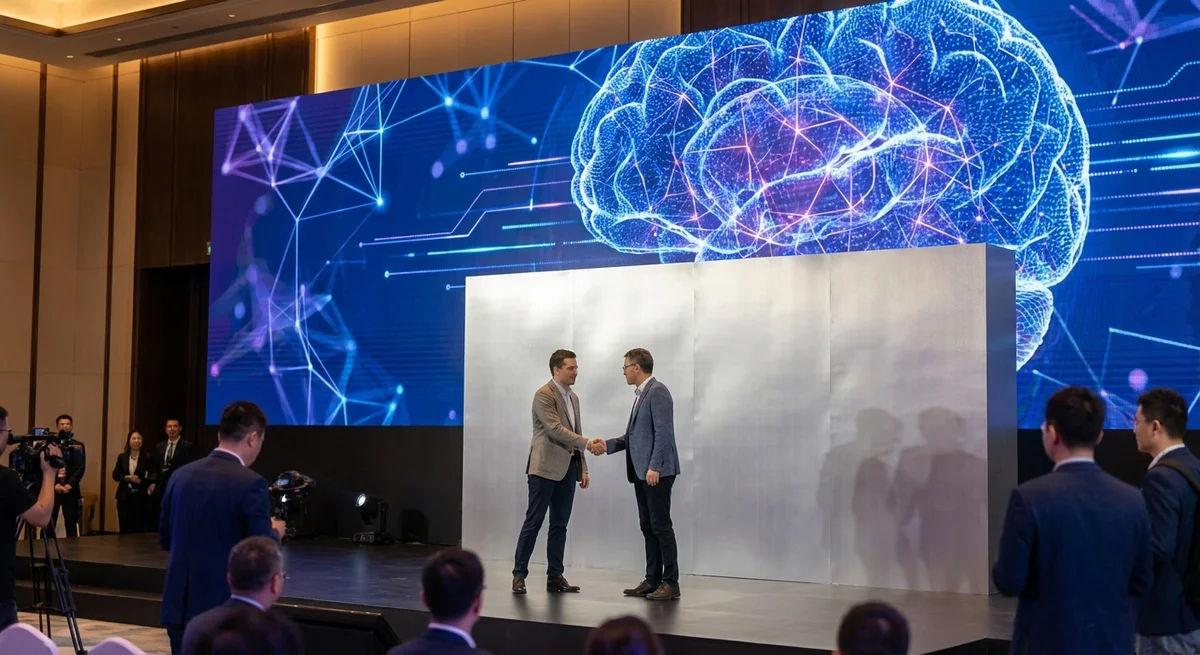
While the whole world watches with bated breath as OpenAI and Google measure their model parameters in benchmarks, in China something is happening that all of this was meant to achieve — AI has finally gone to work on factories, in logistics centers and government structures. At the recent DingTalk summit in Beijing, it became clear once and for all: the era of "look, our bot can write poetry" is officially closed. Now contracts, deep integrations and the real economy are in fashion.
If neural networks used to be a toy for geeks, today they are the foundation for a new operating system of business. DingTalk, which once started as a simple corporate messenger from Alibaba, has over the past year traveled a path that many Western counterparts are only planning. They transformed the platform into a habitat for artificial intelligence.
At the Beijing event, the company didn't just show beautiful slides, but brought representatives of dozens of enterprises to the stage. These companies aren't just "testing" technologies, they have already implemented AI agents into their work workflows. This is an important shift: from a chat where you ask questions to an agent that performs tasks on its own within a corporate ecosystem.
Why does business need this? Previously, implementing neural networks in a large enterprise was like trying to attach a rocket engine to a cart. It was expensive, complicated, and completely unclear how it would pay off.
DingTalk offered a different path: ready-made infrastructure where any company can assemble its own "digital employee" for a specific task — whether it's automating a legal department or quality control on an assembly line. And judging by the mass signing of contracts, Chinese business appreciated this pragmatic approach. They don't need "general intelligence," they need a tool that will reduce costs here and now.
It's interesting to observe how the rhetoric is changing. A year ago everyone was discussing model "hallucinations" and risks to humanity, but now in Beijing people were talking about the cost of a single API request, data processing speed, and the percentage of routine automation. The Chinese AI market is now in a phase of hard landing on real ground.
And DingTalk is acting as the main conductor here. They are not trying to create "the smartest AI in the world" in a vacuum, they are creating the most useful interface for those who are used to counting money. This is "AI-first" strategy in action, where technology becomes invisible, woven into familiar work processes.
This is a serious challenge for global players. While Microsoft is trying to make us use Copilot in Word, DingTalk is integrating AI into processes we don't even think about — from supply chain management to urban resource distribution. This isn't about "smart advice," it's about delegating responsibility to algorithms.
When dozens of companies simultaneously sign agreements on implementation, it's no longer an experiment, but a new industry standard. Chinese companies are effectively creating a marketplace of ready-made solutions where knowledge from one industry can be quickly packaged into an AI agent and scaled to others. Of course, skeptics can say that behind loud words about "digital transformation" there is often ordinary automation, which we have seen before.
But the difference is fundamental: current tools based on large language models (LLM) allow you to do this many times faster and, more importantly, they can work with unstructured data that was previously "invisible" to computers. DingTalk democratizes access to these technologies for medium-sized businesses, offering them ready-made templates instead of months of expensive development from scratch. The future has arrived not in the form of terminators, but in the form of boring, but damn effective algorithms in your work messenger.
The key point: China has stopped playing catch-up in the number of model parameters and switched to capturing the market of applied solutions. DingTalk clearly showed that the future of AI is not a separate website with a chatbot, but an invisible layer inside software that simply does the work. Will Western corporate platforms be able to offer something equally large-scale, or will they remain just windows for correspondence?
Want to stop reading about AI and start using it?
AI News is a curated feed of AI/tech news. Hamidun Academy teaches you to use AI systematically in your work.