Нейросети на коллайдере: ИИ ищет физику, которую мы не заказывали
Большой адронный коллайдер (LHC) столкнулся с интеллектуальным застоем: Стандартная модель физики слишком хороша, и за последние десятилетия серьезных прорывов
AI-processed from IEEE Spectrum AI; edited by Hamidun News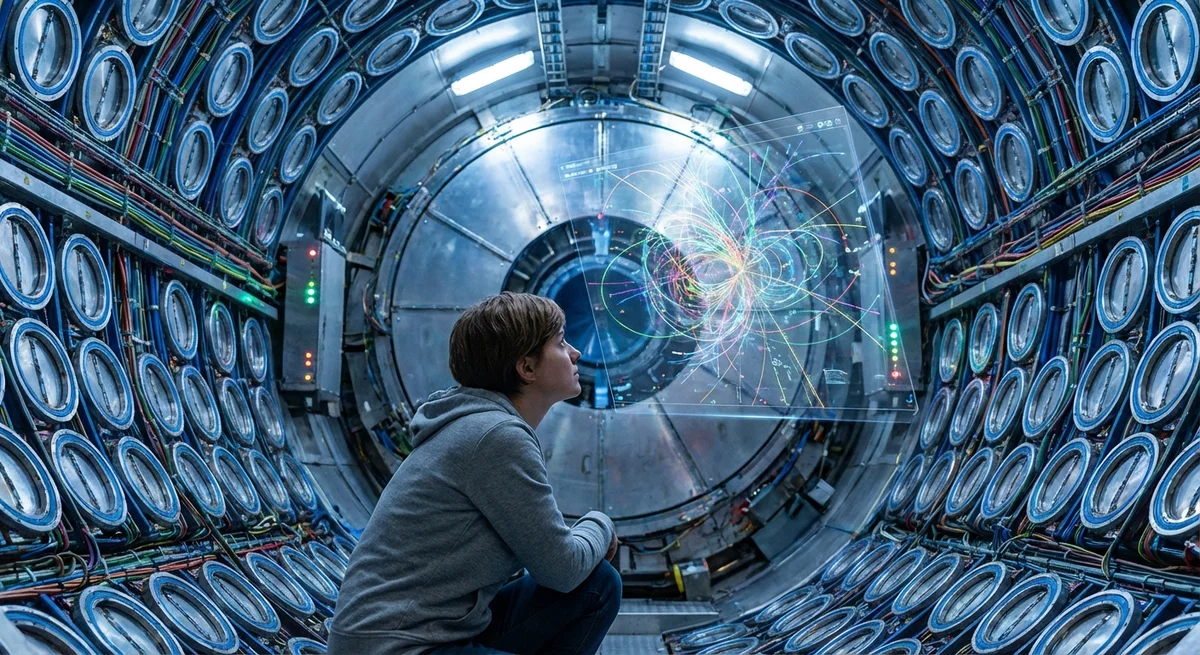
Imagine you've built the most expensive and complex device in human history — a 27-kilometer ring straddling the border between France and Switzerland — and it stubbornly confirms only what you've known for fifty years. This is exactly the situation physicists found themselves in with the Large Hadron Collider. The Standard Model, which describes how our world works, turned out to be frighteningly accurate.
It predicts the properties of particles to parts per trillion, but leaves the main questions unanswered: what is dark matter, where did antimatter go, and why do neutrinos have mass at all. It's as if we're stuck in a perfectly clean room where everything is neatly organized on shelves, but we know for certain that behind the wall lies an entire warehouse of unstudied junk.
For a long time, scientists searched for specific things. For example, supersymmetry — a theory that promised an entire zoo of new heavy particles. When the LHC started up in 2008, young graduate students were convinced that supersymmetry would literally "jump in their faces" in the first year of operation. Eighteen years have passed, and the enthusiasm has died down. We searched for what we expected to find, and found nothing. Now particle physics is taking a different path, where instead of human intuition and preconceived theories, artificial intelligence steps in — AI trained to search for "just something strange."
The key tool here is unsupervised learning, specifically autoencoders. In industry, they're used to detect hacker attacks: a neural network studies normal traffic, compresses it, and tries to reconstruct it. If traffic suddenly changes, the algorithm can't reconstruct it correctly and raises an alarm. Physicists decided: let's replace the computers in the network with elementary particles. We feed the AI data about typical collisions, and when something flies through the detector that the neural network can't "recognize" and compress, it marks it as an anomaly. This allows us to search for physics beyond the Standard Model without having even a rough idea of what it should look like.
The problem is that there's too much data. The collider produces 40 million collisions per second. It's impossible to save such a volume of information — the disks would simply burn out. So decisions about what to keep and what to discard must be made instantly. This is where "hardware" comes in. Scientists from MIT and Fermilab learned to pack neural networks into FPGA chips (field-programmable gate arrays). These systems analyze events in 80 nanoseconds. That's faster than the human brain can even become aware of a flash of light. We're literally creating a "digital genius" that sees the world differently and filters reality in search of cracks in the fabric of the universe.
But even the smartest algorithm is a risk. In the history of physics, there have already been cases of "Oops-Leon" (false discoveries), when statistical fluctuations were mistaken for new particles. Physicists are a cautious people: to claim a discovery, the probability of error must be less than one in 3.
5 million. AI might find an anomaly that turns out to be just noise in the detector or a poorly connected cable. So the neural network here doesn't replace the physicist, but works as a scout.
It says: "Hey, take a look in this corner, something weird is happening here." And then the person with pencil and chalk has to decide whether it's a Nobel Prize or just a faulty sensor.
Ahead of us lies the DUNE project — a giant neutrino detector that will catch ghost particles flying through 1,300 kilometers of rock. There AI will sift through 5 terabytes of data per second searching for traces of supernovae or proton decay. We've finally admitted that our theories can be glasses that not only help us see, but also blind us, hiding colors we're not used to. Perhaps the next great truth about the Universe will be discovered not by a new Einstein, but by an algorithm that simply wasn't told that searching for "impossible" particles isn't done.
Key takeaway: Physics is shifting from testing theories to machine-based anomaly hunting. If the Standard Model falls, it will most likely be under the assault of algorithms working at nanosecond speeds.
Want to stop reading about AI and start using it?
AI News is a curated feed of AI/tech news. Hamidun Academy teaches you to use AI systematically in your work.