ИИ-пузырь и $38 триллионов долга: почему Великая депрессия покажется разминкой
Мир замер в ожидании идеального шторма. Пока госдолг США пробивает отметку в $38 триллионов, технологический сектор делает ставку на ИИ как на последнюю «серебр
AI-processed from Habr AI; edited by Hamidun News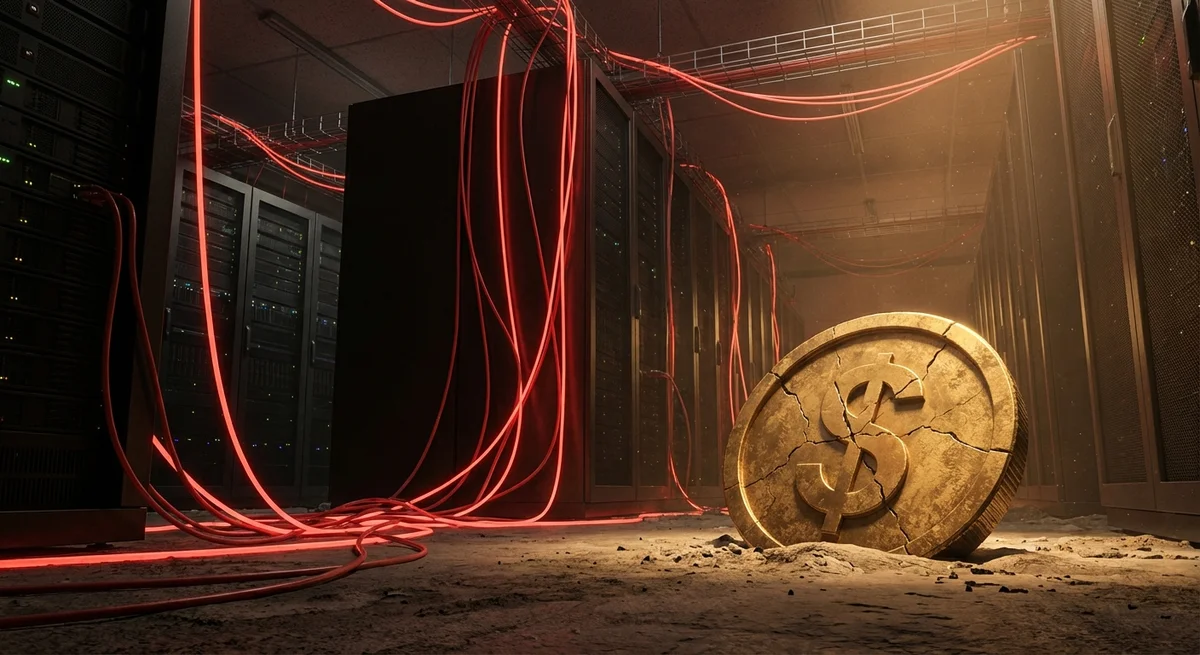
While you discuss the new version of ChatGPT or argue about whether AI will replace your designer, the global financial system is slowly but steadily sliding into an abyss. The depth of this pit is hard to even imagine today, but the numbers speak for themselves. US national debt of 38 trillion dollars sounds like an abstract figure from an astronomy textbook, but for the world economy it's quite a tangible noose. We're used to thinking that progress is linear—something that always works out—but now we stand at a threshold where old rules stop working and new ones haven't even been drafted yet.
Remember 2008, when the housing market collapse nearly brought down the entire planet. Back then, the scale of the problem seemed catastrophic, but today we're dealing with systemic decay of the entire dollar architecture. And here's where artificial intelligence enters the stage. For many investors and governments, AI has become that last straw they're grasping at to justify endless money printing and inflated valuations of tech giants. Silicon Valley is gripped by a dangerous optimism bordering on religious fanaticism: the belief that if AI automates everything, labor productivity will skyrocket, and humanity will simply "grow out of" its debts through explosive GDP growth.
It's a beautiful fairy tale, pleasant to hear at conferences, but reality looks far grimmer. So far, artificial intelligence consumes billions of dollars buying graphics cards and paying electricity bills, without generating comparable profits in the real economy. We're witnessing a classic bubble of expectations. We're investing in a future that may never arrive if the financial foundation collapses before GPT models learn to actually run factories and optimize logistics without human involvement. The dot-com crash in 2000 taught us that even the most promising technologies are not immune to market gravity.
The institutions that have guaranteed us stability for decades are visibly losing credibility. We see the world fragmenting as countries seek alternative payment methods, fearing the toxicity of the main reserve currency. This isn't just another market crash cycle—it's a tectonic shift of power. When influence passes from one set of hands to another, it rarely happens without global upheaval. The Great Depression of 1929 was a painful lesson, but at least the world had an understandable gold standard and industrial capacity. Today we're trying to rebuild the foundation in the middle of a massive earthquake, hoping that algorithms will show us the right way.
What does this mean for ordinary people and the tech industry as a whole? First and foremost, that blind faith in a "technological miracle" can cost very dearly. AI will indeed change the world—there's no doubt about it—but it cannot override the basic laws of mathematics and economics. If a system is built on debt that is physically impossible to repay, no neural network will conjure real wealth from thin air. We're entering a zone of turbulence where the main asset will not be the number of zeros in your account, but ownership of real technologies, computational power, and resources.
The bottom line: Will AI be a lifeline or the final stone that drags the world economy to the bottom due to overheated expectations? For now, it looks like we're being prepared for a grand reset that most market players are simply not ready for.
Want to stop reading about AI and start using it?
AI News is a curated feed of AI/tech news. Hamidun Academy teaches you to use AI systematically in your work.