Port Ningbo Stakes on Millions: How AI Digests Global Exports
Порт Нинбо опубликовал прогнозы на начало 2026 года: ожидается рост контейнерного оборота на 9.5%, что составит внушительные 5.03 млн TEU. Для индустрии это важ
AI-processed from 36Kr (36氪); edited by Hamidun News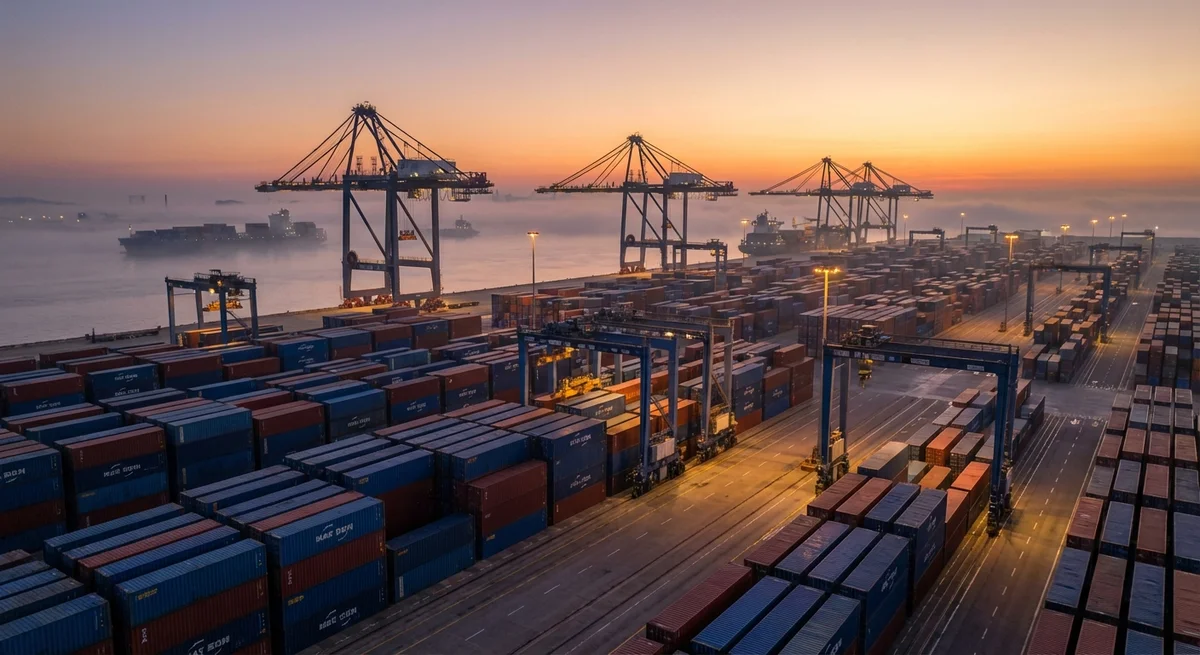
When we talk about five million containers in a single month, human imagination typically falters. Try to picture endless rows of steel boxes that need not just to be moved, but elegantly scheduled across hundreds of ships, railways, and trucks.
Ningbo Port, one of the planet's largest logistics hubs, declares it is ready for such a challenge. The forecast for January 2026 of 5.03 million standard containers (TEU) is not merely dry statistics, but a declaration of technological superiority. Growth of 9.5% amid global instability looks almost defiant.
Why does this matter right now? We are at a point where traditional port management methods have reached their physical limit. A dispatcher, surrounded by radios and monitors, is no longer able to effectively navigate chaos of this magnitude.
Ningbo-Zhoushan has been actively implementing the "smart port" concept for several years now. Here, every crane movement and every route of an unmanned cargo vehicle (AGV) is calculated by an AI-based system. The increase in throughput by almost ten percent means that optimization algorithms have become even more efficient, allowing the reduction of vessel idle time at anchorage to a minimum.
The context here is deeper than it appears. After the crises of recent years, global supply chains have become jerky and unpredictable. China is responding to this with hyper-automation. In Ningbo, they are actively implementing "digital twins" of the entire port, which model loading scenarios in real time. This allows the system to understand in advance where a "bottleneck" will emerge, even before the first container ship appears on the horizon.
If the forecast of 112 million tons in total cargo throughput is confirmed, it will be the best proof that AI-logistics is not a marketing term, but the only way to survive in the modern economy.
What does this mean for us? First, it's a signal to the hardware market. Servicing such capacities requires thousands of sensors, cameras with computer vision, and powerful server nodes right at the edge (edge computing). Second, it's a blow to automation skeptics. If Ningbo processes 5 million boxes without an army of human coordinators, then ports in Europe and the USA will find themselves in the role of laggards, stuck in the past century with their strikes and human factor.
The irony is that while the world debates AI safety, Ningbo simply hands it the keys to its gates. Analyzing these figures, you understand that the battle for AI leadership today is fought not just in chatbots, but on the docks. Port efficiency directly converts to the cost of goods on store shelves around the world. Chinese engineers are betting that code can be more reliable than unions and more experienced than old captains. And judging by the growth dynamics, they have not miscalculated.
The key question: Can Western logistics infrastructure answer this digital challenge, or will Ningbo remain an unreachable benchmark for autonomy?
Want to stop reading about AI and start using it?
AI News is a curated feed of AI/tech news. Hamidun Academy teaches you to use AI systematically in your work.