Hongfuhan and 480 Million: How Robots Capture Chinese Giants' Budgets
Пока индустрия обсуждает софт, китайская Hongfuhan переходит к тяжелому «железу». Компания подписала контракт с Guangdong Quanxiang на 480 млн юаней. Сумма впеч
AI-processed from 36Kr (36氪); edited by Hamidun News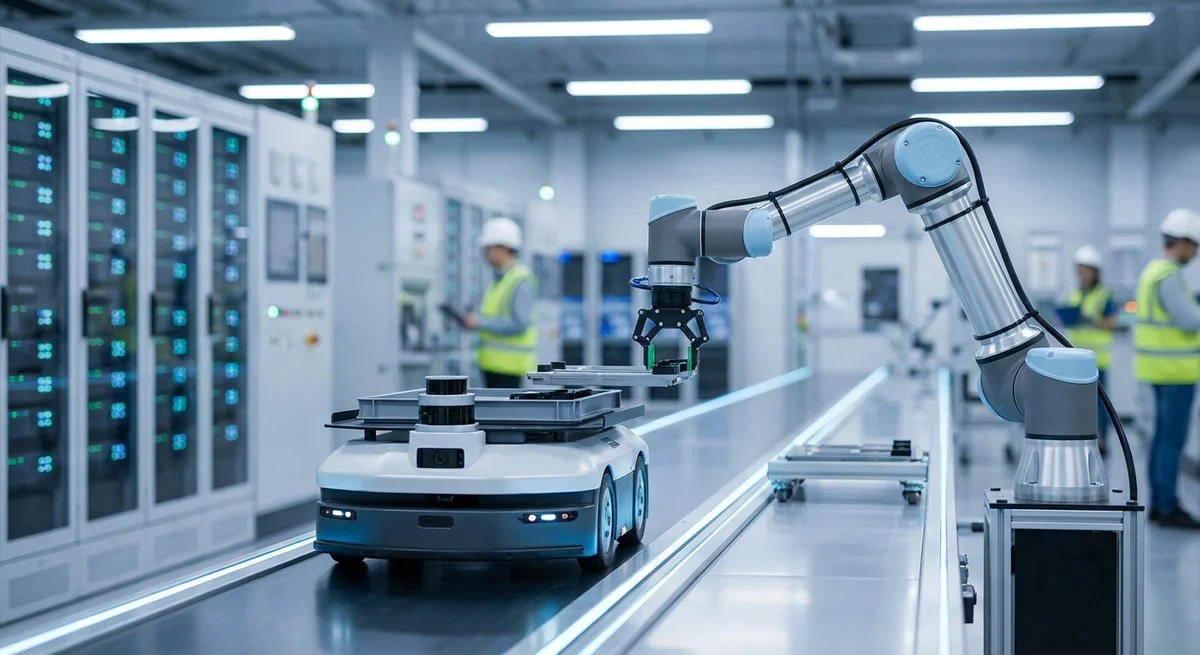
Imagine you're running a business, and a single phone call secures your work for a year ahead, closing more than half of all your financial plans. This is exactly what happened to Chinese company Hongfuhan. While Western startups are burning venture millions trying to teach neural networks to draw fingers, Eastern players are methodically building factories with physical embodiments of intelligence.
A 480 million yuan (approximately 66 million dollars) deal with Guangdong Quanxiang and Jiangxi Xiexun is not just a fortunate sale, but a strategic all-in bet in the real production sector. Let's break down what Guangdong Quanxiang is actually buying. The list includes not only the familiar robotic manipulators, but also more complex systems.
We're talking about mobile transport robots, collaborative robots that can work alongside humans without risk of injury, and even specialized forklifts powered by new energy sources. But the most interesting details lie in the supply of AI servers (AI). This suggests that the customer is building not just an automated warehouse, but a full-fledged "smart" hub, where computational power and execution mechanisms are linked together.
Context is more important than numbers here. Hongfuhan remained in the shadow of larger competitors for a long time, but this contract, which represents 59.68% of their audited revenue for 2024, changes everything.
In the industry, such deals are called "transformative." The company is essentially moving from the league of component suppliers to the premier league of integrators of comprehensive smart manufacturing solutions. This is happening against the backdrop of a general trend in China toward replacing human labor in logistics and heavy industry, where demographic challenges are becoming increasingly acute.
Why does this matter right now? We are seeing how the concept of AI descends from the clouds to the concrete floor of factory workshops. The three-party cooperation agreement implies not just buying and selling, but joint technology development.
This means Hongfuhan gains access to real operational data at major facilities, allowing them to refine their modules and core components in real time. In a world where Nvidia dominates model training, companies like Hongfuhan are building the infrastructure where these models will generate real profit. Of course, such dependence on a single contract has its downside.
Any hiccup in the supply chain or financial difficulties at Guangdong Quanxiang could hurt Hongfuhan's stock hard. However, in the current reality of China's tech sector, where the government actively subsidizes robotics implementation, this risk appears justified. The company is essentially buying itself a place in the future, where factories operate around the clock without human involvement, and servers manage logistics without the slightest delay.
This is not a revolution announced in a press release, but a quiet expansion of machines, backed by very serious money. The key point: Hongfuhan is betting on physical AI and scale. Will they be able to digest such a volume of orders without losing quality, or will we witness the birth of a new industrial automation giant?
Want to stop reading about AI and start using it?
AI News is a curated feed of AI/tech news. Hamidun Academy teaches you to use AI systematically in your work.