Hardware Decides Everything: How Chinese Chips and Servers Accelerated the Stock Exchange
Индекс ChiNext подскочил более чем на 2%, потянув за собой весь технологический сектор Китая. Главными драйверами стали не абстрактные стартапы, а производители
AI-processed from 36Kr (36氪); edited by Hamidun News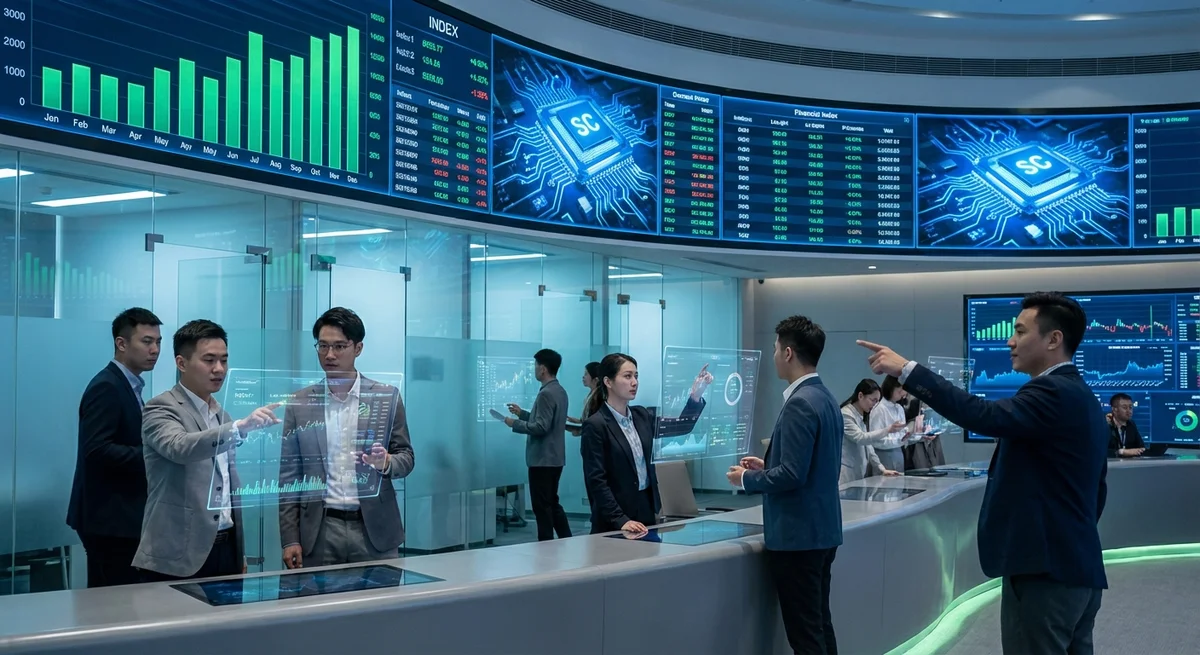
The Chinese market today reminded the world that behind every "smart" algorithm stand quite tangible silicon wafers and endless racks of servers. The ChiNext index, often called the Chinese answer to Nasdaq, surged upward by more than 2%. This is not merely a statistical error or a short-term rebound after prolonged stagnation.
It is an important indicator of where money actually flows in the context of the global AI arms race. While Western analysts debate model safety, Chinese investors are buying up manufacturers of physical infrastructure. At the center of attention are producers of computing equipment and memory chips.
If you follow the industry, you understand that without quality memory and powerful server solutions, any neural network remains merely a collection of code strings on GitHub. Chinese players seem to have finally grasped a simple truth: while software giants battle for user attention and subscriptions, real profits will be captured by those who supply the shovels for this digital gold rush. Hardware has become sexy again, and this is changing the power balance on Asian exchanges.
It is interesting to observe how rapidly the focus is shifting. A year ago in Beijing and Shenzhen, everyone discussed which local GPT analog would hit first and whether it could understand the nuances of Chinese dialects better than Western competitors. Today, the market is voting for infrastructure.
The rise of the ChiNext index was accompanied by growth in quotations of nearly 4,400 companies. This is a large-scale movement that even touched the photovoltaic sector. This makes sense, because enormous data centers require a colossal amount of energy.
Green energy and artificial intelligence now go hand in hand, and the Chinese market understands this connection better than many others. Why did this surge happen right now? First, China's state policy on achieving technological sovereignty is beginning to bear fruit.
Local hardware producers for computing receive not only generous subsidies but also guaranteed demand from domestic tech giants, for whom it is becoming increasingly difficult to purchase equipment in the West. Second, the chronic deficit of memory chips on the global market forces large businesses to seek alternatives within the country. When supplies from market leaders are restricted by regulators, investors look at those ready to fill the vacant niche, even if with some technological lag at the start.
The situation on Shanghai and Shenzhen exchanges confirms the general trend. Growth of 0.54% and 1.
42% respectively looks modest against the backdrop of the tech ChiNext surge, but still points to an overall improvement in sentiment. The market has stopped fearing regulatory risks from past years and focused on fundamental indicators of the technology sector. This is an important signal for global players: Chinese tech is not merely alive, it has regrouped and is preparing for a long siege, relying on its own production capacity.
If we look deeper, we see the formation of a completely closed ecosystem. China is building a foundation where memory chips, computing nodes, and renewable energy create a base for the next breakthrough in large language models and autonomous systems. This is not merely a play on stock quotes, it is a large-scale survival strategy in conditions of technological isolation.
And judging by today's figures, the market is betting that this strategy will prove successful in the long term. The bottom line: China has finally stopped playing light software startups and moved to building heavy AI infrastructure. Will local hardware be able to reach parity with Western analogs before investors run out of patience?
Want to stop reading about AI and start using it?
AI News is a curated feed of AI/tech news. Hamidun Academy teaches you to use AI systematically in your work.