Chinese market at 2 trillion: algorithms take over Shanghai and Beijing exchanges
Совокупный торговый оборот на биржах Шанхая, Шэньчжэня и Пекина снова пробил отметку в 2 триллиона юаней. Несмотря на символическое снижение на 24,9 млрд по сра
AI-processed from 36Kr (36氪); edited by Hamidun News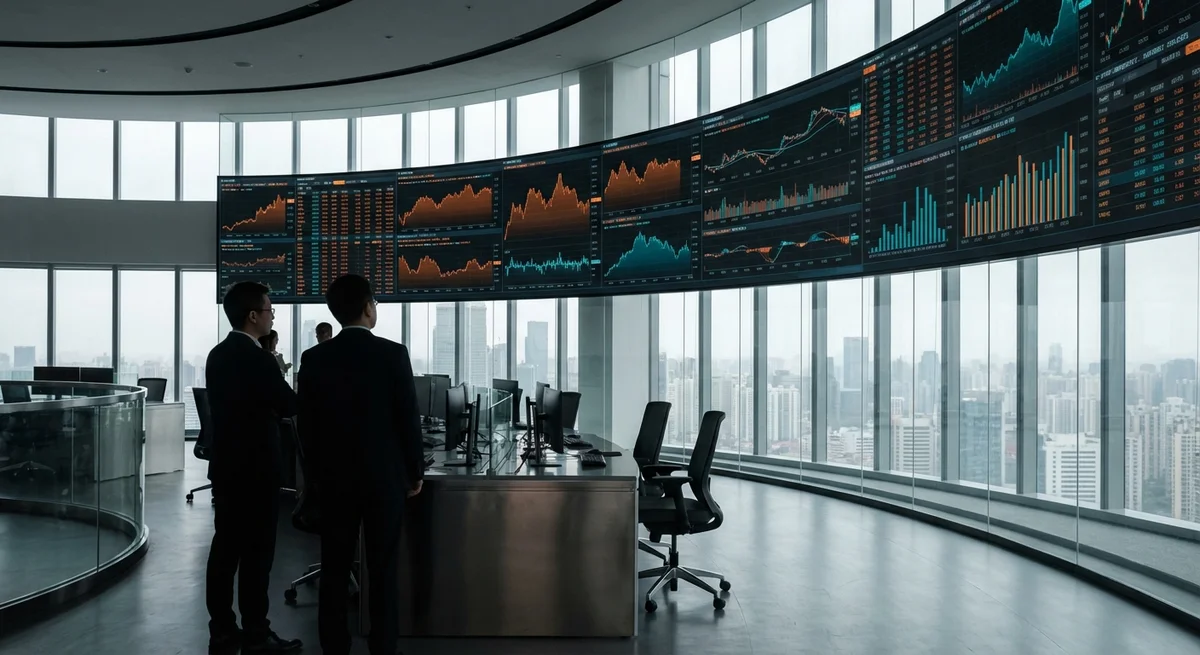
While you were sipping your morning coffee, Chinese server farms processed the budget of an average European country. The combined trading turnover on the three main platforms of the Middle Kingdom — Shanghai, Shenzhen, and Beijing exchanges — once again exceeded the 2 trillion yuan mark. Even a slight "cooling" of 24.
9 billion compared to the previous day doesn't change the overall picture: the Chinese stock market has become a giant sandbox for artificial intelligence. When figures reach such scale, live traders become spectators, and the real battle unfolds between algorithms. To understand the context, you need to recall what has been happening in China over the past months.
The government is actively injecting liquidity, while investors are frantically searching for where to place capital against the backdrop of the real estate slump. But the most interesting thing is hidden under the hood of these trades. A huge share of this turnover is generated by high-frequency robots and deep learning-based systems.
China is currently experiencing a real boom in "quantum" funds that use transformer models to analyze sentiment on social networks and instantly execute trades. These systems are trained to react to every word in state media faster than a human can blink. Why is this important right now?
First, it's a colossal strain on national infrastructure. Processing such transaction volumes requires incredible computing power. Given sanctions on Nvidia chip supplies, Chinese companies have to squeeze the maximum out of domestic hardware.
Every such trading day is a hidden stress test for local graphics accelerators and data transmission systems. If the infrastructure can handle 2 trillion, it means Chinese tech stack is ready for serious loads not only in finance, but also in state AI governance. Second, such volatility and volumes create an ideal environment for training new models.
Data on the behavior of millions of retail investors at peak trading moments is "digital oil" for LLM developers. Companies like Baidu and Alibaba carefully monitor these patterns to integrate financial predictions into their ecosystems. We are seeing how the financial sector is becoming the main customer and at the same time a testing ground for the boldest ideas in automation.
However, this medal has a flip side. Mass use of identical algorithms can lead to a domino effect. If one model decides it's time to lock in profits, the rest can follow in the same second.
A slight reduction in trading volume of 24.9 billion may be a sign that algorithms are starting to "be cautious," probing a new level of resistance. In any case, China's market right now is the most dynamic place on the planet where technology and big money have merged in ecstasy.
The bottom line: China has definitively put its finances on the rails of AI-management. Will algorithms be able to keep the market from overheating, or will we witness the fastest digital crash in history?
Want to stop reading about AI and start using it?
AI News is a curated feed of AI/tech news. Hamidun Academy teaches you to use AI systematically in your work.