Longdianjing: when AI stopped being a diagnostician and picked up a needle
Китайская компания Longdianjing совершила важный прорыв: их навигационный робот для чрескожной пункции получил лицензию медицинского изделия третьего класса (NM
AI-processed from 36Kr (36氪); edited by Hamidun News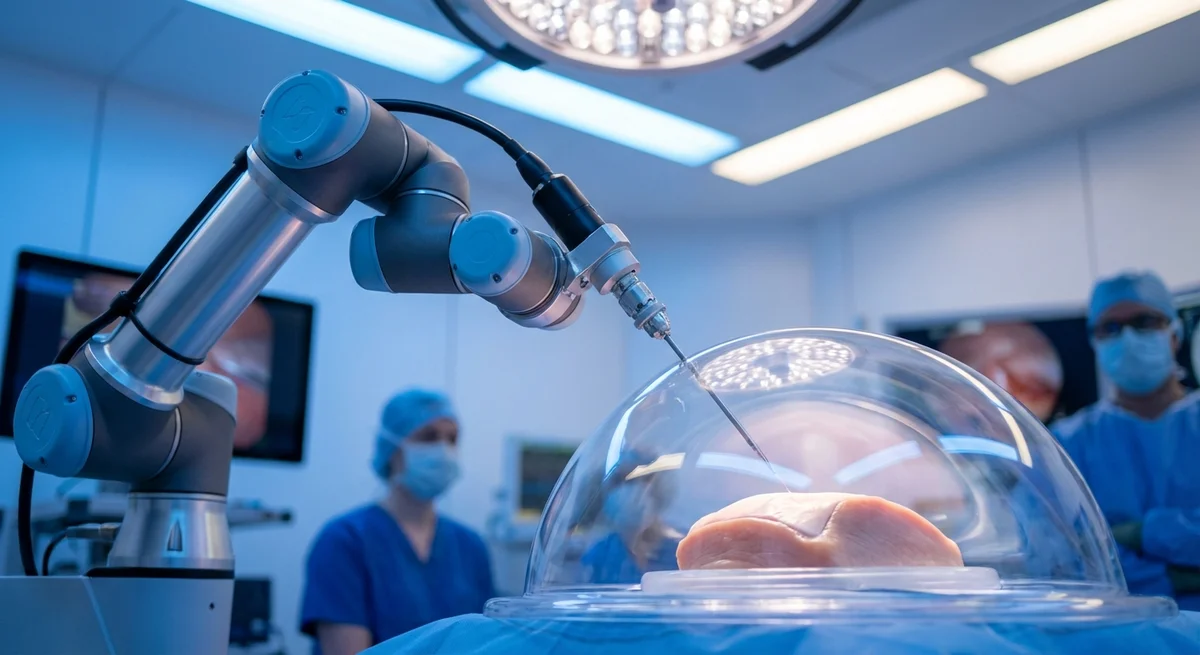
For a long time, artificial intelligence in medicine resembled a very erudite but extremely lazy intern. He could spend hours examining MRI images, finding suspicious spots and giving advice, but as soon as it came to a real scalpel or needle, AI would politely step aside. The situation has changed.
This week, it became known that Chinese company Longdianjing from Wuhan received the "green light" from the National Medical Products Administration (NMPA) to use its navigation robot for percutaneous puncture. This is not just another license; it is official recognition that algorithms are ready for physical contact with a patient in the operating room. To understand the scale of the event, you need to understand what a Class III license means in China.
This is the highest category of complexity and risk. Getting it for software based on deep learning is like going through an obstacle course in fire. The regulator confirmed that the Longdianjing system can not only draw beautiful pictures on a monitor, but act as a highly precise navigator during invasive procedures.
This is percutaneous puncture—a method where through a tiny skin puncture, a needle must be delivered precisely to the target, whether it's a tumor for biopsy or an area for drug injection. The problem is that everything inside a person moves: the patient breathes, the heart beats, tissues shift. It's difficult for a human to account for all these variables in real time, but AI can handle this in milliseconds.
This robot marks a fundamental shift in the industry. We are witnessing a transition from "diagnostic assistance" to "therapeutic assistance." If neural networks previously helped doctors not miss cancer in an image, now they help physically extract or destroy that cancer.
At Longdianjing, they emphasize that their host system combines deep learning software with the mechanical precision of robotics. Essentially, this transforms a complex operation whose outcome previously depended on the steadiness of a particular surgeon's hand and his experience, into a standardized technological process. This is a classic example of how AI democratizes quality medicine: now high-tech medical care can be accessible not only in top Beijing clinics, but also in regions where there is a shortage of star surgeons.
China is acting aggressively and consistently in this regard. While the world community debates whether to trust algorithms with patient lives, Chinese companies, with state support, are producing real-world application cases. The Wuhan technology hub is becoming a kind of testing ground for such solutions.
It is important to understand that Longdianjing is not just a "gadget," but a complex software-hardware system that was trained on thousands of clinical cases. The irony is that the robot doesn't replace the doctor; it makes him a "superhuman," eliminating the fatigue factor and hand tremor. What does this mean for the market?
First, it's a signal to Western giants like Intuitive Surgical that competition in the surgical robot segment is shifting toward software and adaptive intelligence. Second, we are entering an era where the phrase "a robot operated on me" stops being a science fiction plot and becomes a line in an insurance policy. The only question is how quickly trust in such systems will become widespread.
In China, it seems, they decided not to wait for decades and began integration right now, turning "smart diagnostics" into "smart action." The main point: AI has officially stopped being just a spectator in the operating room. Is the world ready for needle accuracy to now be the responsibility of a neural network rather than a doctor's years of experience?
Want to stop reading about AI and start using it?
AI News is a curated feed of AI/tech news. Hamidun Academy teaches you to use AI systematically in your work.