Simier: How Chinese Startup Puts Apple and BYD on "Sensing" Chips
Китайский стартап Simier привлек сотни миллионов юаней на разработку чипов нового поколения. Пока все обсуждают облачные LLM, команда из Шанхая внедряет техноло
AI-processed from 36Kr (36氪); edited by Hamidun News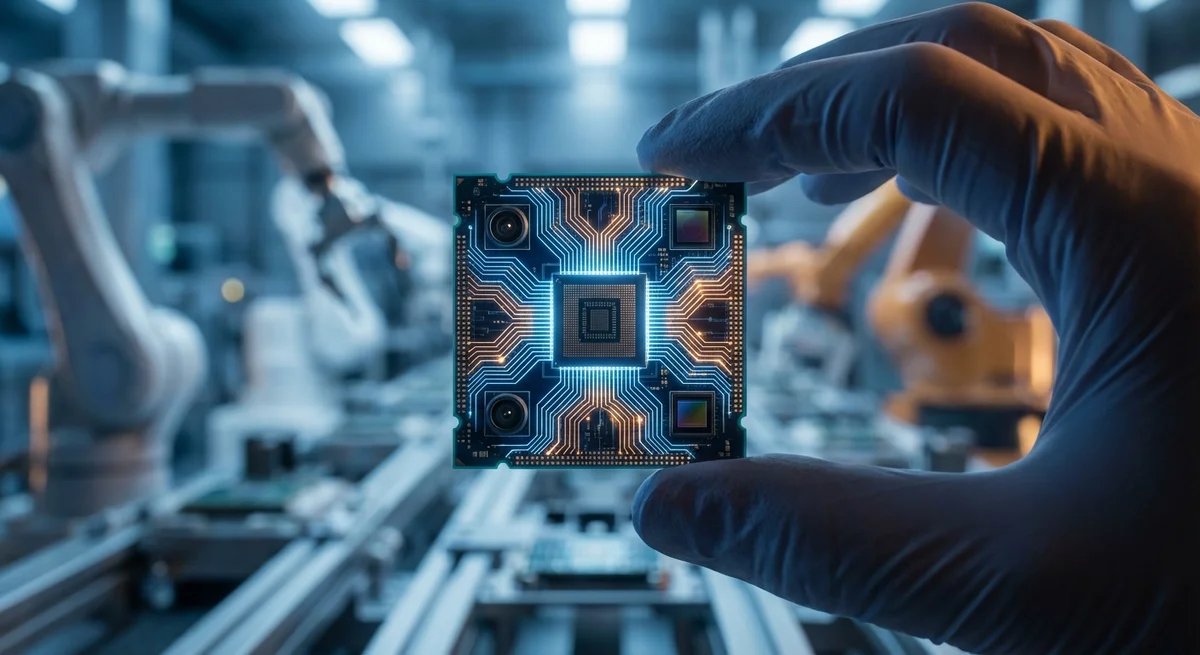
While the world watches mesmerized as chatbots exercise their verbal prowess, a quiet but far more fundamental revolution is unfolding in the shadow of giant server farms. Shanghai startup Simier recently closed Series A and A+ rounds worth hundreds of millions of yuan, and this is one of those cases where dry investment figures mask a real threat to Western architectural dominance. These guys are taking aim at the sacred—the von Neumann architecture, which for decades has forced data to shuttle between processor and memory, wasting time and energy.
Context here is more important than the news itself. We're used to thinking of AI as something cloud-based and heavyweight. But in the real world, on Apple assembly lines or in BYD electric cars, systems don't have seconds to think.
They need instant reaction. The Simier team, composed of alumni from Shanghai Transport University and Tsinghua University, proposed the concept of "unified perception and computation." The idea is simple: why transmit data from camera to processor if you can teach the sensor itself to "think"?
This isn't just optimization; it's a paradigm shift where the chip becomes a "sensing intelligence"—hardware-native intelligence. What does this deliver in practice? Imagine an industrial robot that needs to spot a defect or avoid collision in milliseconds.
Traditional systems waste precious time transmitting video streams. Simier's solution eliminates this bottleneck at the root. Founder Dr.
Yang Minlun, who worked at FANUC, understands well that on a factory floor, an extra watt of power consumption or an extra millisecond of latency translates to million-dollar losses. This is why the startup's client list already includes over 300 giants, including lithium battery makers CATL and aircraft manufacturers. The commercial trajectory is equally interesting.
While many AI startups spend years searching for monetization models, Simier demonstrates aggressive growth. Their overseas revenue grows at 400% annually, and their share of export income is expected to exceed 40% this year. This sends a clear signal: Chinese "smart hardware" is far more in demand in South Korea, Japan, and Southeast Asia than theoretical musings about artificial general intelligence.
Investors from Guotai Junan and other funds are betting that the era of "giant models" is giving way to the era of "highly efficient specialized intelligence." Chief Technology Officer Cheng Yuan explicitly talks about the shift toward "agentization." In his vision of the future, AI devices stop being mere sensors.
They become autonomous systems capable of "instinctive" reactions—like living creatures, where the spinal cord handles reflexes without waiting for commands from the brain. This is the "lower half of the game" in AI development, where victory goes not to those with the most model parameters, but to those who most efficiently embed intelligence into the physical world. While Western corporations build data centers the size of cities, Simier packages this intelligence into a tiny module on an assembly line.
The bottom line: an era is dawning when "hardware" sets the rules again. Will the concept of "sensing intelligence" become a global standard before Western chipmakers offer their answer?
Want to stop reading about AI and start using it?
AI News is a curated feed of AI/tech news. Hamidun Academy teaches you to use AI systematically in your work.