Chinese Tech Sector: AI Glasses and Robots Save Drowning Companies
While you're choosing between a new smartphone and a slightly more powerful laptop, the Chinese electronics market has already issued its verdict: the old…
AI-processed from 36Kr (36氪); edited by Hamidun News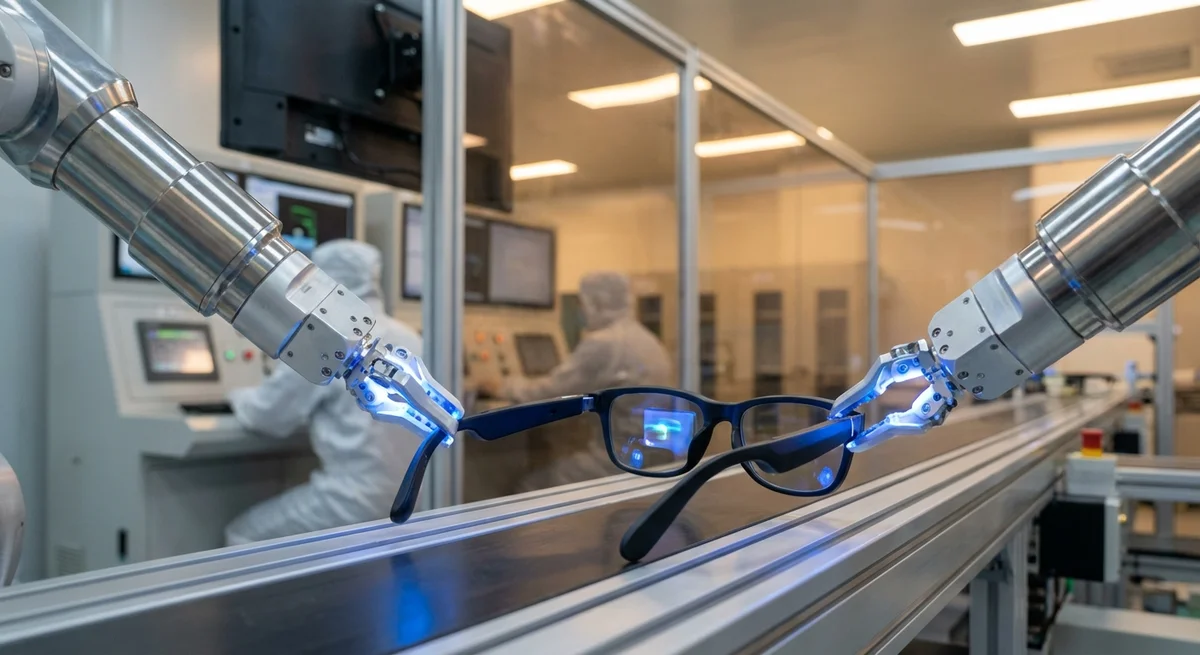
While you're choosing between a new smartphone and a slightly more powerful laptop, the Chinese electronics market has already issued its verdict: the old world of consumption is dead. Fresh financial reports from 63 of the largest sector companies trading on the mainland China stock exchanges (A-shares) read like battlefield dispatches. The picture emerging is extremely contrasting, or, as the Chinese themselves say, there's a sharp polarization.
Out of the entire sample, only 22 companies managed to show growth or escape losses, while 40 players continue to slowly sink. This isn't just temporary difficulties, but a fundamental shift that we're witnessing in real time. Let's understand why the industry has turned into a cocktail of "cold and heat."
On one hand, traditional business — manufacturing components for smartphones, tablets, and consumer electronics — is under tremendous pressure. Competition there has become so toxic that margins are approaching zero. The consumer no longer wants to buy "just a phone"; they want something fundamentally new.
And this is where things get interesting. Those companies that understood early which way the wind was blowing and began investing in new niches are now literally rolling in money, while their former colleagues on the factory floor are tallying losses. The main lifeline for Chinese tech giants has become AI glasses.
After Meta showed off its Ray-Ban, the Chinese market instantly picked up on the trend. It's the ideal form factor for integrating large language models: the glasses see what you see and hear what you hear. For electronics manufacturers, this is a chance to sell us yet another device that we'll wear continuously.
Besides glasses, those who managed to retrain into components for robotics and new energy are among the growth leaders. Essentially, we're seeing factories that yesterday assembled cheap media players transform today into suppliers of complex systems for autonomous vehicles and anthropomorphic robots. Why does this matter to us?
China is the world's main factory, and their financial reports work as a leading indicator. If forty companies out of sixty can't make money on ordinary gadgets, it means the market is completely oversaturated. This means that in the next couple of years we're in for an avalanche of strange, innovative, and sometimes ridiculous AI-branded devices.
Companies will take risks because the path of cautious development leads straight to delisting. We're entering an era when artificial intelligence stops being just an icon in the browser and finally moves into our accessories. It's amusing to watch corporations that spent years building their strategy on mass production of identical boards now desperately trying to hire neural network specialists.
Those who didn't manage to jump on this train are trying to justify their losses with a "complex macroeconomic situation," but the numbers don't lie: money is in the market, it's just now flowing into the pockets of those betting on smart hardware. This is natural selection in the digital environment, where survival belongs not to the largest, but to the most adaptive. And judging by everything, adaptability today is measured by the number of teraflops in your wearable device.
The key point: Stagnation of traditional electronics is forcing manufacturers to flee toward AI and robots with doubled force. Will wearable AI become as mainstream as smartphones, or are we just witnessing yet another attempt to inflate a bubble against the backdrop of falling sales?
Want to stop reading about AI and start using it?
AI News is a curated feed of AI/tech news. Hamidun Academy teaches you to use AI systematically in your work.