YH-1000S: China Launches First Hybrid Cargo Truck to the Sky
Remember those cute promotional videos where small quadcopters pompously deliver a cup of coffee to your doorstep? Forget about it. While Western startups…
AI-processed from 36Kr (36氪); edited by Hamidun News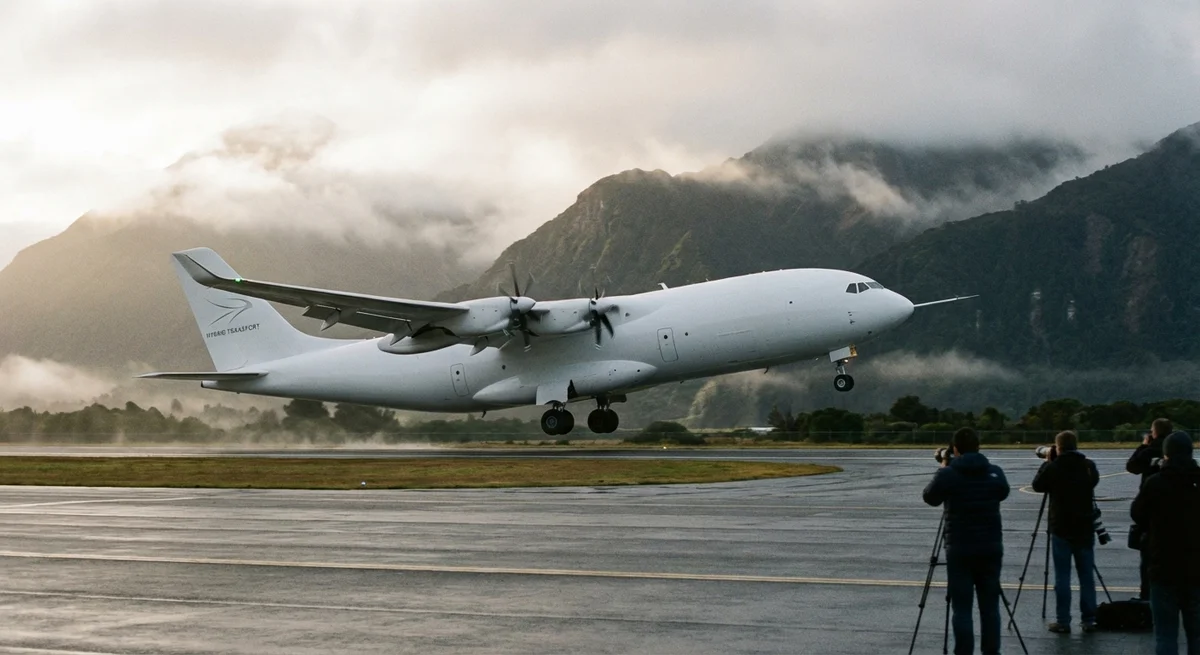
Remember those cute promotional videos where small quadcopters pompously deliver a cup of coffee to your doorstep? Forget about it. While Western startups spent years trying to get permission to fly over residential neighborhoods, engineers from the 11th Academy of the China Aerospace Science and Technology Corporation were doing real adult work.
The result of their labor — Rainbow YH-1000S — recently successfully took to the sky in Chongqing, and this event changes the rules of the game in global logistics far more powerfully than you might have thought. The main problem of modern unmanned aviation is physics, or more precisely, low energy density in batteries. If you want to lift something heavier than a pizza box into the air and send it farther than the next neighborhood, a purely electric scheme becomes a burden: batteries become so heavy that the drone spends all its energy transporting itself.
The Chinese solved this problem elegantly and pragmatically by creating the world's first hybrid transport unmanned aircraft. The use of a hybrid power plant makes it possible to radically increase flight range and payload capacity without waiting for a technological breakthrough in battery chemistry that may happen in ten years, or may never happen at all. The first flight in the Liangping district went smoothly, but its significance extends far beyond a technical report.
Rainbow YH-1000S is not just another prototype, it is a claim to dominance in the autonomous cargo transportation sector. Imagine a network of such machines that tirelessly and without lunch breaks operate between distribution centers, transporting tons of cargo. They don't need expensive pilots, they don't need complex life support systems on board, and they can work in conditions that are considered risky for humans.
We are watching aviation repeat the path of ground transportation, where automation first takes away the most boring and difficult routes. Why is this important right now? The global economy is suffocating from a shortage of qualified personnel and rising fuel costs.
Autonomous systems capable of working efficiently on hybrid fuel become that very "silver bullet" for supply chains. While other companies are only promising "green revolution" in the future, CASC is implementing an intermediate, but maximally efficient technology today. This is the classic Chinese approach: take existing developments, cross them with new control algorithms, and release a product that works here and now.
Looking at the bigger picture, the launch of YH-1000S is another brick in the wall of China's technological sovereignty. Development of such systems requires not only advanced aerodynamics, but also the most complex software for managing the hybrid power plant in real time, navigation systems, and collision avoidance. All this is a battlefield of artificial intelligence and autonomous systems.
And judging by the successful takeoff in Chongqing, China feels extremely confident in this field. The rest of the world will either have to catch up or admit that the sky of the future will belong to autonomous trucks with hieroglyphics on the fuselage. Key point: the hybrid scheme in unmanned aircraft is the only working way to make air cargo transportation profitable today.
Will Western aviation giants be able to offer something of comparable scale before Chinese drones occupy all logistics corridors?
Want to stop reading about AI and start using it?
AI News is a curated feed of AI/tech news. Hamidun Academy teaches you to use AI systematically in your work.