Zero-padding: why extra zeros cost your neural networks too much
Десятилетиями мы добавляем нулевые пиксели по краям изображений, чтобы сверточные слои не «съедали» картинку. Это называется зеро-паддингом. Но свежие исследова
AI-processed from MarkTechPost; edited by Hamidun News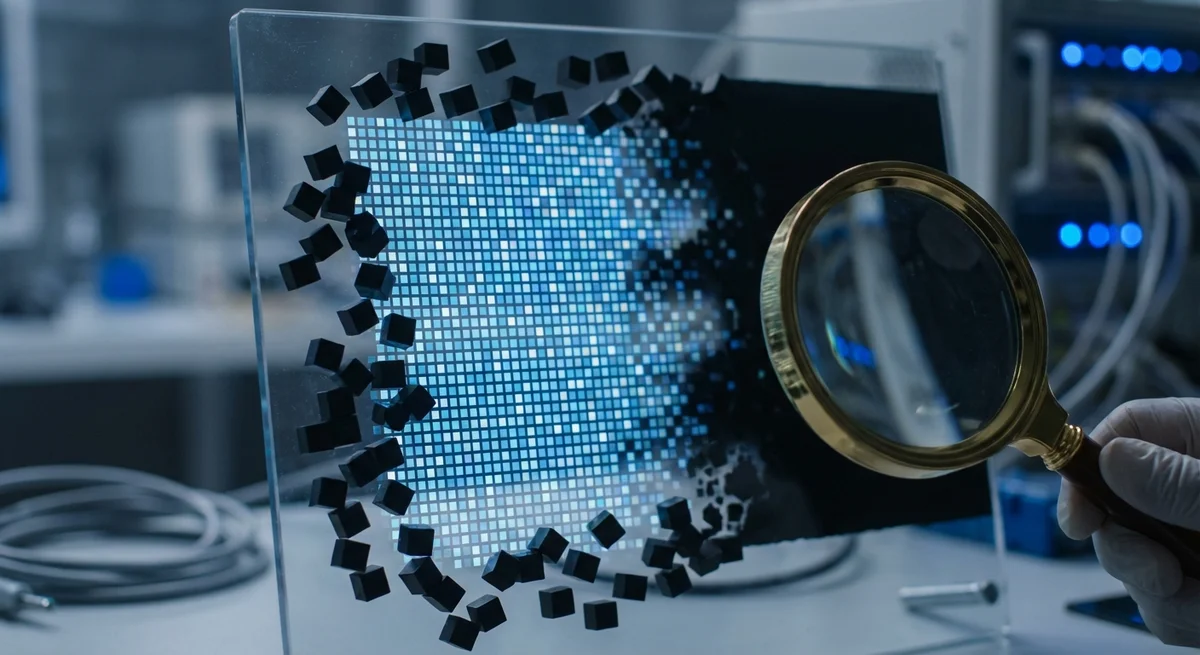
Imagine you're building a house, but every time you reach the edge of the lot, you pour concrete just for symmetry. In the world of computer vision, we've been doing exactly that for about ten years. Convolutional neural networks (CNN) love order, but their mathematical nature forces images to shrink with each layer. To prevent this from happening and to avoid losing important details at the edges, we surround the image with a frame of zeros. This is zero-padding — a technical crutch that has become an industry standard, something almost no one has seriously questioned until recently. We've gotten used to thinking these zeros are "transparent" to the model, but mathematics says otherwise.
The problem is that these zeros aren't simply an absence of information. In a statistical sense, they represent an extremely powerful signal that doesn't exist in reality. When a convolution kernel passes over the edge of an image, it mixes real pixel values with our artificial zeros. This instantly and radically distorts the mean value and variance of activations at the frame boundaries. Instead of looking for important patterns like cats or road signs, the neural network is forced to adapt to this strange "black hole" that we ourselves created. This creates what's called a boundary effect, which confuses the model's weights.
Researchers have long suspected that this affects accuracy, but the scale of this "statistical tax" only became clear now. These boundary effects propagate deep into the neural network, like ripples in water from a thrown stone. In deep architectures, the influence of padding can distort features even in the center of the image, because errors at the boundaries accumulate from layer to layer. We're essentially forcing the model to spend its limited computational weights on ignoring or compensating for noise that we ourselves added to the system. This isn't just inelegant, it's extremely inefficient in terms of GPU resource usage.
So why do we keep doing this if the harm is obvious? The answer is prosaic: it's cheap, fast, and convenient. Implementing zero-padding in code is orders of magnitude easier than implementing complex schemes like reflection padding or cyclic pixel repetition. Most popular frameworks like PyTorch or TensorFlow offer zero-padding by default, and developers rarely dig into settings to change anything. However, in tasks where maximum accuracy is critical — for example, in medical diagnosis from MRI scans or in autonomous vehicle control systems — ignoring this factor is becoming increasingly dangerous.
The industry is currently searching for adequate alternatives to this "zero tax." Some research groups propose using adaptive methods, where padding values are computed dynamically based on the image's own content. Others are looking toward architectures that are inherently robust to feature size changes and don't require artificial frames. It's important to understand that in an era when we're fighting for every teraflop and every percentage point of accuracy, such architectural "trifles" stop being trivial. This is a fundamental bug in the foundation of computer vision that we've been too accustomed to treating as a useful feature.
The future of deep learning will likely force us to abandon simple solutions in favor of more statistically correct methods. We're already seeing how modern models are beginning to account for context even where we previously just "filled" the void with zeros. The question is only how quickly library developers will make these advanced methods standard, so we don't have to pay for zeros with our model's accuracy.
Bottom line: Zero-padding is a convenient lie that we pay for with hidden degradation in model quality. Will new architectures be able to completely eliminate "zero frames" in the next couple of years?
Want to stop reading about AI and start using it?
AI News is a curated feed of AI/tech news. Hamidun Academy teaches you to use AI systematically in your work.