Carbon Robotics and Large Plant Model: robots now recognize weeds by their face
While the whole world is enthusiastically chatting with neural networks and generating pictures of questionable quality, a real quiet revolution is happening…
AI-processed from TechCrunch; edited by Hamidun News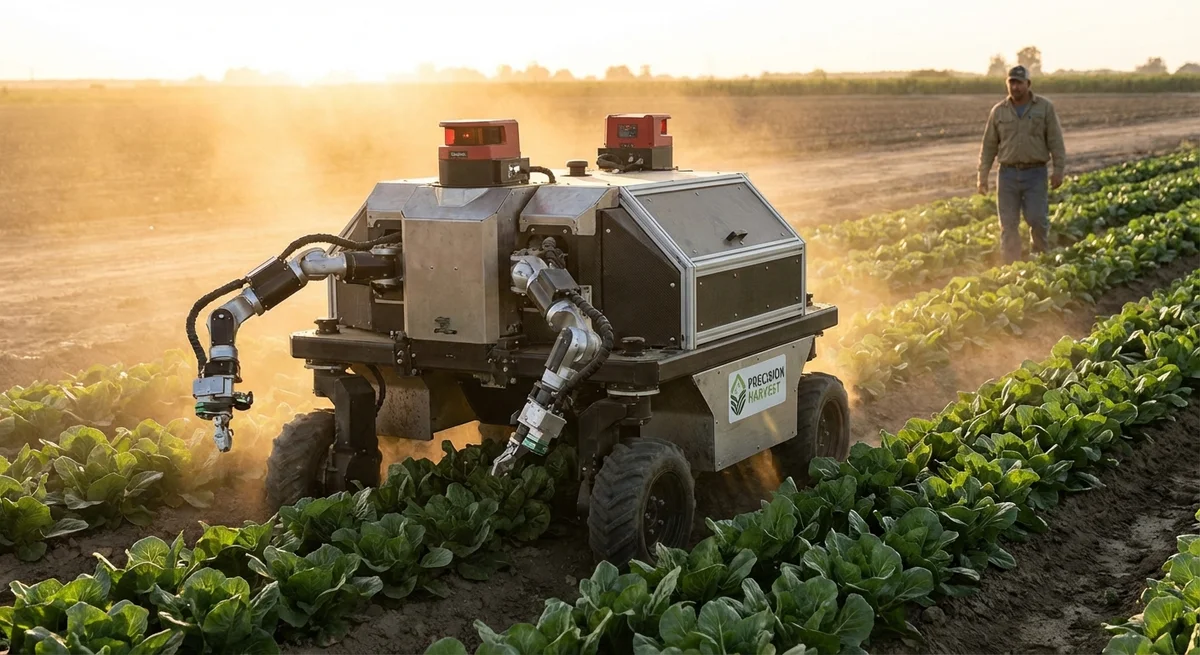
While the whole world is enthusiastically chatting with neural networks and generating pictures of questionable quality, a real quiet revolution is happening in the fields. Carbon Robotics, folks who have been successfully burning weeds with lasers for several years now, have solved agritech's main problem — the slowness of learning. They presented Large Plant Model (LPM), and this is perhaps the most important event in the industry since the invention of the tractor. If before the robot was simply an executor, but quite a limited tool, now it has acquired something like biological vision.
The problem with old systems was their narrow-mindedness. To teach a robot to distinguish broccoli from lamb's quarters, engineers had to feed thousands of photographs of a specific field in specific lighting conditions into the algorithms. As soon as a farmer changed crops or moved to another region, the system had to be retrained. It's expensive, time-consuming, and completely unscalable. Carbon Robotics understood that it was time to stop teaching robots specifics and time to give them an understanding of fundamentals. LPM is a kind of GPT for plants, trained on a colossal dataset of 25 million labeled images.
What does this give in practice? Now the LaserWeeder robot drives onto a field and immediately understands what's in front of it. The model takes into account morphology, growth stage, and even how the plant looks under different lighting or in different weather. This makes it possible to destroy unwanted vegetation with millimeter precision without touching useful crops. The speed of adaptation has increased many times over: what used to take months of development now happens instantly. The robot simply sees a weed and makes a decision to eliminate it without waiting for approval from headquarters.
For agriculture, this is critical due to two factors: labor shortage and growing herbicide resistance in weeds. Chemistry no longer works as effectively as it did thirty years ago, and people increasingly don't want to spend days under the scorching sun. Robots with LPM solve both problems. They don't get tired, don't ask for a raise, and most importantly, don't flood the soil with pesticides. It's pure energy and pure mathematics in action. Instead of poisoning everything alive in hopes of killing a weed, the machine precisely burns out the problem.
The transition to foundational models in robotics is a global trend that we finally saw in the real sector. Carbon Robotics proved that AI can be useful not only in cloud services, but also in physical embodiment, where the cost of an error is a lost harvest. We see how the boundaries between "digital" and "physical" AI are blurring. If before a robot was simply a machine with a program, now it's an intelligent agent capable of navigating the chaos of living nature. And this is just the beginning, because the LPM database will only grow.
The key point: Carbon Robotics did for farmers what OpenAI did for copywriters — gave them a tool that understands context. Will competitors be able to quickly roll out something similar, or is the laser weeding market already captured?
Want to stop reading about AI and start using it?
AI News is a curated feed of AI/tech news. Hamidun Academy teaches you to use AI systematically in your work.