NEWAVE Music Search: Why Your Playlists Will Never Be the Same Again
Поиск музыки по жанрам и годам уходит в прошлое. NEWAVE представила систему интеллектуального ретривала, которая понимает текстовые запросы на человеческом язык
AI-processed from Habr AI; edited by Hamidun News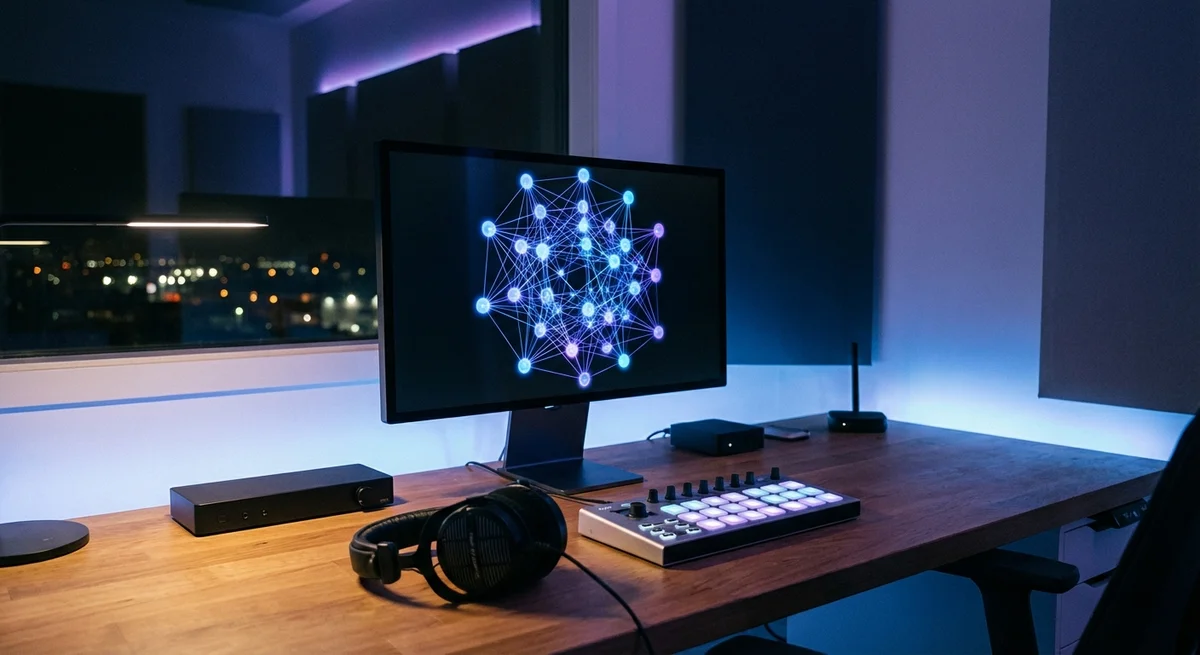
Music search in streaming services has long resembled work in a library archive department: if you don't know the exact title or at least the genre, your chances of finding "that exact one" approach zero. For years we've grown accustomed to rigid filters, tags, and categories invented by marketers rather than listeners. But the NEWAVE team decided it was time to end this bureaucratic approach to art and teach machines to understand music the way we do—through images, emotions, and context. Instead of forcing users to click buttons labeled "rock" or "2010s," the developers created an intelligent retrieval system that literally hears what you type into the search bar.
The project is built on a rather elegant, but technically complex concept of dual-encoder neural networks. If we don't dive into code depths, imagine two translators. One listens to an audio track and translates it into a set of mathematical coordinates, while the other does the same with your text query.
The training task in this case is to ensure that "sad violin" in text and an actual audio recording with violin end up in the same point of this mathematical space. To achieve this, NEWAVE employed contrastive learning: the model was forced not just to recognize similar objects, but to actively repel dissimilar ones. This allowed the system to catch the finest nuances that are usually lost with simple tag annotation.
The problem with most existing solutions is their limitation: they either understand text well but poorly grasp sound, or vice versa. To avoid this trap, the developers engaged ten different datasets at once. This isn't simply a matter of data volume; it's about diversity. One dataset may be rich in technical descriptions of tempo and instruments, another in emotional listener reviews. By combining them, NEWAVE taught their system to understand that "music for a night city drive" isn't just a certain BPM, but a specific combination of synthesizers, reverberation, and rhythmic pattern.
The use of the late fusion mechanism deserves special attention. In the ML world, it often becomes the decisive factor between "just works" and "works perfectly." Instead of mixing all features into one pile from the start, the system analyzes data across different channels and combines their results at the final decision-making stage. This preserves the purity of each domain's features—both text and sound—and delivers the most relevant result. As a result, we get a search that understands the query "something in the style of early Radiohead, but with more aggressive bass" without the need for manual annotation of millions of tracks.
Why does the industry need all this? The answer lies on the surface: the current recommendation model in major services is beginning to burn out. Algorithms often get stuck in loops of similar artists, creating echo chambers from which it's hard for listeners to escape. Intelligent retrieval from NEWAVE opens doors to what's called "zero search," when you don't need to know an artist's name to find your new favorite song. This changes the rules of the game not only for listeners, but for independent musicians whose creativity can now be found by atmosphere description rather than through multi-million marketing budgets and placement in official playlists.
Of course, we're still at the beginning of the road, where AI attempts to interpret human feelings through vectors and matrices. But NEWAVE's progress shows that the line between a file's technical description and its emotional content is becoming increasingly blurred. If before we adapted to search engine interfaces, now machines are finally beginning to adapt to our language. And this is perhaps the most logical development of technology in an era when there's too much content and too little time to sort it manually.
The bottom line: NEWAVE has proven that music search can be human. Does this mean the end of the era of curated playlists, or will AI simply become their perfect assistant?
Want to stop reading about AI and start using it?
AI News is a curated feed of AI/tech news. Hamidun Academy teaches you to use AI systematically in your work.