Agibot vs Television: Why Hundreds of Robots on Stage Matter More Than New Year Shows
Китайский лидер в сфере воплощенного интеллекта Agibot решил пропустить участие в новогоднем гала-концерте CCTV, направив бюджет на R&D. Вместо этого компания г
AI-processed from 36Kr (36氪); edited by Hamidun News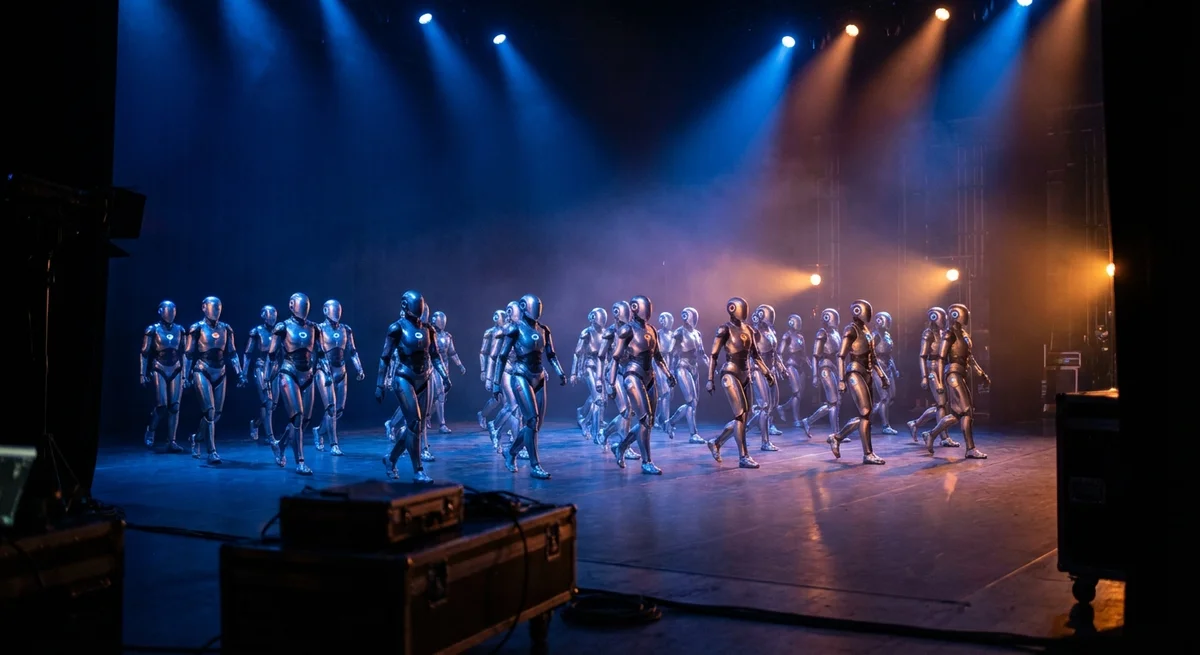
Imagine you're offered to perform on the world's most popular TV show, watched by hundreds of millions of people, and you say: "No, thank you, we need to finish the software for robots." That's exactly what Chinese startup Agibot did. The company officially declined participation in the 2026 New Year's gala show, citing budget priorities focused on embodied AI development.
This decision reads as a programmatic statement for the entire industry: the era of empty demonstrations for optics is over, the time of hard pragmatism has arrived. Instead of appearing on state TV, Agibot is preparing its own show called "Evening of Robot Wonders." It's not just a corporate event, but a large-scale technology demonstration where hundreds of robots of various types will sing, dance, and participate in sketches.
For the industry, this is a serious challenge. Coordinating such a quantity of machines in real-time requires incredible computational power and refined control algorithms. We see a company attempting to turn a marketing event into a full-fledged stress-test of its systems, proving that robots are ready to leave laboratories for the real world.
While some are rolling robots onto the stage, others are rebuilding the internal economics of giant corporations. Ant Group, led by CEO Han Xinyue, has launched the "AI Credit" program. This is a special incentive system for employees who implement AI in business processes.
If a team creates a solution that the market recognizes as successful, they receive bonuses that can be converted into real assets after two years. Han Xinyue directly states the goal—complete "AI-ification" of the organization. This is no longer just using chatbots, but an attempt to make neural networks the foundation of every workplace.
When a corporation of this scale changes its incentive system, it means AI has stopped being a toy of the innovation department and has become a survival issue.
In this context, Peng Xinyue's words from Alibaba Cloud sound interesting. He proposed a new criterion for assessing a company's modernity: it's no longer the number of servers, but the volume of token consumption and the share of "AI-employees" in the staff. We're entering an era where business efficiency is measured by how much intellectual work you delegate to algorithms.
This is confirmed by Tesla's recent success. Elon Musk confirmed the launch of mass production of batteries with dry electrodes. This is a technological breakthrough that reduces factory complexity and energy consumption. Tesla once again proves that winning the AI race is often forged not only in code, but in optimizing physical production.
Even at the state level, China is transitioning to creating "innovation triangles," such as Beijing-Tianjin-Xiong'an. The goal is to create a seamless environment for transferring technology from laboratories to production. Added to this are new standards of "low-altitude economy" that legalize mass drone usage.
All these disparate pieces of news fold into a single picture: China's AI and robotics industry has stopped chasing hype and is beginning to build infrastructure that will change daily life. Agibot's refusal of a TV show is just the tip of the iceberg, beneath which lies a tectonic shift toward the real sector.
Main point: Are we ready to evaluate the efficiency of our business in tokens and "AI-employees," as they're already doing in China?
Want to stop reading about AI and start using it?
AI News is a curated feed of AI/tech news. Hamidun Academy teaches you to use AI systematically in your work.