Radeon AI PRO R9700: AMD Tries to Take Bread from NVIDIA (and It's Working)
Пока индустрия замерла в ожидании поставок Blackwell от NVIDIA, AMD решила нанести удар в самое больное место — по объему видеопамяти и доступности. Новый Radeo
AI-processed from Habr AI; edited by Hamidun News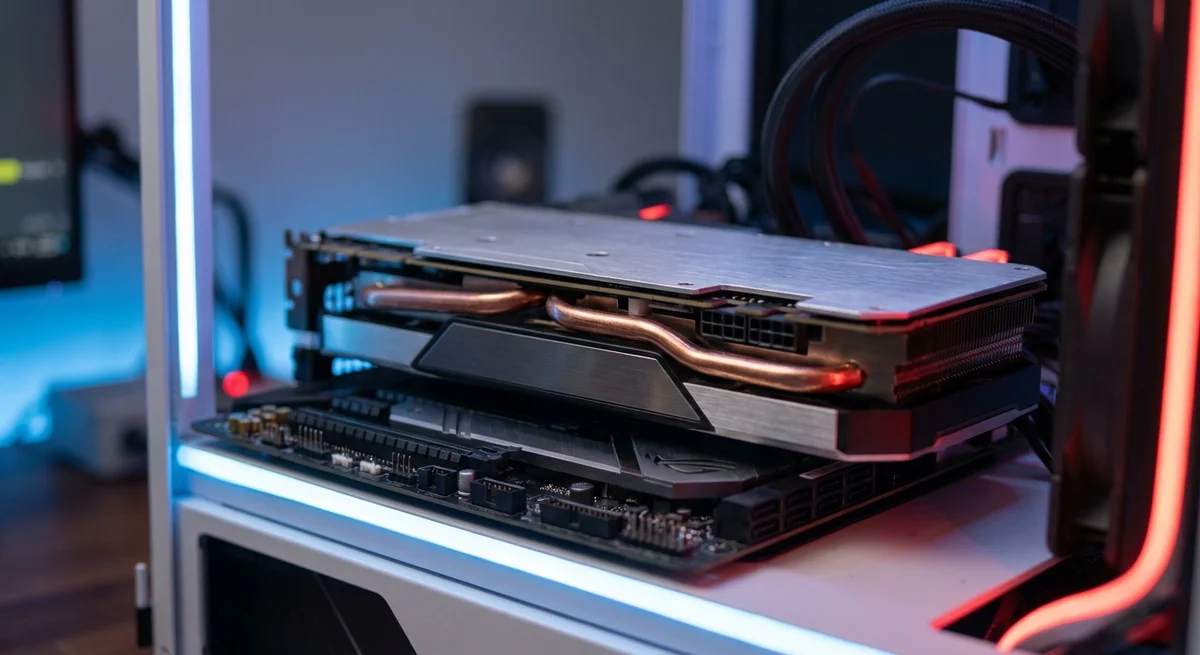
The professional AI hardware market has long resembled an exclusive NVIDIA party, where entry required payment of the "CUDA tax." We've all grown accustomed to the reality that if you need to train a model or run heavy inference, alternatives barely exist. However, the eternal dominance of the "green" team has started to wear even on the most devoted fans, especially against a backdrop of scarcity and Jensen Huang's specific pricing policies. Against this backdrop, the emergence of the Radeon AI PRO R9700 looks not just like another hardware release, but like AMD's attempt at a quiet revolution in the workstation segment.
The new card's main trump card is 32 gigabytes of video memory. In today's reality, when even "lightweight" versions of Llama 3 demand substantial resources, VRAM volume becomes more important than processor clock speed. AMD clearly caught this trend. While competitors in the mid-price segment are stingy with memory, the "reds" provide room for maneuver. In our tests, the R9700 showed surprisingly brisk performance when working with quantized 70B models. Where cards with 16 or 24 GB start to choke and offload computations to slow system RAM, Radeon continues to confidently pound out tokens. The difference in working comfort is physically noticeable: latencies are minimal, and generating long contexts doesn't turn into torturous waiting.
Of course, hardware is only half the battle. Historically, AMD lost specifically in the software department. The ROCm ecosystem was long considered the domain of masochist enthusiasts willing to spend weeks compiling libraries. But with the release of recent updates, the situation has changed radically. We checked: most popular PyTorch and Stable Diffusion frameworks now boot practically "out of the box." Yes, NVIDIA is still ahead in optimizing specific transformer kernels, but that gap has ceased to be a chasm. For a developer who just needs to run a local server for testing, the Radeon AI PRO R9700 becomes a perfectly rational choice, not an act of desperation.
In video generation and complex 3D rendering tasks, the card also shows its teeth. We compared it with current solutions from the Blackwell line and the previous Ada Lovelace generation. In raw performance when working with video diffusion, AMD goes head-to-head with NVIDIA's top consumer cards, while winning in stability over long distances thanks to more efficient cooling and professional driver infrastructure. This is especially important for studios that cannot afford equipment downtime due to crashing drivers mid-render.
Why is this important right now? The AI industry is transitioning from the "play around with ChatGPT" stage to the "deploy your own and on the cheap" stage. Dependence on cloud providers and scarce H100 chips is forcing companies to seek alternatives for local computing. If AMD can ensure stable R9700 supplies at reasonable prices, this could seriously shake up the market. NVIDIA will have to either increase memory volume in its lower-end professional cards or cut prices, which in any case benefits us, the end users. Monopoly always leads to stagnation, and the emergence of such an aggressive player is the best stimulus for progress.
Bottom line: Radeon AI PRO R9700 is the first AMD product in a long time that can be recommended for AI tasks without a long list of caveats. Will the ROCm software stack ultimately defeat the magic of CUDA in developers' minds?
Want to stop reading about AI and start using it?
AI News is a curated feed of AI/tech news. Hamidun Academy teaches you to use AI systematically in your work.