China's Low Sky: How 10 Ministries Decided to Organize the Chaos
Пока мир обсуждает LLM, Китай методично строит инфраструктуру для «низковысотной экономики». Десять ведомств, включая регулятора рынка и комиссию по управлению
AI-processed from 36Kr (36氪); edited by Hamidun News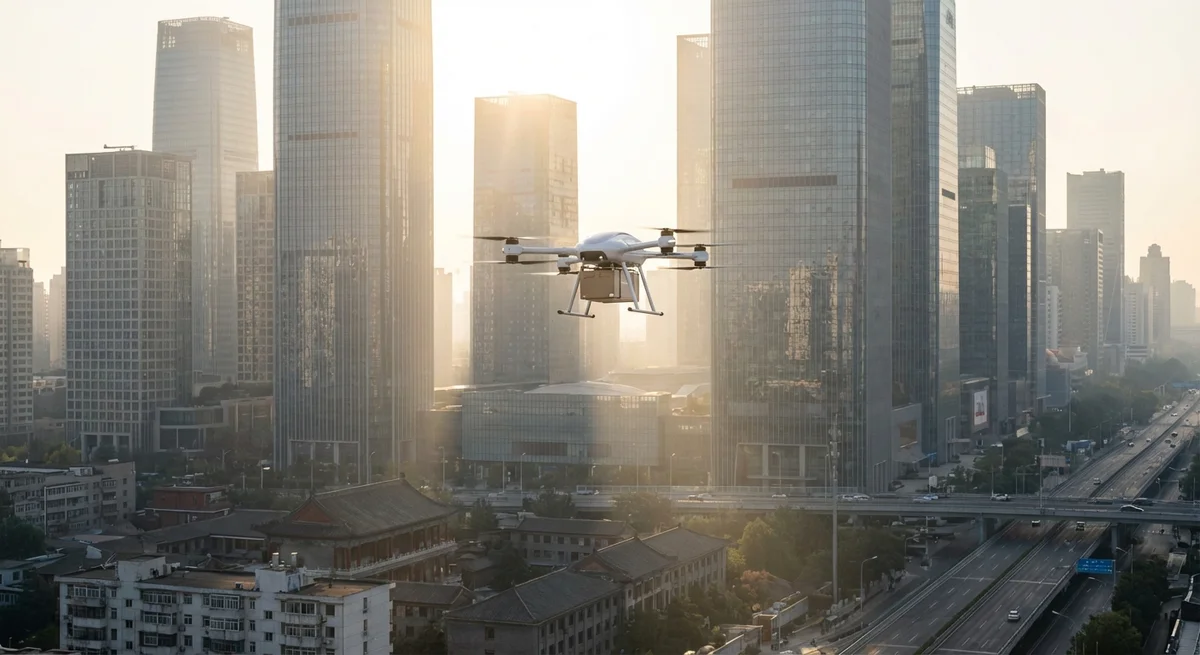
While Western headlines are preoccupied with AI wars for a place in your browser, China has decided it's time to bring order to the skies. We're not talking about commercial aviation as we know it, but about the so-called "low-altitude economy." Ten leading ministries of the Middle Kingdom, including market regulators and strategists from the air traffic control committee, have released a document that essentially transforms the sky above Chinese megacities into yet another digital corridor.
It's the "Guidelines for Creating a Standards System for 2025"—not just a stack of papers, but a detailed blueprint for how thousands of drones and air taxis will coexist without crashing into each other or frightening passersby. To grasp the scale, one must understand that for China, the low-altitude economy is a new growth driver, comparable in potential to electric vehicles. Previously, each drone manufacturer or logistics network operator played by their own rules.
Now the state is introducing "four-dimensional convergence." It sounds like a term from science fiction, but in reality it means a rigid linkage between technical standards, management norms, internal regulations, and international requirements. Beijing understands: if they create a working standard first, the rest of the world will be forced to adapt to it, buying Chinese equipment and software.
The plan covers five critical areas. First, the aircraft themselves. Here everything will be prescribed: from noise levels to communication protocols.
Second, infrastructure. Where drones charge, where they land, and how they exchange data with the ground. The third and perhaps most complex point is traffic management.
Imagine a cloud system that in real time routes thousands of paths for courier copters. Without artificial intelligence and 5G/6G, there's nothing to do here, and this is another reason for a technological leap. The fourth and fifth pillars are security and use cases.
Chinese authorities want to clearly understand who is flying, why, and how safe it is for people below. As for use cases, the regulators' imagination is not limited to food delivery. This includes monitoring power transmission lines, emergency medicine, and full-fledged passenger service at low altitudes.
China is methodically moving from the stage of "let's try" to the stage of "let's scale." Why is this happening right now? The answer is simple: traditional markets are saturating.
The economy needs new spaces, and the space between the ground and the flight paths of large aircraft turned out to be perfectly empty. After several years of local experiments in Shenzhen and Guangzhou, the government decided that the technology was mature for a national standard. This is a direct challenge to Western regulators like the FAA in the US, which have so far floundered on the issue of mass certification of commercial drones.
If you thought drones were just toys for videographers, China's plan forces a rethink. This is the creation of a new logistical reality, where the "last mile" of delivery costs pennies and delivery time is independent of traffic. Standardization is boring only at first glance.
In reality, it's the very glue that turns scattered startups into a powerful industry ready for global expansion. The main point: China is building not just rules for flying, but a complete operating system for the sky. Will the world be able to offer an alternative to these standards, or will we have to learn Chinese communication protocols for our drones?
Want to stop reading about AI and start using it?
AI News is a curated feed of AI/tech news. Hamidun Academy teaches you to use AI systematically in your work.