Maps, Light, and Claude: How Prompts Killed Classical Development in IoT
Интеграция промышленного IoT с интерактивными картами всегда была головной болью для разработчиков. Десятки параметров уличного освещения, контроллеры и сложные
AI-processed from Habr AI; edited by Hamidun News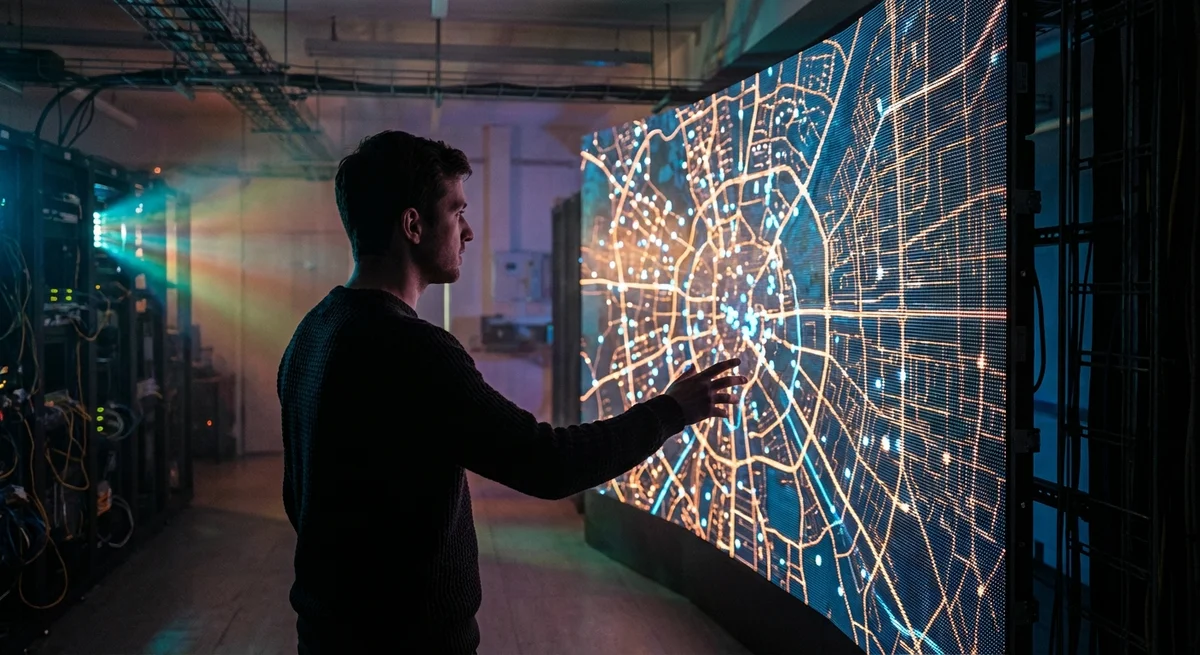
Many still try to attach neural networks anywhere they can, just to have an AI-driven checkbox in the investor report. Finding a real task for a model in the harsh industrial sector is quite a quest. Usually everything ends with reading dozens of Habr articles that provide nothing but theory. But sometimes a breakthrough happens when a developer decides to turn their brain inside out and stops expecting 100% determinism from the system. This is exactly what happened with industrial internet of things (IoT) for street lighting control systems.
Imagine a typical task: you have thousands of control cabinets and controllers scattered across the city. Each one has dozens of parameters, its own combinations of states, and a complex mesh network where devices communicate with each other. The traditional approach requires creating an interactive map with multiple layers. Developers spent years trying to pack this data array into a working scheme, but the result always came out either too heavy or not flexible enough. Classical development of map layers simply couldn't keep up with the dynamics of real hardware.
Everything changed when Claude and n8n were added to the equation. Instead of hardcoding every system twitch in the code, engineers decided to use prompts. This sounds like heresy to the old school, but the transition to probability logic allowed automating what previously took weeks of coding. AI agents began processing map data requests, forming the needed representations on the fly. The mesh network visualization problem, which previously seemed unsolvable due to its non-linearity, was solved through describing relationships in natural language.
Why is this important right now? We're at the threshold of a moment when "writing code" becomes too expensive and slow a way to solve interface tasks. In industrial IoT, where the cost of error is high and there's too much data, prompt flexibility starts winning over algorithm rigidity. Using LLM for managing map layers is just the first swallow. It shows that complex visual systems can be adaptive without rewriting the frontend every six months.
Of course, such an approach requires a certain boldness. You need to accept that the system can make mistakes and learn to work with these errors. But when you see Claude structure data in seconds that a team struggled with for months, questions disappear on their own. We're no longer building rigid structures, we're training a system to understand what exactly we want to see on the map at this moment. This is the real transition from programming to managing intelligence.
The bottom line: prompt engineering has officially entered industrial development. If you're still drawing every map layer by hand, you might just be wasting company time. Are you ready to entrust critical infrastructure visualization to "probabilistic" intelligence?
Want to stop reading about AI and start using it?
AI News is a curated feed of AI/tech news. Hamidun Academy teaches you to use AI systematically in your work.