VL-LN Bench: Robots Learn to Ask for Directions and Finally Stop Being Stupid
Исследователи представили VL-LN Bench — новый стандарт для проверки навигационных способностей ИИ. В отличие от старых тестов, где робот просто шел из точки А в
AI-processed from Jiqizhixin (机器之心); edited by Hamidun News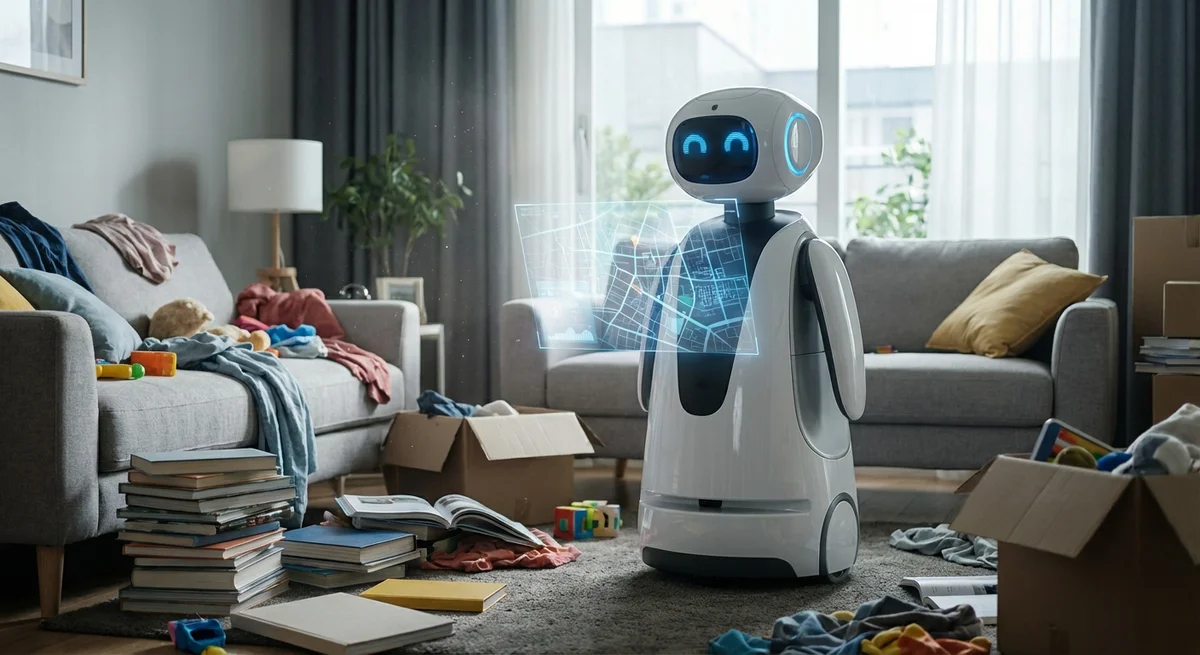
Imagine you've entered a huge unfamiliar shopping mall. You don't have a map, but you have a goal — to buy that exact blue vase from the advertisement. You don't just walk forward, you turn your head, read the signs and, most importantly, ask passersby: "Where is the home decor section?" Researchers have packaged this very natural process into a new benchmark called VL-LN Bench (Vision-Language-Location Navigation). It's not just another dataset, but an attempt to teach machines to survive in the chaos of the real world, where instructions are rarely complete and maps are rarely up-to-date.
For a long time, robot navigation resembled movement along rails. Developers fed algorithms ideal digital twins of rooms and clear commands. In classical Vision-Language Navigation (VLN) tests, a model typically received an instruction like "go straight five meters, turn left at the ficus tree." But life is dynamic. The ficus tree could be moved to another corner, and the door could be closed for repairs. Old methods failed against reality because they couldn't do active exploration and context clarification. They were too passive: a robot either executed a command or broke down.
VL-LN Bench changes the rules of the game. Now an AI agent has to imitate the behavior of a "lost but determined" person. The essence is that the robot must not just move, but constantly match what it sees (Vision) with language clues (Language) and its position in space (Location). Researchers call this "active goal-seeking through dialogue with the environment." The robot doesn't just walk, it constantly analyzes: "Does what I see now bring me closer to the goal or have I turned the wrong way?" If there's doubt, the system initiates a request for clarification.
What does this give in practice? First, robots become more autonomous in decision-making. They no longer need a detailed script for every step. Second, this benchmark forces models to better understand spatial relationships and object semantics. If you say "find a mug, it's somewhere near the microwave," the robot will first identify the kitchen, then find the microwave, and only then start scanning nearby surfaces. This seems simple to us, but for neural networks, such multilevel deduction remained an insurmountable peak for a long time.
It's interesting how the authors approached the question of interaction. VL-LN Bench incorporates the possibility of clarifying information. The robot can "ask" the system or analyze text metadata of objects to narrow the search. This is essentially a transfer of large language model (LLM) mechanics to the physical world. We see pure intelligence finally gaining a "body" capable of navigating space as well as, and in perspective better than, humans.
Researchers emphasize that the key difficulty here is multimodality — the ability to simultaneously process video streams, text commands, and coordinates.
Why do we need this right now? The household and warehouse robot industry has hit a ceiling. We taught them not to fall down stairs and avoid cats, but we didn't teach them to understand that "bring me beer from the refrigerator" is a complex chain of finding the right room, identifying household appliances, and manipulating objects under conditions of uncertainty. VL-LN Bench creates a sandbox where these skills can be honed to perfection. Without such tests, we would remain with vacuum cleaners that are panic-stricken of black stripes on carpets.
Of course, mass deployment is still far away. One of the main problems remains computing power. Processing heavy video streams, comparing them with a huge array of text data, and building the optimal route in real time is a task that requires serious resources. However, the vector is set correctly: from blind instruction-following to conscious exploration. In the future, the phrase "I got lost" should disappear forever from machine vocabulary.
The main point: VL-LN Bench translates robot navigation from "following a navigator" mode to "conscious search" mode. Will your future butler robot find your keys in a pile of unironed laundry? Now we at least know how to test it.
Want to stop reading about AI and start using it?
AI News is a curated feed of AI/tech news. Hamidun Academy teaches you to use AI systematically in your work.